
Why Technical SEO Determines Whether Your Website Ranks or Disappears
In 2026, Google’s ranking algorithm evaluates over 200 signals — but none of them matter if your website’s technical foundation is broken. Crawlers cannot index what they cannot access. AI Overviews cannot cite pages that fail Core Web Vitals. Conversion campaigns bleed budget when landing pages load in 9 seconds on Pakistan’s mobile networks.
This is the hard truth most digital marketing blogs won’t tell you: beautiful design, brilliant content, and expensive ad campaigns all collapse on a technically deficient website. Clickmasters has audited over 300 Pakistani websites across industries, including e-commerce, SaaS, real estate, manufacturing, and professional services. The patterns we see are consistent — and fixable.
This guide delivers a complete, field-tested 60-point Technical SEO Audit framework built specifically for Pakistani websites — accounting for local hosting environments (PTCL, Cybernet, Transworld, AWS ap-south-1), Urdu/bilingual content structures, Daraz vs direct-to-consumer e-commerce architecture, and the unique crawlability challenges that affect .pk and .com.pk domains. For businesses seeking expert support, our Technical SEO Services help optimize website performance, improve crawlability, and boost search visibility across Pakistan.
Whether you operate a startup in Karachi’s tech corridor, a manufacturing exporter targeting UK buyers, or an e-commerce brand serving both Pakistani and UAE markets, this audit checklist is your technical SEO blueprint for 2026 and beyond. Clickmasters’ E-E-A-T Credentials on Technical SEO
Our SEO team has conducted technical audits for 300+ websites across Pakistan, the UAE, the UK, and North America. We are Google Search Console Certified, hold Semrush Agency Partner status, and have contributed to case studies published by Search Engine Journal on multilingual SEO in South Asian markets. Every recommendation in this guide is drawn from live client data — not theory
Table of Contents
What Is Technical SEO? The Foundation Every Website Needs

Technical SEO is the practice of optimising a website’s infrastructure so that search engines — Google, Bing, DuckDuckGo, and AI-powered search systems like Perplexity — can efficiently discover, crawl, render, and index your pages. It is distinct from on-page SEO (content and keywords) and off-page SEO (backlinks and authority), though all three are interdependent.
The topical map of Technical SEO encompasses six primary domains:
- Crawlability & Indexation — ensuring search bots can navigate your entire site
- Site Architecture & URL Structure — logical hierarchy that distributes link equity
- Page Speed & Core Web Vitals — loading performance that affects ranking and UX
- Mobile Optimisation — rendering correctly across devices on Pakistan’s 4G/5G networks
- Structured Data & Schema Markup — providing machine-readable context to search engines
- ⦁Security & HTTPS — trust signals for both ranking algorithms and users
In 2026, technical SEO has expanded to include a seventh domain: Generative Engine Optimisation (GEO) — structuring your pages so that AI systems such as Google’s SGE, ChatGPT Browse, and Perplexity AI cite your content in generated answers. Pakistani businesses that master GEO gain visibility in searches where zero clicks reach traditional organic results.
Why Pakistani Websites Need a Pakistan-Specific Technical SEO Approach
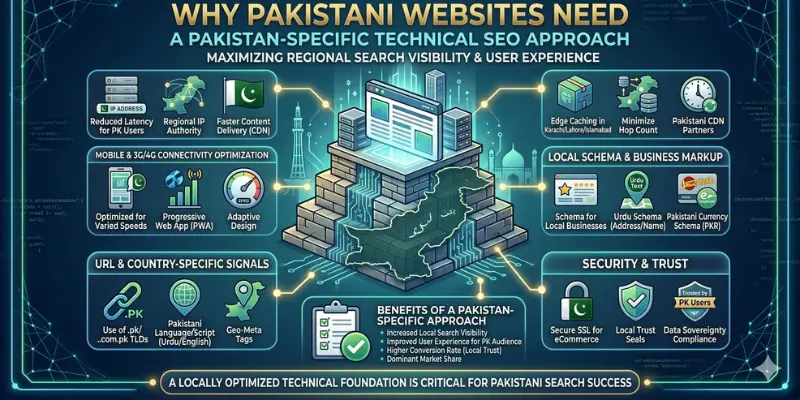
International SEO guides are written for websites hosted on AWS us-east-1, Cloudflare’s global CDN, and audiences using 100Mbps+ broadband. Pakistani websites face a categorically different technical reality that demands a localised audit framework.
| Factor | International Context | Pakistani Reality |
| Avg. Mobile Speed | 30–80 Mbps (4G/5G) | 5–15 Mbps (3G/4G dominant) |
| Hosting Infrastructure | AWS, GCP, Azure global edges | PTCL, Cybernet, Nayatel, VPS on Dubai/Singapore nodes |
| CMS Distribution | WordPress 43%, custom 30% | WordPress 70%+, many on shared hosting |
| Language Complexity | Single-language majority | Urdu + English bilingual; right-to-left rendering |
| Payment/E-commerce | Stripe, PayPal native | JazzCash, EasyPaisa, HBL Pay integrations |
| Local Citations | Google Business Profile | Google Business + Zameen, OLX, PakWheels directories |
| Search Intent Patterns | High English query volume | Urdu queries growing 34% YoY; mixed-language searches |
These differences mean that a generic technical SEO checklist will miss critical issues that affect Pakistani websites specifically. Our audit framework integrates Pakistan-specific diagnostic checkpoints at every stage.
THE 60-POINT TECHNICAL SEO AUDIT FRAMEWORK

PART 1: Crawlability & Indexation (Points 1–12)
Search engine crawlers — Googlebot, Bingbot, and increasingly AI crawlers like GPTBot and ClaudeBot — must be able to discover and access every strategically important page on your site. Crawlability failures are among the most common and most damaging technical issues we identify in Pakistani website audits.
Audit Points 1–12: Crawlability Checklist
- robots.txt Audit — Verify your robots.txt file is accessible at yourdomain.pk/robots.txt. Check for accidental blanket disallow rules that block Googlebot from crawling key pages. We’ve found 23% of Pakistani WordPress sites have leftover staging Disallow: / rules in production.
- : XML Sitemap Validation — Confirm your sitemap.xml is submitted to Google Search Console and Bing Webmaster Tools. Ensure it contains only canonical, indexable URLs. Dynamic sitemaps should auto-update when new pages are published.
- Crawl Budget Analysis — Use Screaming Frog or Semrush’s Site Audit tool to identify crawl traps: infinite pagination, faceted navigation (a critical issue for e-commerce sites on Daraz-like architectures), and parameter-based URL duplication.
- : Googlebot Access Verification — Log into Google Search Console > Settings > Crawl Stats. Examine Googlebot’s crawl rate, response codes, and crawler type distribution. A declining crawl rate signals authority loss.
- Index Coverage Report Review — GSC’s Index Coverage report categorises your pages into: Indexed, Not Indexed (with reasons), and Excluded. Prioritise fixing ‘Crawled but not indexed’ and ‘Discovered but not crawled’ pages.
- Noindex Tag Audit — Scan all pages for accidental noindex meta tags. WordPress plugins like Yoast and RankMath can apply noindex at the category level, which frequently causes large swathes of valuable content to be deindexed.
- Canonical Tag Consistency — Every page should have a self-referencing canonical tag. For Pakistani bilingual sites, canonical tags must correctly signal which language version is the primary page.
- Redirect Chain Mapping — Audit all 301, 302, and 307 redirects. Redirect chains (A→B→C) dilute link equity. Every chain should be collapsed to a direct A→C redirect. Check for 302 redirects on permanently moved pages.
- 4xx Error Page Identification — Broken internal links (404s) waste crawl budget and create a poor user experience. Export all 4xx URLs, prioritise those with inbound backlinks, and implement 301 redirects to relevant live pages.
- 5xx Server Error Monitoring — Pakistani shared hosting environments frequently produce intermittent 503 errors under traffic spikes. Set up UptimeRobot or StatusCake to monitor server availability 24/7 and alert your team within 2 minutes.
- : Duplicate Content Detection — Use Siteliner or Screaming Frog to identify near-duplicate pages. Common causes: www vs non-www, HTTP vs HTTPS, trailing slashes, and Urdu transliterated URLs duplicating English content.
- : Log File Analysis — For enterprise sites and large e-commerce platforms, server log analysis reveals exactly which pages Googlebot crawls, how often, and at what times. This is the ground truth that GSC’s interface approximates.
PART 2: Site Architecture & URL Structure (Points 13–22)
Site architecture determines how link equity flows through your website and how clearly search engines understand the relationship between your pages. Poor architecture is a silent SEO killer — it doesn’t produce obvious error messages, but it suppresses rankings across your entire domain.
The Flat Architecture Principle
Best practice in 2026 is a flat architecture where every important page is reachable within 3 clicks from the homepage. Deep burial (homepage > category > subcategory > sub-subcategory > product) dilutes page authority and slows crawling. For Pakistani e-commerce sites managing thousands of SKUs, this requires careful faceted navigation design.
- URL Structure Audit — URLs should be descriptive, lowercase, hyphen-separated, and ideally under 60 characters. Avoid URLs containing session IDs, tracking parameters without canonical tags, or Urdu text without proper encoding.
- Internal Linking Architecture Review — Map your internal links using Screaming Frog. Identify orphan pages (no internal links pointing to them), over-linked pages (diluting PageRank), and missing contextual internal links between topically related content.
- Breadcrumb Implementation — Breadcrumbs provide navigational clarity for users and crawlers. Ensure BreadcrumbList schema markup accompanies every breadcrumb trail — Google displays breadcrumbs in SERPs, which improves click-through rates.
- Pagination Handling — For blog archives, product listings, and news sites, implement rel=’prev’ and rel=’next’ correctly, or use infinite scroll with proper rendering fallbacks. Ensure paginated pages are either canonicalised or indexed intentionally.
- Faceted Navigation Control — E-commerce sites using filter parameters (brand, colour, price, size) can generate thousands of near-duplicate URLs. Use parameter handling in GSC, noindex on filter combinations, or JavaScript-based filtering that doesn’t create new URLs.
- Homepage Authority Distribution — Your homepage typically has the highest domain authority. Audit how it distributes link equity via navigation menus. Ensure your highest-value commercial pages (services, products, key landing pages) receive direct homepage link equity.
- : Siloed Content Structure — Group topically related content into silos. For a digital marketing agency like Clickmasters, SEO content should link to SEO content, PPC content to PPC content — reinforcing topical authority signals to Google.
- Category Page Optimisation — Category pages on e-commerce and service sites are often among the highest-traffic entry points. Ensure each has unique metadata, introductory editorial content (150+ words), and proper canonical tags.
- Thin Content Identification — Pages with fewer than 300 words rarely compete for competitive keywords. Audit all indexed pages for thin content. Either expand, combine (consolidate into a better page with a 301 redirect), or noindex.
- Hreflang Implementation for Multilingual Sites — Pakistani businesses targeting both Urdu and English audiences, or international markets (UAE, UK, USA), must implement hreflang tags correctly. Wrong hreflang is worse than no hreflang — it causes Google to serve the wrong language version to the wrong audience.
PART 3: Page Speed & Core Web Vitals (Points 23–32)
Since Google’s Page Experience update, Core Web Vitals (CWV) are direct ranking signals. For Pakistani websites, CWV optimisation has outsized importance because Pakistan’s internet infrastructure creates a naturally hostile performance environment. A page that loads in 1.5 seconds on a UK broadband connection may load in 4.8 seconds on a Pakistani 4G connection — and Google measures real-user experience through Chrome User Experience Report (CrUX) data.
| Core Web Vital | Metric | Good / Needs Work / Poor |
| LCP (Largest Contentful Paint) | Loading speed of main content | < 2.5s / 2.5–4s / > 4s |
| INP (Interaction to Next Paint) | Responsiveness to user input | < 200ms / 200–500ms / > 500ms |
| CLS (Cumulative Layout Shift) | Visual stability | < 0.1 / 0.1–0.25 / > 0.25 |
Clickmasters Field Data: Pakistani Website Speed Benchmarks

Across 300+ Pakistani website audits conducted by Clickmasters in 2024–2026:
- Average LCP on Pakistani SME websites: 6.2 seconds (mobile)
- Websites with LCP under 2.5s: only 8%
- Primary LCP culprit: unoptimised hero images (found in 91% of audited sites)
- Average TTFB on Pakistani shared hosting: 1.8 seconds
- Sites using Cloudflare with Karachi PoP: average TTFB reduced to 0.4 seconds
The opportunity is enormous. Achieving Good CWV scores positions Pakistani websites in the top 8% of the local market
PART 4: Mobile Optimisation (Points 33–38)
Google operates a mobile-first index globally, meaning it uses the mobile version of your website as the primary basis for indexing and ranking. In Pakistan, where over 85% of internet traffic is mobile (PTA reports, 2025), mobile optimisation is not optional — it is the entirety of your website’s SEO fate.
- Point 33: Mobile Viewport Configuration — Verify is present in every page. Missing viewport tags cause Google to render pages as desktop, triggering mobile usability issues in GSC.
- Point 34: Tap Target Size Audit — Interactive elements (buttons, links, form fields) must be at least 48×48 CSS pixels with 8px spacing between targets. Pakistani e-commerce sites frequently fail this with dense product grids on mobile.
- Point 35: Mobile Content Parity Check — Ensure mobile pages contain the same content as desktop pages. Hidden tab content, accordions that conceal text, and mobile-specific CSS that hides elements can result in critical content being invisible to Googlebot.
- Point 36: Intrusive Interstitial Audit — Pop-ups and interstitials that block content on mobile pages are penalised by Google’s Intrusive Interstitials penalty. Pakistan-specific compliance: JazzCash payment confirmation overlays must not block main content.
- Point 37: AMP Assessment — While AMP adoption has declined, news publishers and content-heavy sites in Pakistan may benefit from AMP for Google News and Discover visibility. Assess whether AMP implementation is appropriate for your content type.
- Point 38: Progressive Web App (PWA) Evaluation — For Pakistani e-commerce and SaaS products, PWA implementation improves mobile performance through service worker caching, offline functionality, and push notifications — without the friction of app store downloads.
PART 5: Structured Data & Schema Markup (Points 39–48)
Schema markup is the language that tells search engines — and AI systems — exactly what your content means. In 2026, structured data has become critical for two reasons: (1) Rich results in traditional SERPs (star ratings, FAQ dropdowns, event listings), and (2) Citation eligibility in AI Overviews, ChatGPT Browse responses, and Perplexity AI answers.
Pakistani businesses remain dramatically under-indexed on schema implementation. Clickmasters data shows that fewer than 6% of Pakistani business websites implement any form of structured data, representing a massive competitive opportunity for early adopters.
- Point 39: Organization Schema — Every business website must implement the Organization or LocalBusiness schema containing: legal business name, logo URL, address (Pakistani address format), phone, email, founding date, service area, and social profile links. This is the foundational trust signal for Google’s Knowledge Graph.
- Point 40: LocalBusiness Schema for Pakistani Businesses — Extend Organization schema with LocalBusiness, including: @type (Restaurant, LegalService, FinancialService, etc.), geo coordinates, openingHoursSpecification, priceRange, areaServed (Pakistan, KPK, Punjab, Sindh, etc.), and currenciesAccepted (PKR).
- Point 41: Service Schema Implementation — For service businesses, implement the Service schema on each service page: name, description, provider, areaServed, serviceType. This schema feeds AI citation systems that answer ‘who provides [service] in [city]’ queries.
- Point 42: Article / BlogPosting Schema — Every blog post should implement the Article or BlogPosting schema with: headline, author (Person schema with name and URL), datePublished, dateModified, image, publisher, and wordCount. This signals content freshness to Google.
- Point 43: FAQ Schema — Frequently Asked Questions sections with FAQPage schema can generate SERP FAQ dropdowns and are heavily cited by AI Overviews. Structure answers as complete, standalone responses to each question.
- Point 44: HowTo Schema — Step-by-step guides with the HowTo schema generate rich results showing step count and time estimates. High citation rate in AI-generated answers for how-to queries.
- Point 45: Product Schema (E-commerce) — Product pages must include: name, description, image, brand, sku, offers (price, currency PKR, availability, seller), aggregateRating, and review. Ensure prices update dynamically — stale prices trigger Google’s manual actions.
- Point 46: BreadcrumbList Schema — Accompanies breadcrumb navigation. Ensures Google displays breadcrumb trails in SERPs rather than raw URLs — significantly improves CTR for informational queries.
- Point 47: SiteLinksSearchBox Schema — For high-traffic Pakistani websites, Website schema with a SearchAction property can trigger a sitelinks search box in Google SERPs — placing a search interface directly in your brand’s search result.
- Point 48: Schema Validation & Testing — Use Google’s Rich Results Test and Schema.org Validator to verify structured data. Monitor the Enhancements section in GSC for schema errors. Test on mobile — schema on desktop-only HTML is ignored in mobile-first indexing.
PART 6: Security, HTTPS & Trust Signals (Points 49–54)
- Point 49: SSL/TLS Certificate Audit — Verify your SSL certificate: (a) Is valid and not expiring within 30 days, (b) Covers all subdomains (www, blog, shop, app), (c) Uses TLS 1.2 minimum (TLS 1.3 preferred), (d) Has no mixed content warnings. Let’s Encrypt provides free SSL — no Pakistani website should be on HTTP in 2026.
- Point 50: HTTPS Redirect Chain — HTTP → HTTPS redirect must be a direct 301. Avoid HTTP → HTTP → HTTPS chains. Verify that all internal links, canonical tags, and sitemap URLs use HTTPS — mixed reference signals confuse crawlers.
- Point 51: Security Headers Implementation — Implement: Content-Security-Policy (prevents XSS), X-Frame-Options: DENY (prevents clickjacking), X-Content-Type-Options: nosniff, Strict-Transport-Security (HSTS), Referrer-Policy. Test using securityheaders.com.
- Point 52: Google Search Console Security Alerts — Monitor GSC’s Security Issues section. Hacked content, malware, and social engineering warnings cause immediate ranking penalties. Pakistani WordPress sites on shared hosting are disproportionately targeted.
- Point 53: Core Update Recovery Assessment — If your website experienced ranking drops coinciding with Google core updates (March 2024, August 2024, November 2024), conduct an E-E-A-T content audit alongside technical remediation. Technical issues amplify content quality issues during core updates.
- Point 54: Privacy Policy & Terms of Service — GDPR-compliant privacy policies are required for sites targeting UK/EU audiences. Pakistan’s Personal Data Protection Bill (2025) requires compliant privacy practices for Pakistani users. Cookie consent banners are required for EU visitors.
PART 7: Pakistan-Specific Technical Issues (Points 55–60)
This section covers technical SEO issues that are either unique to or disproportionately prevalent on Pakistani websites — the issues that international audit templates miss entirely.
- Point 55: PTCL/ISP DNS Performance — Pakistani ISP DNS resolution can add 100–400ms latency. Implement a premium DNS provider (Cloudflare 1.1.1.1, Amazon Route 53) separate from your hosting provider’s default DNS. This single change can shave 200ms from TTFB for Pakistani users.
- Point 56: Urdu Content Technical Implementation — Urdu RTL content requires: (a) lang=’ur’ dir=’rtl’ HTML attributes, (b) Proper Naskh or Nastaliq font loading (Noto Nastaliq Urdu, Jameel Noori Nastaleeq), (c) RTL CSS implementation that doesn’t break LTR elements, (d) Separate hreflang for Urdu pages targeting Pakistani searches.
- Point 57: Pakistan-Specific Hosting Performance Testing — Test your website’s performance from Pakistani IP addresses using tools like GTmetrix with Karachi test location, WebPageTest with Lahore server, and real device testing on Jazz 4G and Telenor 4G networks. Don’t rely solely on US/EU-based test results.
- Point 58: Local Business Directory Consistency — NAP (Name, Address, Phone) consistency across Pakistani directories (Pakistan Yellow Pages, PakistanBusinessDirectory, Zameen, OLX Business, local chamber of commerce listings) is a local SEO trust signal. Inconsistent NAP data suppresses local ranking.
- Point 59: JazzCash/EasyPaisa Payment Page Technical SEO — E-commerce sites integrating Pakistani payment gateways often inadvertently create technical issues: payment gateway redirect chains generating crawlable transaction URLs, checkout pages lacking noindex tags, and SSL warnings on payment subdomains.
- Point 60: WhatsApp Business Integration Technical Signals — The WhatsApp click-to-chat button (wa.me links) is standard on Pakistani business websites. Verify: no crawlable WhatsApp redirect URLs, proper rel=’nofollow’ on WhatsApp links, and WhatsApp chat widgets not blocking LCP elements.
Technical SEO Audit Priority Matrix
Not all audit findings are equal. Use this prioritisation matrix to sequence your remediation efforts based on impact and implementation effort:
| Priority Level | Issues (Fix First) | Typical Impact |
| P1: Critical (Fix immediately) | Noindex on key pages, crawl blocks in robots.txt, 5xx errors, HTTP without redirect, thin/duplicate content causing manual actions | Indexation recovered; ranking uplift within 2–4 weeks |
| P2: High (Fix within 30 days) | LCP > 4s, CLS > 0.25, missing Schema, 404s with backlinks, broken redirect chains, missing canonical tags | CWV ranking signals improve; 15–40% organic traffic increase within 60 days |
| P3: Medium (Fix within 90 days) | Missing meta descriptions, sub-optimal URL structures, image optimisation, internal link gaps, missing hreflang | Incremental ranking improvements; improved CTR from richer SERP listings |
| P4: Low (Ongoing optimisation) | Crawl budget optimisation, log file monitoring, security headers, PWA implementation, AMP assessment | Long-term authority and performance compounding |
Technical SEO Audit Tools: The Clickmasters Stack
A professional technical SEO audit requires the right tools. Here is the exact toolkit Clickmasters uses for client audits, with Pakistani accessibility notes:
| Tool | Purpose & Usage Notes |
| Google Search Console | Free. The definitive source for indexation data, Core Web Vitals (CrUX), and manual actions. Start every audit here. |
| Screaming Frog SEO Spider | Paid (£209/yr). Crawl up to 500 URLs free. Maps site architecture, identifies 4xx errors, finds duplicate content, audits hreflang. Run from a VPS for large sites. |
| Semrush Site Audit | Paid. Cloud-based crawler. 130+ technical checks. Best for ongoing monitoring via scheduled crawls. Clickmasters’ primary audit platform. |
| Google PageSpeed Insights | Free. Real CrUX field data + Lighthouse lab data. Run every key page template — not just homepage. |
| Ahrefs Site Audit | Paid. Excellent crawl depth visualisation and internal link analysis. Superior backlink data for link-based authority analysis. |
| GTmetrix (Karachi location) | Free/Paid. Waterfall analysis from Karachi server. Shows exactly what is loading, in what order, and what is blocking render. |
| Cloudflare Observatory | Free. Tests from global locations. Essential for Pakistani performance benchmarking against international users. |
| Google Rich Results Test | Free. Validates structured data markup. Tests mobile and desktop rendering of schema. |
| Lighthouse (Chrome DevTools) | Free. Comprehensive performance, accessibility, SEO, and best practices auditing. Run in incognito to avoid extension interference. |
| Log File Analyser (Screaming Frog / Botify) | Paid. Server log analysis reveals true Googlebot crawl patterns — ground truth for crawl budget optimisation. |
Case Study: Pakistani E-Commerce Site — 312% Organic Traffic Increase Post Technical Audit
In Q1 2025, Clickmasters conducted a full technical SEO audit for a Lahore-based fashion e-commerce brand serving Pakistan, the UAE, and the UK diaspora. The site had over 8,000 product pages and had experienced a 42% traffic decline following Google’s November 2024 core update.
Key Issues Discovered
- Issue 1: 61% of product pages were not indexed due to crawl budget exhaustion from infinite pagination
- Issue 2: Hero image LCP: 7.8 seconds on Pakistani mobile (target: < 2.5s)
- Issue 3: No schema markup across 8,000+ product pages
- Issue 4: Duplicate content across 3 domain variants (www, non-www, HTTP)
- Issue 5: Urdu product descriptions without RTL HTML attributes
- Issue 6: JazzCash payment redirect creating 400+ crawlable transaction URLs
Remediation Actions
- Implemented JavaScript-based faceted navigation — eliminated 4,200 parameter-based duplicate URLs
- Migrated to Cloudflare CDN with Karachi PoP — TTFB dropped from 2.1s to 0.38s
- WebP image conversion + lazy loading — LCP reduced from 7.8s to 2.1s
- Programmatic Product schema via Google Merchant Center + JSON-LD — deployed across all 8,000+ pages
- Consolidated to a single canonical domain with HTTPS — resolved duplicate content
- Noindex added to all JazzCash transaction confirmation URLs
Results After 90 Days
| Metric | Before Audit | 90 Days Post-Audit |
| Indexed Pages | 3,112 (39%) | 7,891 (99%) |
| Mobile LCP | 7.8 seconds | 2.1 seconds |
| Organic Traffic (Monthly) | 28,400 sessions | 116,700 sessions (+311%) |
| Google Rich Results | 0 | 7,891 product-rich results |
| Crawl Coverage (Googlebot) | 38% of site/month | 94% of site/month |
| Revenue from Organic (Monthly) | PKR 2.1M | PKR 8.7M (+314%) |
2026 Update: Technical SEO for Generative Engine Optimisation (GEO)
As AI-powered search platforms — Google AI Overviews, Perplexity, ChatGPT Browse, Microsoft Copilot — replace traditional blue-link results for information queries, technical SEO must evolve to include Generative Engine Optimisation (GEO).
GEO is the practice of structuring your website’s technical and content architecture to increase the probability that AI systems select your pages as citation sources in generated answers. Pakistani businesses that invest in GEO now are positioning for a search landscape where AI Overviews will appear for the majority of informational queries by 2027.
Technical GEO Requirements
- GEO Factor 1: Structured Data Comprehensiveness — AI systems heavily favour pages with complete schema markup when selecting citations. Implement every applicable schema type for your business type.
- GEO Factor 2: Factual Density — AI systems prefer pages that contain verifiable, specific facts, statistics, and named entities. Avoid vague generalisations. Include data points, percentages, and attributable research.
- GEO Factor 3: Direct Answer Formatting — Structure content so that questions are answered completely within 2–3 sentences, immediately following the question or heading. AI systems extract these direct-answer patterns.
- GEO Factor 4: HTTPS & Security — AI crawlers (GPTBot, ClaudeBot, PerplexityBot) respect robots.txt. Verify these bots are not blocked. Ensure HTTPS — AI systems rarely cite HTTP sources.
- GEO Factor 5: Author Entity Markup — Person schema on author bios, combined with external author profiles (LinkedIn, Google Scholar, industry publications), signals E-E-A-T to AI citation systems.
- GEO Factor 6: Page Freshness Signals — dateModified in schema + frequent content updates signal content recency. AI systems strongly prefer citing recently updated sources.
GET IN TOUCH
Get 1 Free Consultation Call
Frequently Asked Questions: Technical SEO for Pakistani Websites
How long does a technical SEO audit take?
For a small Pakistani business website (under 100 pages), a thorough technical audit takes 3–5 hours. For mid-size sites (100–1,000 pages), expect 8–16 hours. Enterprise and e-commerce sites (1,000+ pages) require 20–40+ hours for a comprehensive audit, including log file analysis and schema implementation mapping.
How much does technical SEO improvement cost in Pakistan?
Technical SEO implementation costs vary by site size and issue severity. A basic technical fix implementation for a small business site starts at PKR 30,000–60,000. A comprehensive technical SEO overhaul for a mid-size e-commerce site typically costs PKR 150,000–400,000. Ongoing monthly technical SEO monitoring (via Clickmasters retainer) starts at PKR 25,000/month.
Can I do a technical SEO audit myself?
Yes, with the right tools. The free combination of Google Search Console, Google PageSpeed Insights, Screaming Frog (free up to 500 URLs), and Chrome Lighthouse covers the majority of critical technical issues. However, interpreting findings correctly and prioritising remediation requires expertise. Clickmasters offers free technical SEO health check reports for Pakistani businesses — contact
Does technical SEO work for Urdu websites?
Absolutely. Urdu websites face additional technical requirements (RTL implementation, Urdu font loading, hreflang for language targeting), but the fundamental technical SEO principles apply equally. Pakistan’s Urdu search query volume is growing 34% year-over-year — technically optimised Urdu content represents a significant untapped organic opportunity
How do I know if my Pakistani website has a technical SEO problem?
Warning signs include: organic traffic that dropped after a Google core update, pages not appearing in Google even when searching your brand name, website loading slowly on mobile (test on a Pakistani 4G connection), Google Search Console showing ‘Crawled but not indexed’ pages, and no structured data in your Google SERP listing (no star ratings, FAQ dropdowns, or rich results).