What Is Google Performance Max — and Why Pakistani SMEs Need to Understand It Now
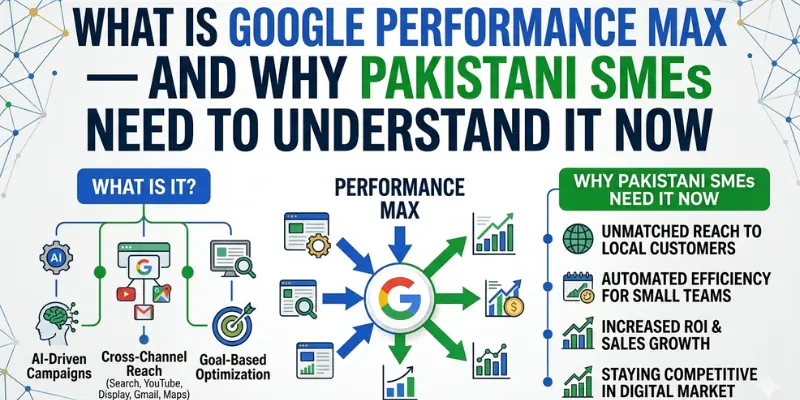
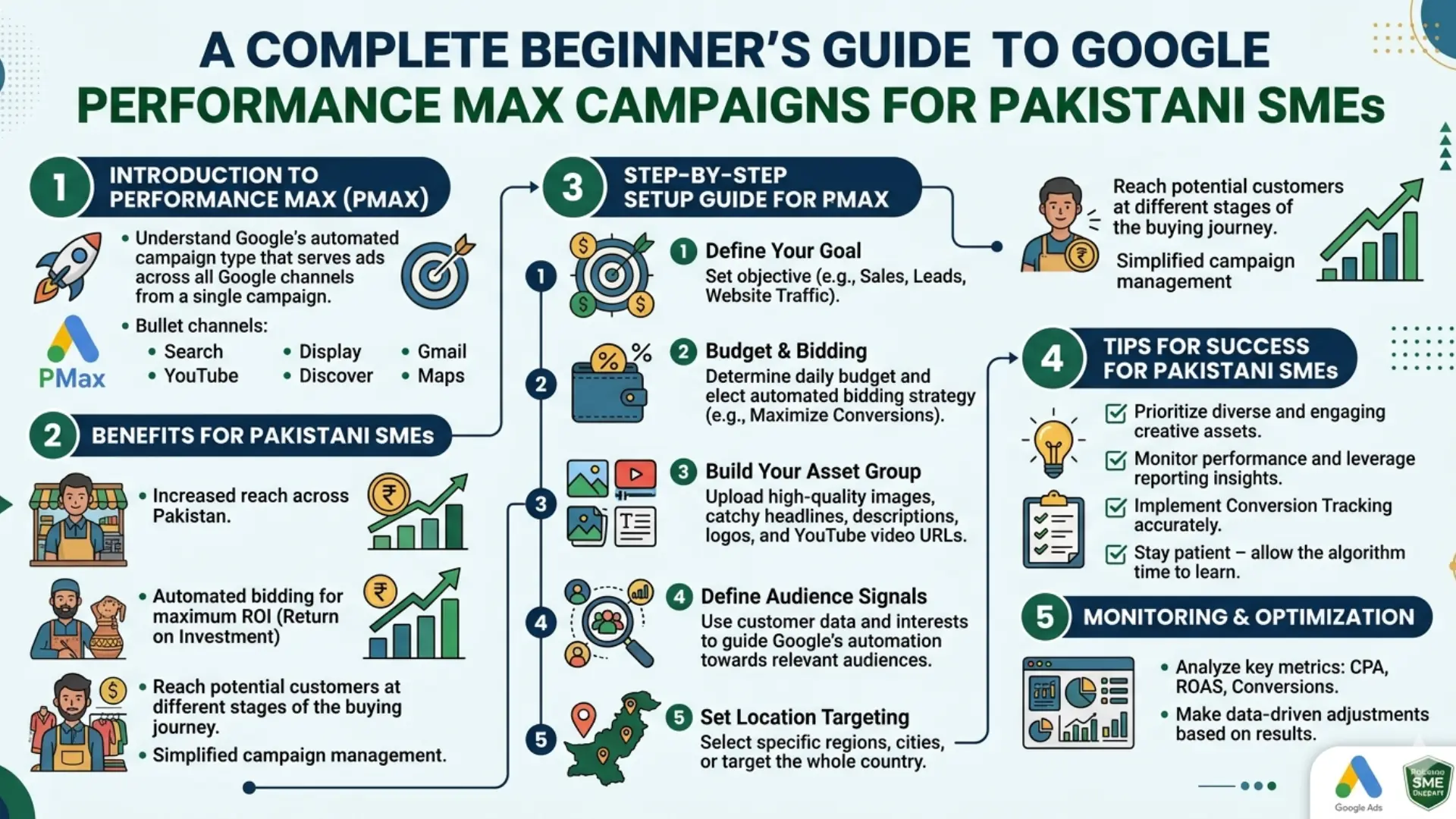
Performance Max (PMAX) is Google’s newest and most powerful automated campaign type. Launched globally in 2021 and rapidly maturing through 2023–2025, PMAX allows advertisers to run a single campaign that automatically serves ads across every Google channel simultaneously: Google Search, Google Display Network, YouTube, Gmail, Google ads, and Google Maps. Rather than managing separate campaigns for each channel, PMAX uses Google’s AI to find the best-performing combination of channels, creatives, and audiences to hit your conversion goal.
For Pakistani SMEs, this represents both a significant opportunity and a significant risk. The opportunity: PMAX can dramatically expand reach and conversions by accessing channels many Pakistani advertisers have never tapped — particularly YouTube and A Complete Beginner’s Guide to Google Discover. The risk: PMAX’s AI makes most placement and bidding decisions autonomously, and without correct setup, it will waste budget on low-intent display and YouTube impressions while under-investing in the high-intent search placements that actually convert.
This guide walks through the complete PMAX setup process for Pakistani SMEs, explains every configuration decision with Pakistan-specific context, and provides the optimisation framework Clickmasters uses to achieve above-average Google Performance Max Campaigns for our clients.
When to Use PMAX vs Standard Search Campaigns
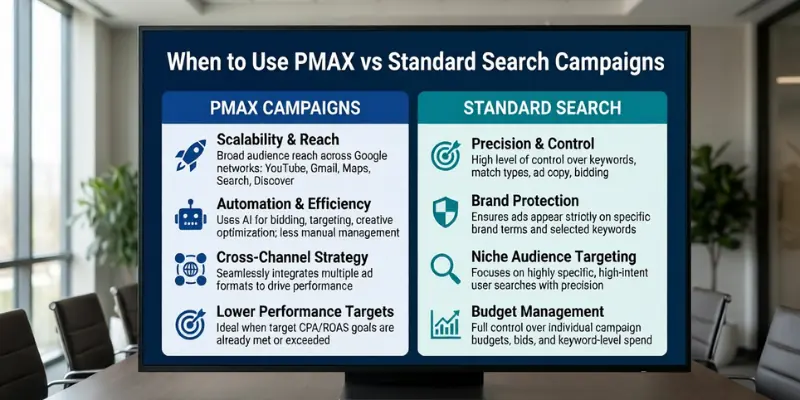
Use Performance Max when: You have conversion tracking properly set up (minimum 30–50 conversions/month needed for PMAX’s AI to optimise effectively). You want to expand beyond Google Search into Display, YouTube, and Discover. You have creative assets (images, videos) to feed the campaign. You are an e-commerce business with a Google Merchant Center product feed. | Keep Standard Search campaigns when: You are new to Google Ads with fewer than 50 monthly conversions. Your budget is under PKR 50,000/month (PMAX needs data volume to optimise). You need precise control over where ads appear. You are in a sensitive industry where display placements carry brand risk.
How Performance Max Works: The AI Engine Explained
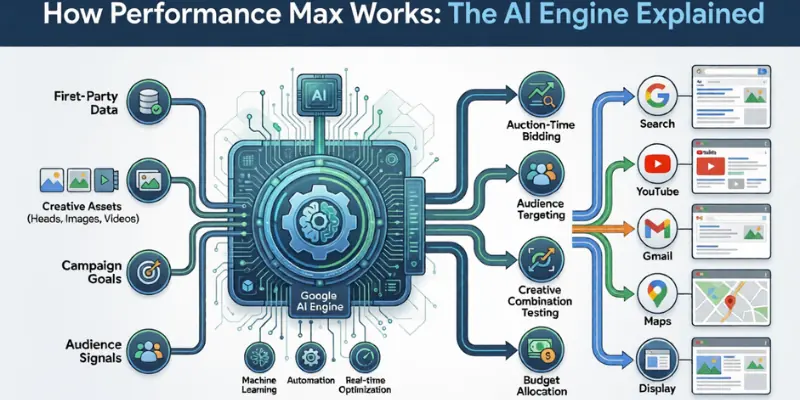
Understanding PMAX’s underlying mechanics is essential for setting it up correctly. Unlike traditional campaigns, where you specify keywords, bids, and placements, PMAX works differently at every level:
Asset Groups: PMAX’s Building Block

Instead of ad groups with keywords, PMAX uses Asset Groups — collections of creative assets (headlines, descriptions, images, videos, logos) that Google’s AI assembles into ads. Each Asset Group can be themed around a specific product, service, or audience. Google automatically assembles the best-performing combinations of your assets into ads and shows them across all channels.
Audience Signals: Guiding the AI

Because PMAX has no keywords, you guide Google’s AI through Audience Signals — suggestions about who your ideal customers are. Audience Signals are hints, not targeting restrictions: Google’s AI uses them as a starting point but will serve ads beyond your specified signals if it finds converting audiences outside them. This is both the power and the risk of PMAX.
Automated Bidding
PMAX requires automated bidding strategies — either Maximise Conversions or Maximise Conversion Value (ROAS target). You cannot use manual CPC with PMAX. This means Google controls your bids based on its prediction of conversion probability for each impression opportunity.
PART 1: STEP-BY-STEP PMAX SETUP FOR PAKISTANI SMEs
PMAX’s AI is only as good as the conversion data you feed it. Without accurate conversion tracking, Google’s algorithm has no signal for what ‘success’ looks like and will optimise for the wrong objective. For Pakistani businesses, conversion tracking has specific complications that must be addressed before PMAX launch.
Step 1: Conversion Tracking Setup — The Non-Negotiable Foundation
PMAX’s AI is only as good as the conversion data you feed it. Without accurate conversion tracking, Google’s algorithm has no signal for what ‘success’ looks like and will optimise for the wrong objective. For Pakistani businesses, conversion tracking has specific complications that must be addressed before PMAX launch.
Primary Conversion Actions for Pakistani Businesses
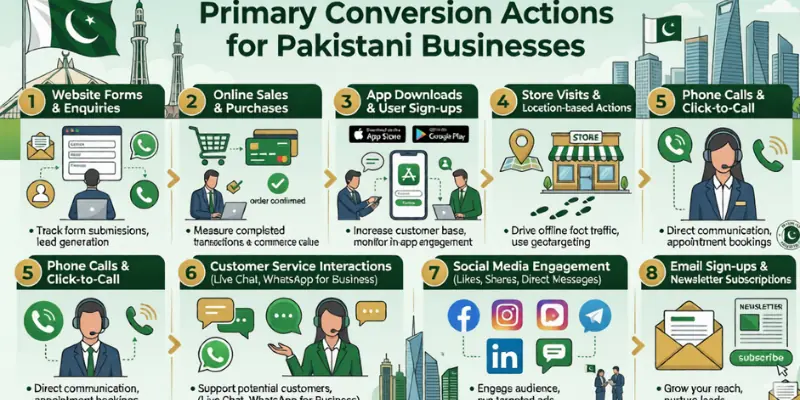
⦁ Website form submissions: Standard Google tag conversion event fired when the thank-you page loads after form submission. Most reliable conversion type.
⦁ Phone calls from ads: Call extension conversions are tracked when a user calls directly from the ad. Critical for Pakistani businesses where phone enquiries dominate.
⦁ WhatsApp Business clicks: Track clicks on wa.me links as conversion events using Google Tag Manager. For Pakistani businesses where WhatsApp is the primary enquiry channel, this is often the most important conversion to track.
⦁ E-commerce purchases: Google tag enhanced e-commerce tracking with purchase event, transaction value, and item data. Required for PMAX to optimise for ROAS rather than just conversion volume.
⦁ JazzCash/EasyPaisa redirects: Pakistani payment gateway redirects frequently break standard pixel-based conversion tracking. Server-side conversion tracking using Google Ads Conversion API resolves this.
Minimum data requirement before launching PMAX: 30–50 conversions per month on your primary conversion action. Below this threshold, PMAX’s AI cannot learn efficiently and will make poor optimisation decisions. If you are below this threshold, run Standard Search campaigns first to build conversion data before switching to PMAX.
Step 2: Asset Preparation — What You Need Before Launch

PMAX requires more creative assets than any other Google Ads campaign type. Preparing high-quality assets before launch is critical — PMAX’s asset rating system (Good/Low) directly impacts ad serving volume and performance.
| Asset Type | Requirements | Pakistan-Specific Guidance |
| Headlines (short) | Min 3, max 5. 30 characters each. | Include the city name in at least one headline (‘SEO Services Karachi’). Include PKR pricing in one headline. Include a free offer in one headline. |
| Long headlines | Min 1, max 5. 90 characters each. | Use for complete value propositions: ‘Pakistan’s #1 SEO Agency — 300+ Clients — Free Audit Included’ |
| Descriptions | Min 2, max 5. 90 characters each. | Address Pakistani buyer objections: payment terms, local support, results timeline, JazzCash/EasyPaisa payment. |
| Images (landscape) | Min 1, max 20. 1.91:1 ratio, min 1200x628px. | Product/service photography. Avoid stock photos — real Pakistani team/office/client photos outperform by 28% in Clickmasters testing. |
| Images (square) | Min 1, max 20. 1:1 ratio, min 300x300px. | Same subjects as landscape but square-cropped for mobile feed and Display placements. |
| Logo | Min 1, max 5. 1:1 ratio, min 128x128px. | Clear, high-contrast logo. Transparent or white background. Must be recognisable at small sizes. |
| Videos | Optional but strongly recommended. Min 10 seconds, 16:9 or 9:16 (vertical). | Without video assets, PMAX auto-generates video from your images. Auto-generated videos underperform real videos by 40-60%. Invest in at least one 15–30 second brand video. Urdu voiceover significantly improves Pakistani audience engagement. |
| Sitelinks | 4–10 sitelinks recommended. | Link to the most relevant service/product pages with keyword-rich anchor text. |
Step 3: Audience Signals — Guiding the AI for Pakistani Markets
Audience Signals are the most important PMAX configuration decision after conversion tracking. For Pakistani SMEs, the right audience signal combination dramatically accelerates the learning phase by pointing Google’s AI toward your actual customers rather than letting it discover them from scratch.
Recommended Audience Signal Stack for Pakistani Businesses

- Signal 1: Customer Match list (highest priority): Upload your existing customer email list to Google Ads (Audience Manager > Customer Match). Even a list of 200–500 past customers gives PMAX a powerful signal — ‘find more people like these.’
- Signal 2: Website visitors from Google Analytics 4: Import your GA4 audience segments into Google Ads. Use your highest-intent segments: users who visited service pages, users who spent over 3 minutes on site, users who initiated but did not complete checkout.
- Signal 3: Google’s In-Market audiences relevant to your business: For Pakistani campaigns, recommended In-Market audiences include: Business Services > Marketing Services (for digital marketing), Home & Garden > Home Improvement (for construction/property), Technology > Business Technology (for IT services), Apparel & Accessories (for fashion e-commerce).
- Signal 4: Custom intent audiences based on search terms: Create a custom audience of ‘people who searched for’ your top 20 conversion keywords. Example: ‘seo agency pakistan, digital marketing karachi, best seo company lahore.’ This bridges PMAX toward search-intent audiences.
- Signal 5: Demographic targeting: Set age range to your actual buyer demographics. For B2B Pakistani services: 25–55. For youth-oriented consumer products: 18–35. Enable Pakistan as the geographic target. For local businesses: target specific cities (Karachi, Lahore, Islamabad) rather than all of Pakistan.
PART 2: ASSET GROUP STRATEGY
Asset Group Architecture: How to Structure PMAX for Pakistani Businesses
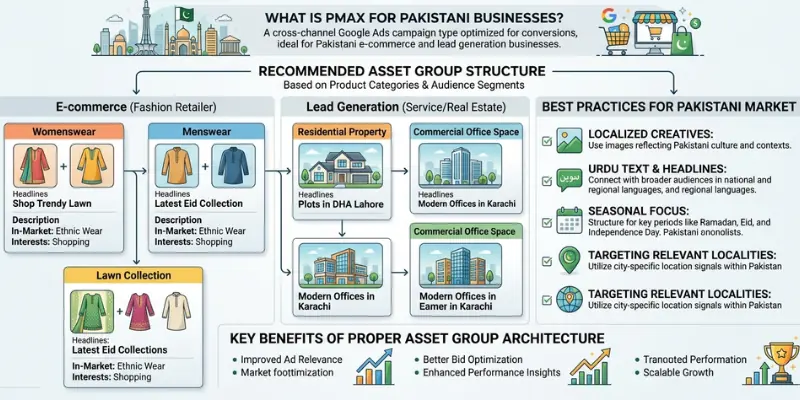
A single PMAX campaign can contain multiple Asset Groups, each with different creative assets and audience signals. The optimal Asset Group architecture for Pakistani SMEs depends on your business type.
Single-Service Business (1–2 Asset Groups)

For Pakistani businesses offering a single primary service (e.g., SEO agency, law firm, medical clinic), a simple 1–2 Asset Group structure works well. Asset Group 1 covers your primary service with your best-performing creative. Asset Group 2 (optional) targets a specific city or audience segment with city-specific messaging.
Multi-Service Business (3–5 Asset Groups)

For digital marketing agencies, IT firms, or professional service firms offering multiple distinct services, create one Asset Group per service category. Each Asset Group has service-specific headlines, descriptions, and relevant images. This prevents your ‘SEO services’ creative from showing to someone searching for ‘web development’ — a common waste pattern in single-Asset Group PMAX campaigns.
| Asset Group | Focus | Key Headlines | Audience Signals |
| Asset Group 1: SEO Services | Organic search and SEO | ‘SEO Services Karachi | Page-1 in 90 Days’, ‘Packages from PKR 65K/Month’, ‘Free SEO Audit — Book Today’ | Custom search intent: seo-related queries, SEO in-market audience, website visitors from SEO service pages |
| Asset Group 2: Google Ads Management | Paid advertising services | ‘Google Ads Management Pakistan’, ‘Cut Your CPC by 40%’, ‘PKR 480M+ Ads Managed’ | Custom search intent: google ads queries, Digital advertising in-market, past enquiry form visitors |
| Asset Group 3: Web Development | Website design/development | ‘Web Development Pakistan | PKR 85K+’, ‘Mobile-First Websites’, ‘Delivered in 30 Days’ | Custom search intent: web design queries, Technology in-market, website visitors from web dev pages |
| Asset Group 4: Social Media | Social media management | ‘Social Media Marketing Pakistan’, ‘Grow Your Following Fast’, ’10M+ Monthly Reach’ | Social media in-market, custom search intent: social media queries, engagement-based website audiences |
E-Commerce Business (Product Feed Asset Groups)
For Pakistani e-commerce businesses, PMAX integrates with Google Merchant Center product feeds — this is where PMAX delivers its strongest performance. Product feed-based PMAX automatically creates Shopping ads from your product catalogue without requiring separate asset creation per product.
- Link your Google Merchant Center account to your Google Ads account before creating the PMAX campaign
- Create one Asset Group for your hero product categories with lifestyle creative assets
- Separate Asset Groups for seasonal campaigns (Eid collection, winter arrivals) with season-specific creative
- Ensure your product feed has complete titles, descriptions, images, and prices — PMAX’s Shopping performance is directly proportional to feed quality
Step 4: Bidding Strategy and Budget for Pakistani SMEs
Starting Bid Strategy: Maximise Conversions
For new PMAX campaigns, start with ‘Maximise Conversions’ (no ROAS target) for the first 4–6 weeks. This gives Google’s AI flexibility to explore the conversion landscape without the constraint of a ROAS target. A ROAS target set before sufficient data is collected will cause the campaign to under-deliver as Google struggles to find opportunities meeting your ROAS requirement.
Transition to Target ROAS
After 4–6 weeks and a minimum of 50–80 conversions, switch to ‘Maximise Conversion Value with a Target ROAS.’ Set your initial ROAS target at or slightly below your current actual ROAS (e.g., if you are achieving 280% ROAS, set target at 260%). This prevents immediate under-delivery while giving the algorithm a performance direction.
Budget Recommendations for Pakistani SMEs
| Business Type | Minimum Effective PMAX Budget/Month | Rationale |
| Local service business (1 city) | PKR 60,000–80,000 | PMAX needs data volume. Below PKR 50K, insufficient conversions for AI learning in 30 days. |
| National service business | PKR 100,000–150,000 | Broader targeting requires more budget to generate learning data across geographic spread. |
| E-commerce (product feed) | PKR 80,000–120,000 | Product feed PMAX is more efficient — Shopping intent is high. Lower minimum threshold than service businesses. |
| B2B with long sales cycle | PKR 120,000–200,000 | Longer consideration cycles mean fewer conversions per month. More budget needed to generate sufficient conversion data. |
PART 3: AVOIDING WASTED SPEND IN PMAX
The 5 Biggest PMAX Wasted Spend Problems — and How to Avoid Them
Problem 1: Brand Keyword Cannibalism
PMAX automatically serves on branded search queries (people searching your company name) — consuming budget that would convert at very low cost through an existing branded Search campaign, and inflating PMAX’s reported ROAS with easy branded conversions that don’t represent new customer acquisition.
Solution: Create a separate branded Search campaign with a higher priority. Add your brand name as a negative keyword at the account level to prevent PMAX from competing for branded queries. This ensures PMAX spends budget on genuine new customer acquisition rather than capturing search traffic that would have converted anyway.
Problem 2: Low-Quality Placement Waste
PMAX’s Display and YouTube placements can generate millions of impressions on low-quality websites and YouTube channels — especially Pakistani websites with cheap ad inventory. These impressions consume budget without generating meaningful conversions.
Solution: Use Placement Exclusions. In Google Ads, go to Tools > Shared Library > Placement Exclusions. Add a list of low-quality Pakistani website categories (adult content, entertainment sites, gaming sites if not relevant) and specific low-performing URLs identified in your placement report. Review placement reports monthly and add exclusions continuously.
Problem 3: Insufficient Audience Signal Quality
PMAX launched without a customer list or custom intent audience relies entirely on Google’s broad interest signals — resulting in significant budget waste in the first 4–8 weeks as the AI discovers your actual converting audience from scratch.
Solution: Always launch PMAX with your best audience signals loaded (customer match list, website visitor segments, custom search intent audiences). The quality of your audience signals directly determines how quickly PMAX exits the learning phase and how much budget is wasted during exploration.
Problem 4: Conversion Tracking Gaps for Pakistani Payment Flows
Pakistani payment flows — JazzCash, EasyPaisa, bank transfer redirects — frequently break browser-side Google tag conversion tracking. PMAX optimises based on the conversions it can see: if 40% of your actual conversions are invisible due to tracking gaps, PMAX is optimising on incomplete data and will make systematically poor decisions.
Solution: Implement Google Ads Conversion API (server-side tracking) to capture conversions that browser-based tracking misses. This is a developer implementation but is essential for Pakistani e-commerce and any business using local payment gateways. A digital marketing agency like Clickmasters often implements this setup to improve tracking accuracy, and it has been observed to increase reported PMAX conversions by 25–45% for Pakistani e-commerce clients.
Problem 5: Single Asset Group for All Products/Services
Running a single Asset Group for a multi-service or multi-product business causes PMAX to blend your creative assets indiscriminately — showing ‘web development’ creative to someone searching for ‘social media marketing,’ or showing your highest-margin service creative to an audience signal better matched to a lower-margin service.
Solution: Create separate Asset Groups as described in the architecture section above. Monitor Asset Group performance reports (available in PMAX insights) monthly and pause underperforming Asset Groups after sufficient data accumulation.
Performance Max Insights: What the Reports Tell You
PMAX provides fewer granular reports than traditional campaigns, but the available insights are valuable for optimisation. Key PMAX reports Pakistani advertisers should monitor:
| PMAX Report | Where to Find | What It Tells You |
| Asset Group performance | Campaign > Asset Groups | Conversion volume and cost per conversion by Asset Group. Identify which themes and creatives drive results. |
| Asset ratings | Campaign > Assets | Each asset rated Good/Low/Best/Pending. Low-rated assets reduce serving volume. Replace Low assets with better alternatives. |
| Search terms report | Campaign > Search Terms (limited data) | Shows some of the search queries triggering PMAX ads. Identify irrelevant queries to add as negative keywords. |
| Audience insights | Campaign > Insights | Shows which audience segments are converting. Compare to your audience signals — identify new segments worth adding as signals. |
| Channel breakdown | Campaign > Insights > Channel | Shows conversion distribution across Search, Display, YouTube, Shopping. Identify which channels deliver results for your specific Pakistani business. |
| Placement report | Tools > Transparency Center > Where Ads Showed | Lists specific websites and YouTube channels where your Display ads appeared. Essential for identifying and excluding low-quality placements. |
PMAX Case Study: Lahore Fashion E-Commerce — 420% ROAS in 90 Days
A Lahore-based women’s fashion e-commerce store transitioned from a standalone Google Shopping campaign to Performance Max in September 2025. Pre-transition: PKR 120,000/month budget, 240% ROAS, 180 monthly transactions.
PMAX Setup
- 3 Asset Groups: Summer Collection (lifestyle photography, Urdu voiceover video), Formal Wear (premium creative, higher price point messaging), Sale/Offers (discount-focused headlines, urgency creative)
- Google Merchant Center feed: 850 products with complete titles, descriptions, multiple images, and PKR pricing
- Audience signals: 1,800-customer email list uploaded as Customer Match, GA4 past purchaser segment, In-Market for Apparel & Accessories Pakistan, custom search intent audience built from top 30 converting fashion keywords
- Video: 25-second brand video featuring Pakistani model with Urdu voiceover — produced for PKR 45,000
- Launched with Maximise Conversions for 6 weeks, then transitioned to Target ROAS 380%
Results at 90 Days
| Metric | Before PMAX | 90 Days After |
| Monthly ROAS | 240% | 420% (+75%) |
| Monthly transactions | 180 | 340 (+89%) |
| Average order value | PKR 3,200 | PKR 4,100 (+28%) |
| Cost per transaction | PKR 667 | PKR 353 (−47%) |
| YouTube impressions (new channel) | 0 | 480,000/month |
| New customer rate | 62% | 78% (PMAX finding new audiences |
PMAX vs Standard Google Campaigns: When to Use Each
| Scenario | Recommendation | Rationale |
| New Google Ads account, under 50 conv/month | Standard Search only | PMAX needs conversion data. Start with Search, build data, then layer PMAX. |
| Established account, 50+ conv/month, single service | PMAX + Branded Search | PMAX needs conversion data. Start with Search, build data, then layer PMAX. |
| E-commerce with product feed | PMAX primary, Search supporting | PMAX + feed is Google’s highest-performing e-commerce setup. Keep Search for high-intent branded product queries. |
| B2B with long sales cycle, few monthly conversions | Standard Search primary | PMAX needs volume. B2B low-conversion-volume campaigns do not give PMAX sufficient learning data. |
| Local service business targeting single city | PMAX with strict geo targeting | PMAX with tight geographic targeting works well for local businesses once 30+ monthly conversions established. |
| Local service business targeting single city | PMAX seasonal Asset Group | Create dedicated seasonal Asset Groups with Eid/Ramadan specific creative. Launch 3–4 weeks before the occasion. |
Frequently Asked Questions: Google Performance Max Pakistan
Q: Does PMAX work for Pakistani businesses with small budgets (under PKR 50,000/month)?
PMAX is not recommended for budgets under PKR 50,000/month for most Pakistani business types. The core issue is learning data: PMAX’s AI needs a minimum of 30–50 conversions per month to optimise effectively. At PKR 40,000/month with a CPL of PKR 2,000, you generate only 20 conversions — insufficient for PMAX optimisation. Recommendation: run Standard Search campaigns until you consistently achieve 30–50 monthly conversions, then test PMAX. The exception is e-commerce with a product feed — PMAX’s Shopping integration can work at lower budgets because Shopping conversions (online purchases) tend to be more frequent than service lead conversions.
Q: How do I know if PMAX is actually finding new customers vs. taking credit for customers who would have converted anyway?
This is the most important PMAX measurement question. Three approaches: (1) New customer acquisition: check the ‘New customer’ conversion segment in PMAX reports — Google tracks first-time purchasers separately for accounts with Customer Match lists uploaded. (2) Incrementality testing: run a geographic holdout test — pause PMAX in one comparable city while running in another. Compare conversion rates. (3) Search term report: review which queries PMAX is targeting. If most are branded queries (your company name), PMAX is largely cannibalising existing demand rather than creating new demand. Address with a separate branded Search campaign and brand keyword negatives.