The Platform Decision That Shapes Your Pakistani E-Commerce Business for the Next 5 Years
Pakistan’s e-commerce market reached USD 6.8 billion in 2025 and is projected to exceed USD 12 billion by 2029. Pakistani entrepreneurs launching or scaling online stores face a foundational decision before any marketing, inventory, or logistics planning can begin: which platform to build on. The wrong platform choice creates technical debt, limits scalability, and can cost Pakistani e-commerce businesses hundreds of thousands of rupees in migration costs within 18 to 24 months of launch.
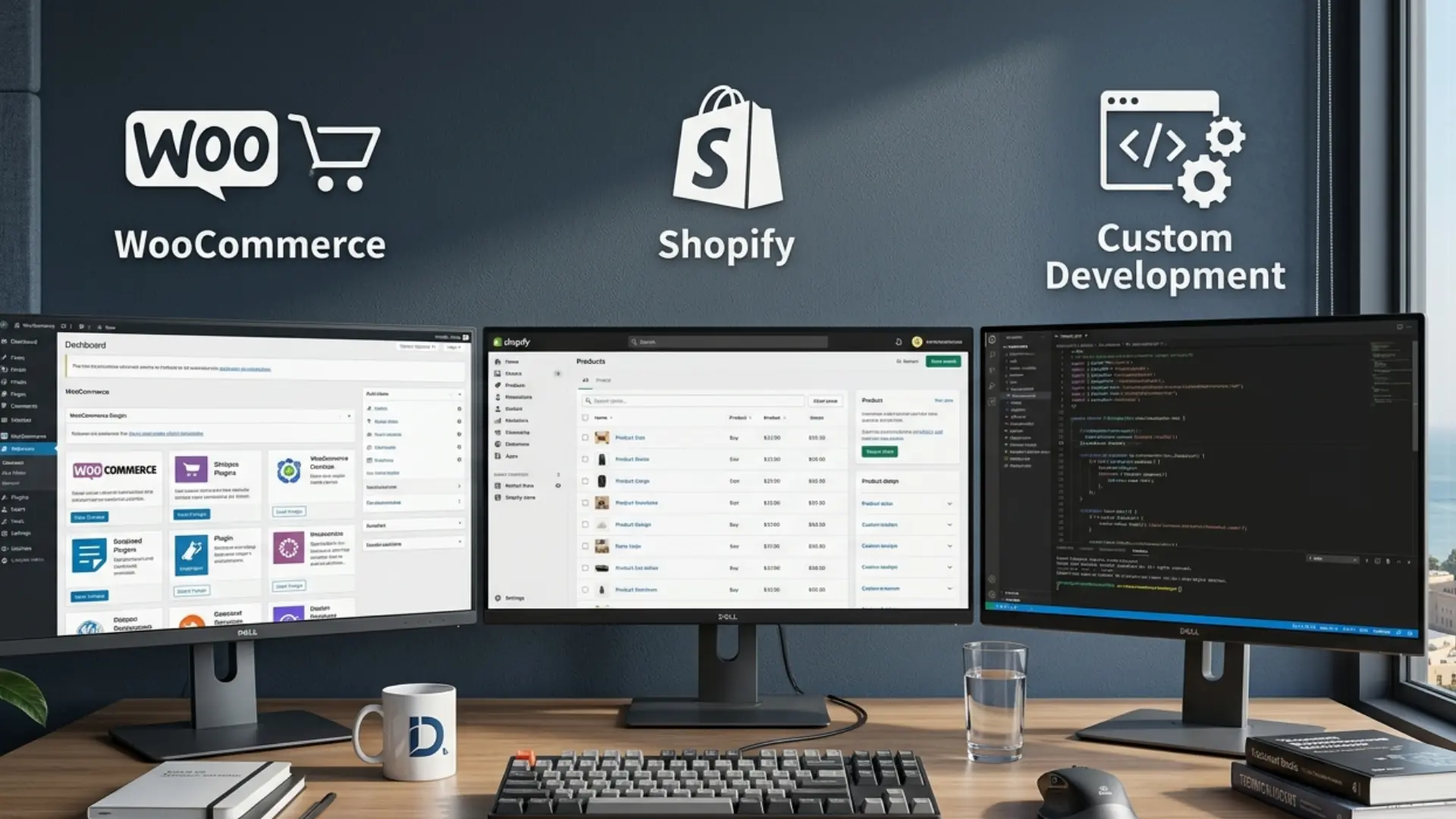
Three platforms dominate Pakistani e-commerce website development in 2026: WooCommerce, which powers approximately 62 percent of Pakistani e-commerce stores due to its WordPress integration and local developer availability; Shopify, which has grown significantly in Pakistan since adding JazzCash and EasyPaisa payment integrations and now powers approximately 18 percent of Pakistani online stores; and Custom Development, which powers marketplace platforms, B2B portals, and enterprise e-commerce where the standard platforms cannot meet requirements.
This guide provides a comprehensive three-way comparison specifically calibrated for Pakistani e-commerce entrepreneurs — covering PKR platform costs, local payment gateway compatibility, SEO capabilities, mobile performance on Pakistani connections, developer availability and costs, scalability ceilings, and the decision framework for each business type. By the end of this guide, you will have a clear recommendation for your specific Pakistani e-commerce situation.
| Quick Platform Recommendation by Business Type WooCommerce: Pakistani fashion brands, artisans, home goods retailers, multi-category stores, businesses needing extensive SEO control, stores with a Pakistani WordPress developer already engaged. Shopify: Businesses wanting fastest time-to-market with minimal technical management, brands also selling internationally, stores with simple product catalogues. Custom development: Marketplaces, B2B wholesale portals, platforms with complex business logic, stores requiring deep integration with existing Pakistani ERP or inventory systems. |
PART 1: PLATFORM-BY-PLATFORM OVERVIEW FOR PAKISTAN
WooCommerce: Pakistan’s Most-Used E-Commerce Platform
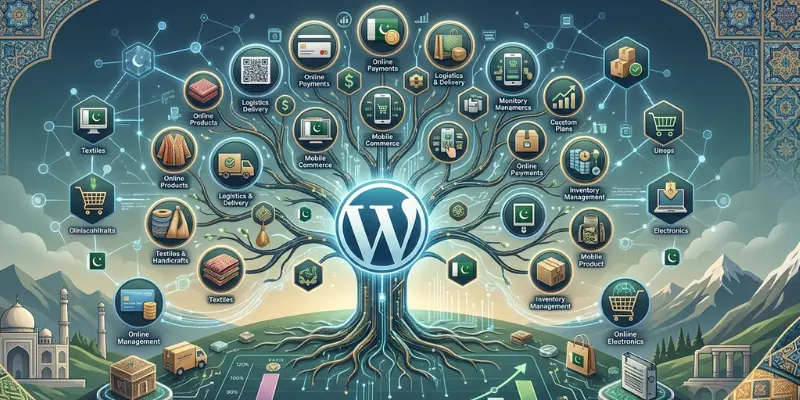
WooCommerce is a free open-source e-commerce plugin for WordPress that transforms any WordPress website into a fully functional online store. It powers more Pakistani e-commerce stores than any other platform because it integrates directly with WordPress (which already powers the majority of Pakistani business websites), Pakistani developers are abundant and affordable, and the plugin ecosystem provides virtually any functionality a Pakistani store could need.
WooCommerce in Pakistan: The Full Picture
- Cost structure: WooCommerce core is free. You pay for hosting (PKR 4,000 to 20,000 per month for appropriate VPS), a premium theme (PKR 15,000 to 40,000 one-time), premium plugins for functionality extensions (PKR 20,000 to 80,000 annually), and development time for setup and customisation (PKR 150,000 to 600,000 build cost depending on complexity).
- Pakistani payment gateways: JazzCash and EasyPaisa have official WooCommerce plugins with straightforward API integration. HBL, Meezan Bank, and multiple Pakistani bank payment gateway plugins are available. The WooCommerce Pakistani payment gateway ecosystem is the most mature of any platform.
- Developer availability: Thousands of Pakistani WooCommerce developers across all price points. Local freelancers from PKR 40,000 to 200,000 per month. Agencies from PKR 150,000 to 500,000 per project. This depth of local talent makes WooCommerce the most cost-effective platform to build and maintain in Pakistan.
- SEO capabilities: WordPress plus WooCommerce gives the most granular SEO control of any e-commerce platform. Full control over URL structure, meta tags, schema markup, canonical tags, and technical SEO configuration. Yoast SEO and RankMath integrate directly with WooCommerce product pages.
- Scalability ceiling: WooCommerce handles up to approximately 100,000 SKUs and moderate traffic volumes with proper server configuration. Above this level, database query optimisation and potentially a headless architecture become necessary.
Shopify: The Fastest Pakistani E-Commerce Launch Path
Shopify is a fully hosted SaaS e-commerce platform where the technical infrastructure — servers, security, updates, and performance — is managed entirely by Shopify. Pakistani merchants pay a monthly subscription and focus on products, marketing, and fulfilment rather than server management. Shopify has become significantly more viable for Pakistani e-commerce since adding local payment gateway support.
Shopify in Pakistan: The Full Picture
- Cost structure: Shopify Basic at USD 39 per month (PKR 10,900), Shopify at USD 105 per month (PKR 29,400), Shopify Advanced at USD 399 per month (PKR 111,700). Additional transaction fees of 0.5 to 2 percent on sales if not using Shopify Payments (not yet available in Pakistan). Plus USD costs for premium themes (PKR 16,000 to 22,000 one-time) and premium apps.
- Pakistani payment gateways: Shopify added official JazzCash and EasyPaisa integrations in late 2024, making it significantly more viable for Pakistani merchants. Bank transfer and cash-on-delivery are supported via third-party apps. However, Shopify Payments (the native payment processor with no additional transaction fees) is not available in Pakistan, meaning Pakistani merchants pay both Shopify’s transaction fee and the payment gateway fee on every sale.
- Developer availability: Growing but less deep than WooCommerce. Shopify development uses Liquid templating language, which fewer Pakistani developers specialise in. Pakistani Shopify developers typically charge a 30 to 50 percent premium over equivalent WooCommerce developers.
- SEO capabilities: Good but less flexible than WooCommerce. Shopify handles basic SEO well (automatic sitemap, canonical tags, mobile-optimised themes) but limits URL customisation (the /products/ and /collections/ URL structure cannot be changed) and restricts some technical SEO configurations available in WordPress.
- Scalability: Shopify’s infrastructure scales automatically. There is no server management required regardless of traffic volume. This is Shopify’s most significant advantage for Pakistani businesses expecting rapid growth or viral traffic spikes.
Custom E-Commerce Development: When Pakistani Businesses Outgrow Platforms
Custom e-commerce development builds the online store from scratch using PHP (Laravel), Python, Node.js, or other frameworks. Every feature is purpose-built for the specific Pakistani business requirements rather than adapted from a platform’s capabilities and limitations. This approach is chosen by Pakistani marketplace operators, B2B wholesalers, and enterprises with specific functional requirements that WooCommerce and Shopify cannot meet.
Custom E-Commerce in Pakistan: The Full Picture
- Cost structure: Build cost PKR 800,000 to 4,000,000 depending on complexity. Ongoing maintenance PKR 80,000 to 250,000 per month. No monthly platform subscription fees but significantly higher total cost of ownership over 3 years.
- Pakistani payment gateway integration: Full flexibility to integrate any Pakistani payment API — JazzCash, EasyPaisa, HBL, bank transfer, installment providers, or custom B2B invoicing workflows. No plugin limitations.
- Developer availability: Available but expensive. Senior Pakistani Laravel or Node.js developers who can build production-quality custom e-commerce command PKR 200,000 to 450,000 per month. Competent local agencies charge PKR 500,000 to 2,500,000 for complete e-commerce builds.
- SEO capabilities: Complete — every URL structure, meta tag, canonical, schema markup, and technical SEO element is implemented by the development team. The best SEO flexibility available, but requires the development team to actually implement each SEO feature rather than configuring it in a plugin.
- Scalability: Unlimited when architected correctly from the start. Requires proactive architecture planning and database optimisation as the business scales.
PART 2: THE COMPLETE THREE-WAY COMPARISON
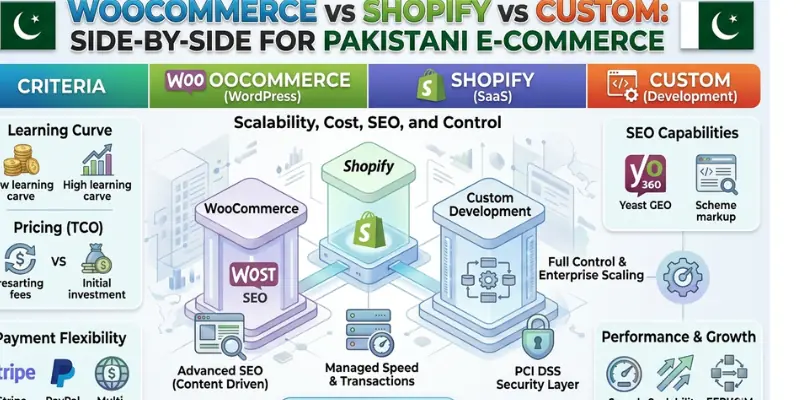
WooCommerce vs Shopify vs Custom: Side-by-Side for Pakistani E-Commerce
| Dimension | WooCommerce | Shopify | Custom Development |
| Build cost Pakistan (PKR) | PKR 150,000 to 600,000 | PKR 80,000 to 300,000 (lower because platform handles infrastructure) | PKR 800,000 to 4,000,000 plus |
| Monthly ongoing cost PKR | PKR 8,000 to 25,000 (hosting plus plugins) | PKR 11,000 to 112,000 (plan fee) plus transaction fees | PKR 80,000 to 250,000 (maintenance retainer) |
| 3-year total cost of ownership | PKR 600,000 to 1,800,000 | PKR 900,000 to 4,400,000 | PKR 1,700,000 to 8,000,000 plus |
| JazzCash and EasyPaisa | Native plugins available. Most mature Pakistani gateway ecosystem. | Official integrations added 2024. Transaction fees apply on every sale. | Full custom integration. No additional fees beyond gateway rates. |
| Time to launch | 6 to 12 weeks for professional build | 3 to 6 weeks. Fastest launch path. | 16 to 52 weeks depending on complexity. |
| Pakistani developer availability | Highest. Thousands of WooCommerce developers across all budgets. | Growing. Fewer Shopify specialists. 30 to 50 percent premium over WooCommerce rates. | Available but expensive. Senior developers command high rates. |
| SEO flexibility | Highest. Full URL control, complete meta management, plugin ecosystem. | Good but limited. URL structure fixed. Some technical SEO constraints. | Complete. Developer implements every SEO element custom. |
| Mobile performance Pakistan | Excellent with proper optimisation. Requires developer effort. | Excellent out of the box. Shopify themes are mobile-optimised by default. | Excellent when architected correctly. Full control. |
| Scalability ceiling | 100,000 SKUs and moderate traffic with good server setup. | No practical ceiling. Shopify infrastructure scales automatically. | No ceiling. Requires proactive architecture planning. |
| Platform lock-in | Low. Open source. Migrate anywhere. | High. Custom code in Liquid. Product data exportable but theme and apps do not migrate. | None. You own the code entirely. |
Pakistani Payment Gateway Comparison Across Platforms
Payment gateway integration is the most Pakistan-specific platform consideration. Pakistani consumers overwhelmingly prefer JazzCash, EasyPaisa, and bank transfer for e-commerce purchases. The platform you choose determines how cleanly these integrations work and what costs they add.
| Gateway | WooCommerce Integration | Shopify Integration | Custom Development |
| JazzCash | Official plugin. API v3. Easy setup. No platform transaction fee. | Official integration added 2024. Shopify charges 0.5 to 2 percent transaction fee additionally. | Full API integration. Maximum control. No additional fees. |
| EasyPaisa | Official plugin. Clean integration. No platform transaction fee. | Official integration added 2024. Same Shopify transaction fee applies. | Full API integration. No additional fees. |
| Bank transfer (manual) | WooCommerce BACS gateway built-in. Customisable instructions. | Supported via manual payment apps. Less flexible than WooCommerce. | Full control. Automated reconciliation possible. |
| Cash on Delivery | Built-in WooCommerce feature. Easy configuration. | Built-in Shopify feature. Works well. | Custom implementation required. |
| Installment plans (BankAlfalah, HBL) | Plugin available. Integration requires developer work. | Limited official apps. More complex to implement. | Custom API integration. Best for installment plan customisation. |
| Shopify Transaction Fee Impact for Pakistani E-Commerce Shopify charges 0.5 percent (Advanced plan) to 2 percent (Basic plan) on every transaction that does not use Shopify Payments. Since Shopify Payments is not available in Pakistan, every Pakistani Shopify merchant pays this additional fee on top of JazzCash or EasyPaisa gateway fees. For a Pakistani store processing PKR 500,000 per month on the Basic plan: PKR 10,000 per month in Shopify transaction fees (PKR 120,000 annually) plus PKR 10,000 to 12,500 in gateway fees. This transaction fee cost makes Shopify more expensive than it appears from the subscription price alone for high-revenue Pakistani stores. |
SEO Comparison: Which Platform Wins for Pakistani Organic Search
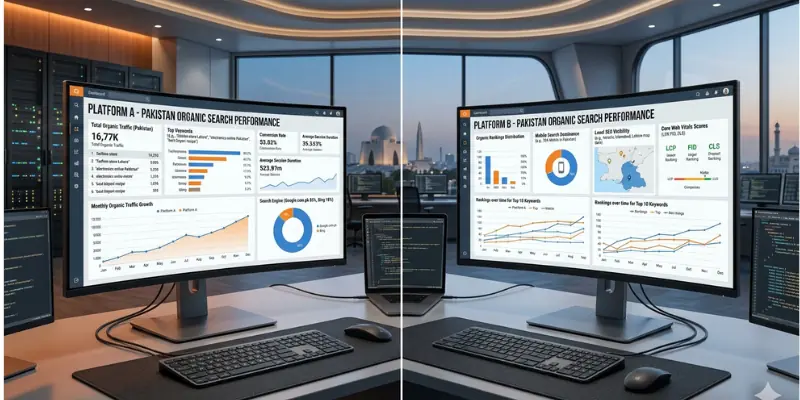
Organic search traffic is the highest-ROAS acquisition channel for established Pakistani e-commerce businesses. Platform SEO capabilities directly determine how well your store can rank for high-intent Pakistani buying searches.
WooCommerce SEO Advantages for Pakistan
- Full URL structure control: Create SEO-optimised URLs for Pakistani product and category pages exactly as you choose. /shalwar-kameez-women-karachi/ is possible on WooCommerce; Shopify forces /products/shalwar-kameez-women-karachi/.
- Complete meta tag control: Product page titles, descriptions, Open Graph tags, and Twitter Card tags configurable per product with WooCommerce plus Yoast or RankMath.
- Schema markup: WooCommerce product schema includes price, availability, reviews, and breadcrumb markup that enables Google Shopping rich results for Pakistani product searches.
- Blog integration: WordPress’s native blogging is the best content marketing platform available. Pakistani fashion, electronics, and lifestyle e-commerce brands with active content strategies consistently rank better on WooCommerce.
Shopify SEO Limitations for Pakistan
- Fixed URL structure: The /products/ prefix in all Shopify product URLs cannot be removed. While Google generally ignores this, it limits URL customisation for targeting specific Pakistani keyword patterns.
- Duplicate content risk: Shopify generates canonical and non-canonical versions of collection pages that require careful canonical tag management.
- Blog functionality: Shopify’s built-in blog is adequate but less flexible than WordPress. Pakistani e-commerce brands with aggressive content marketing strategies will find WooCommerce’s blogging capabilities superior.
- Technical SEO ceiling: Advanced technical SEO configurations such as hreflang for Pakistani Arabic or Urdu content, custom robots.txt rules, and advanced schema types are more complex to implement on Shopify than WordPress.
Case Study: Lahore Women’s Fashion Brand — WooCommerce vs Shopify Decision
A Lahore-based women’s fashion brand selling lawn, formal, and casual wear was choosing between WooCommerce and Shopify for their first professional e-commerce store. They had approximately 800 SKUs, a 3-person team with no technical staff, and a PKR 300,000 website build budget. Monthly revenue target was PKR 1,500,000 within 6 months.
Evaluation Factors
| Factor | WooCommerce Assessment | Shopify Assessment |
| Build cost at PKR 300,000 budget | Full professional WooCommerce store achievable at this budget. | Shopify store achievable with budget focused on theme customisation. |
| Technical management capability | Requires developer for updates, plugins, and maintenance. | Shopify handles technical management. Less developer dependency. |
| JazzCash and EasyPaisa | Clean integration. No transaction fees beyond gateway rates. | Integrations available but Shopify charges 0.5 to 2 percent transaction fee per order. |
| SEO for Pakistani fashion keywords | Full control. Best for long-term organic growth. | Good but URL structure and some technical SEO limitations. |
| Pakistani developer for ongoing support | Abundant. PKR 40,000 to 80,000 per month for maintenance support. | Fewer specialists. PKR 60,000 to 120,000 per month for equivalent Shopify developer. |
| Time to launch | 8 to 10 weeks professional build. | 4 to 6 weeks. Faster to market. |
Decision and Results
Clickmasters recommended WooCommerce based on the brand’s SEO ambition (wanted to rank for competitive Pakistani fashion keywords within 12 months), the PKR transaction fee savings at scale, the deep Pakistani WooCommerce developer pool for ongoing support, and the content marketing strategy that relied heavily on WordPress blog integration.
At 12 months post-launch: PKR 2,340,000 monthly revenue, 18 top-10 Google rankings for Pakistani fashion keywords, conversion rate of 4.8 percent from organic traffic. Estimated annual saving on transaction fees vs Shopify Basic plan: PKR 280,000 based on actual monthly revenue.
When Shopify Is the Right Choice for Pakistani E-Commerce
Despite WooCommerce’s advantages for most Pakistani e-commerce use cases, there are specific scenarios where Shopify genuinely wins for Pakistani entrepreneurs.
- Fastest possible launch with minimal technical involvement: A Pakistani entrepreneur launching their first store with no technical team and wanting to be operational within 3 to 4 weeks benefits from Shopify’s managed infrastructure and pre-built theme ecosystem. The time to revenue advantage can outweigh the higher ongoing costs.
- International sales as a primary objective: Pakistani brands targeting UAE, UK, USA, and international markets benefit from Shopify’s multi-currency, international shipping rate calculators, and the global Shopify app ecosystem that supports international tax, duties, and compliance.
- Simple product catalogues with high transaction volumes: For Pakistani businesses with straightforward products, high monthly revenue (where admin efficiency matters), and no complex customisation needs, Shopify’s clean admin and reliable performance justify the subscription cost.
- Dropshipping or print-on-demand for Pakistani market: Shopify’s dropshipping app ecosystem (Oberlo, DSers, Printful) has no WooCommerce equivalent in depth. Pakistani entrepreneurs in dropshipping or print-on-demand benefit from Shopify’s supplier integrations.
Frequently Asked Questions: E-Commerce Platform Choice for Pakistan
| Can I migrate from Shopify to WooCommerce later if I start on Shopify? Yes, migration is possible but involves real cost and effort. Product data (titles, descriptions, images, prices, SKUs) migrates cleanly via CSV export. What does not migrate: Shopify themes (rewritten in Liquid, incompatible with WordPress), Shopify-specific app configurations, and your URL structure (requiring 301 redirect mapping to preserve SEO rankings). Migration from Shopify to WooCommerce typically costs Pakistani businesses PKR 80,000 to 200,000 in developer time plus risk of temporary SEO impact. Factor this eventual migration cost into your platform decision if you anticipate outgrowing Shopify’s limitations. |
| Is WooCommerce really free for Pakistani businesses? WooCommerce core is free and open-source, but running a professional Pakistani WooCommerce store is not free. Budget for: appropriate VPS hosting at PKR 4,000 to 15,000 per month, a premium theme at PKR 15,000 to 35,000 one-time, essential premium plugins (WooCommerce subscriptions, advanced shipping, booking) at PKR 20,000 to 60,000 annually, and developer setup cost at PKR 150,000 to 400,000 for a professional build. Total year-one cost for a professional Pakistani WooCommerce store: PKR 350,000 to 700,000. This compares favourably to Shopify’s year-one cost of PKR 350,000 to 600,000 at equivalent configuration quality. |
| Which platform is better for Pakistani mobile shoppers? Both WooCommerce (properly configured) and Shopify deliver excellent mobile experiences. Shopify has a slight advantage in out-of-the-box mobile performance because all Shopify themes are mobile-first by design and the platform handles performance optimisation automatically. WooCommerce requires deliberate performance optimisation — the right theme, caching plugin, image compression, and CDN configuration — to match Shopify’s default mobile performance. For Pakistani businesses working with experienced developers, the WooCommerce performance gap is easily closed. For businesses without technical support, Shopify’s default mobile performance is more reliable. |