Why On-Page SEO Is the Highest-Leverage SEO Activity
Of all the SEO activities you can invest in, on-page optimization delivers the fastest, most controllable results. Unlike link building — which depends on other websites — or technical SEO — which often requires developer resources — professional On-Page SEO Services give you full control to optimize every page you publish, with zero external dependencies.
But here’s the problem: most businesses are publishing pages that are 60-70% optimized. They do the basics — throw a keyword in the title, add a meta description, and call it done. That approach worked in 2018. In 2026, it’s table stakes, not a competitive advantage.
The search landscape has changed dramatically. Google’s ranking algorithm now evaluates pages across hundreds of signals simultaneously. AI search engines like Perplexity, ChatGPT, and Google’s own AI Overviews have added an entirely new dimension: content now needs to be structured not just for human readers and crawlers, but also for AI extraction and citation. Pages that fail to optimize for AI search are leaving a growing slice of organic traffic on the table.
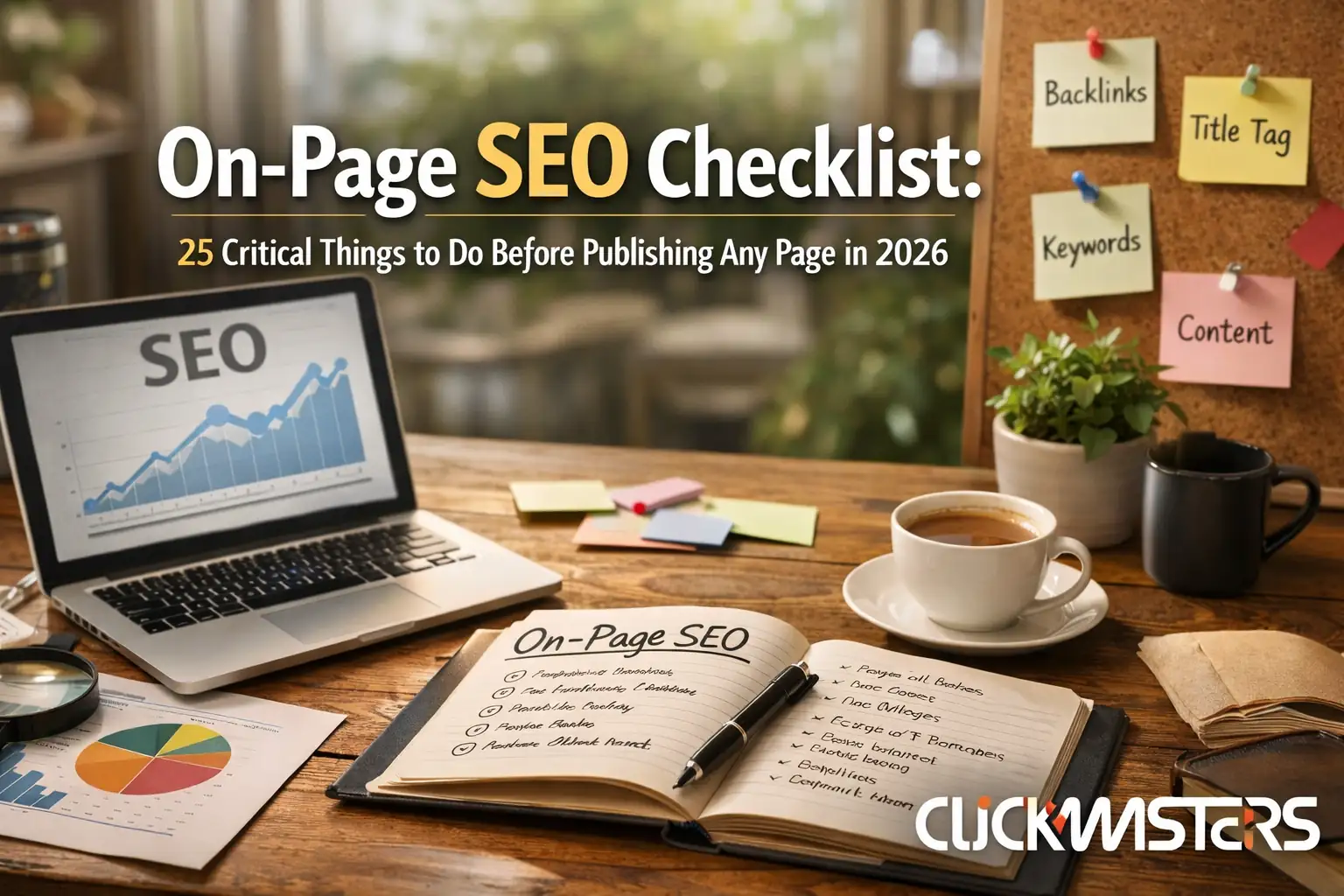
This checklist is the exact pre-publish process the Clickmasters SEO team follows before publishing any page for any client. It’s split into 5 sections covering all dimensions of on-page optimization. Work through it methodically, and every page you publish will start life with a significant ranking advantage over the competition.
On-page SEO does not work in isolation. To get the best results, it needs to be backed by a strong overall strategy. That is where Digital Marketing Services come in — combining SEO, content marketing, and audience targeting to drive real, measurable growth. When your on-page efforts are aligned with a broader digital strategy, every page you publish has a much higher chance of ranking and converting.
Table of Contents
| HOW TO USE THIS | Print this checklist or bookmark it. Work through each item before hitting ‘publish’ on any new page. For existing pages, use it as an audit framework — check every page on your site and prioritize fixing items marked ‘Critical’ first. |
The Impact of On-Page SEO: By the Numbers
| 67%more traffic on fully optimized pages vs partial | 5.8xmore clicks with optimized title tags & meta descriptions | 36%of ranking factors are on-page elements (Moz 2025) |
| 3.4saverage load time of top-ranking pages (Google) | 78%of AI Overview citations come from well-structured content | 2.1xhigher CTR from pages with schema markup vs those without |
Sources: Backlinko 2025, Moz State of SEO 2025, Google Search Central
| �� CATEGORY 1: Keyword & Search Intent Optimization (5 items items) |
Before a single word of content is written, you must be absolutely clear on what keyword this page is targeting and — more importantly — what the searcher behind that keyword actually wants to find. A technically perfect page targeting the wrong intent will never rank.
| 01 | Define Your Primary Keyword and Search IntentEvery page must target exactly ONE primary keyword. Identify it before writing. Then determine the search intent: is the searcher looking for information (informational), comparing options (commercial), ready to buy (transactional), or navigating to a specific site (navigational)? Your content format, depth, and CTA must match the intent perfectly. A transactional page should convert, not educate. An informational page should answer comprehensively, not sell aggressively. | PRIORITYCritical |
| 02 | Validate Search Volume and Keyword DifficultyUse Ahrefs, Semrush, or Google Keyword Planner to verify that your target keyword has meaningful monthly search volume (minimum 100 searches/month for niche B2B, 500+ for general topics). Check keyword difficulty (KD) against your site’s current domain authority. A brand-new site targeting KD 70+ keywords is setting itself up for failure. Prioritize keywords where your site can realistically compete within 3-6 months. | PRIORITYCritical |
| 03 | Identify 3-5 Semantic/LSI Keywords to Include. Naturally, Latent Semantic Indexing (LSI) keywords are conceptually related terms that Google expects to see on a page about your topic. If your primary keyword is ‘logistics software Pakistan,’ semantic keywords include: ‘supply chain management,’ ‘inventory tracking,’ ‘warehouse system,’ ‘fleet management.’ Use tools like Surfer SEO, SEMrush’s Topic Research, or simply look at Google’s ‘People Also Ask’ and ‘Related Searches’ to identify these terms. Weave them naturally into your content — never force them. | PRIORITYHigh |
| 04 | Analyze the Top 5 Ranking Pages Before WritingOpen an incognito browser and search for your target keyword. Look at the top 5 results and ask: What content format are they using (list, guide, video, comparison)? How long are they? What subtopics do they cover? What questions do they answer? What are they missing? Your page needs to be demonstrably better than these pages on at least three dimensions to outrank them. Never write blind. | PRIORITYHigh |
| 05 | Check for Keyword Cannibalization on Your Own SiteKeyword cannibalization happens when two or more pages on your site target the same primary keyword, causing them to compete against each other and dilute your ranking signals. Before publishing, search ‘site:yoursite.com [your target keyword]’ in Google. If existing pages appear targeting the same term, you have two choices: consolidate them into one comprehensive page, or clearly differentiate the intent of each page so they target distinct sub-queries. | PRIORITYMedium |
| �� CATEGORY 2: Title Tag, Meta Description & URL (5 items) |
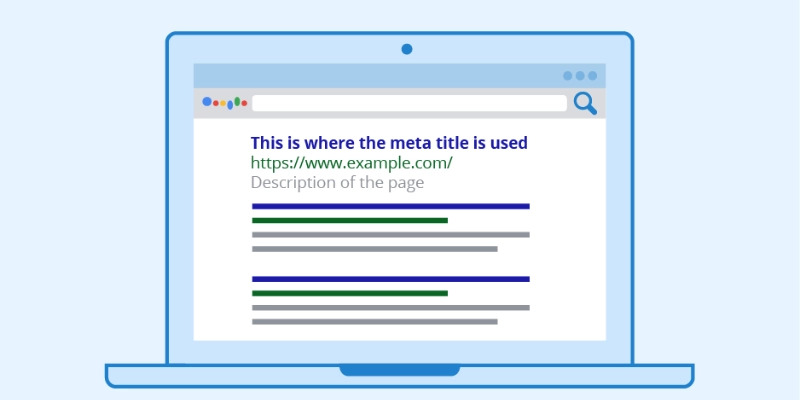
Your title tag, meta description, and URL are the three elements that appear in search results — before any user has visited your page. They determine your click-through rate as much as your ranking. A poorly written title at position #3 will often get fewer clicks than a compelling title at position #5.
| 06 | Write a Click-Worthy Title Tag (50-60 Characters)The title tag is the most heavily weighted on-page SEO element after the content itself. Include your primary keyword as close to the beginning as possible. Keep it under 60 characters (Google truncates longer titles in search results). Make it compelling — it’s a headline competing for attention on a page with 9 other results. For 2026, front-load the benefit or the specific number: ’25-Point On-Page SEO Checklist (2026)’ outperforms ‘On-Page SEO Tips for Beginners.’ Never keyword-stuff — write for humans first. | PRIORITYCritical |
| 07 | Write a Persuasive Meta Description (150-160 Characters). Meta descriptions don’t directly affect rankings, but they massively affect CTR, which does affect rankings (through Google’s user engagement signals). Write your meta description as a mini-advertisement: include your primary keyword (Google bolds it in results when it matches the search query), communicate the specific value the page delivers, and include a soft call-to-action (‘Learn how,’ ‘Discover,’ ‘Get the full guide’). Stay under 160 characters. Every character counts. | PRIORITYCritical |
| 08 | Create a Clean, Keyword-Rich URL SlugYour URL slug should be short, descriptive, and contain your primary keyword. Use hyphens to separate words (not underscores). Remove stop words (a, the, and, of, in) to keep slugs concise. Good: /on-page-seo-checklist — Bad: /blog/2026/01/15/complete-on-page-seo-checklist-for-beginners-2026. Once a URL is indexed and has backlinks, avoid changing it — URL changes require 301 redirects and can cause temporary ranking drops. | PRIORITYHigh |
| 09 | Set a Canonical Tag to Prevent Duplicate Content. If your page can be accessed via multiple URLs (e.g., with/without trailing slash, with/without www, via different parameter strings), you must set a canonical tag pointing to your preferred URL. This tells Google which version of the page to index and attribute all ranking signals to. In WordPress, RankMath and Yoast handle this automatically. On custom sites, add <link rel=’canonical’ href=’https://yoursite.com/preferred-url’> in your <head>. | PRIORITYHigh |
| 10 | Verify Open Graph & Social Meta Tags. Open Graph tags control how your page looks when shared on Facebook, LinkedIn, Twitter/X, and WhatsApp. Without them, social shares use random images and truncated titles — dramatically reducing social engagement. Set og:title, og:description, og:image (minimum 1200x630px), and og:type. For blog posts, og: type should be ‘article.’ Twitter requires separate Twitter: card, Twitter: title, and Twitter: image tags. This takes 5 minutes and significantly impacts referral traffic quality. | PRIORITYMedium |
| ✍️ CATEGORY 3: Content Quality & Structure (7 items items) |
Content is where rankings are won and lost at the highest level. Technical SEO and links can amplify great content — but they cannot rescue fundamentally weak content. Google’s Helpful Content System specifically demotes sites with content that prioritizes search engines over genuine human value. Write for people who have a real problem your page genuinely solves.
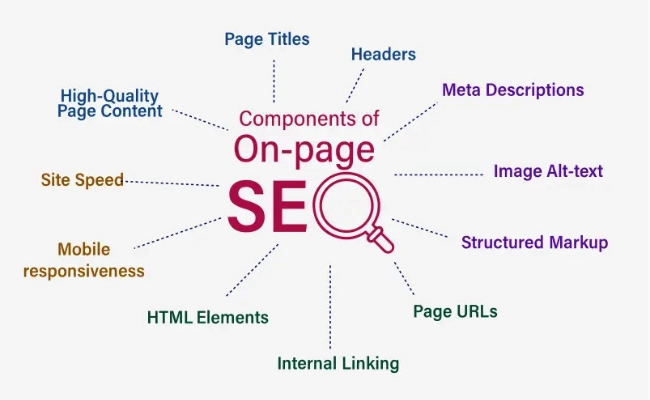
| 11 | Nail the H1 Tag — One Per Page, Keyword Included. Your H1 is the most prominent heading on your page and carries significant SEO weight. Every page must have exactly one H1 — no more, no less. It should contain your primary keyword (not necessarily verbatim — close variants are fine), be distinct from your title tag (they don’t have to be identical — your H1 can be more descriptive), and clearly communicate what the page is about within 2 seconds of scanning. Weak H1: ‘Our Services.’ Strong H1: ‘Logistics Software Built for Pakistani SMEs.’ | PRIORITYCritical |
| 12 | Use a Logical H2/H3 Heading Hierarchy. Your heading structure is both an SEO signal and a user experience element. H2 tags are your major section headers — each should ideally include a secondary keyword or a question phrase (questions naturally match ‘People Also Ask’ boxes). H3 tags are sub-sections within H2 sections. Never use heading tags purely for visual styling — use them to organize content hierarchically. A well-structured page’s headings should read like a table of contents. Screen readers, featured snippet algorithms, and AI search engines all rely on heading structure to understand your content. | PRIORITYCritical |
| 13 | Write Content That Fully Satisfies the Search Intent. Content depth is not about word count — it’s about completeness. A 5,000-word article that never answers the actual question is worse than a 1,200-word article that answers it precisely and thoroughly. That said, for most competitive keywords in 2026, comprehensive coverage (1,500-3,500 words for guides, 800-1,500 for blog posts, 600-1,200 for service pages) signals topical expertise. Use the top-ranking pages as your depth benchmark and aim to be more complete, more specific, and more expert than any of them. | PRIORITYCritical |
| 14 | Include Your Primary Keyword in the First 100 Words. Google gives greater weight to keyword mentions that appear early in the page content. Include your primary keyword naturally within the first paragraph — ideally within the first 100 words. This is a confirmed ranking signal, not an old myth. It should appear once in the opening naturally, not stuffed awkwardly. Write the intro that immediately delivers value and includes the keyword organically — this also helps with bounce rate because visitors see immediately that they’re on the right page. | PRIORITYHigh |
| 15 | Add Unique Data, Research, or Original Insights. Pages that contain original data, unique insights, or proprietary research earn significantly more backlinks and featured snippet placements than pages that simply restate commonly available information. This is a direct EEAT (Experience, Expertise, Authoritativeness, Trustworthiness) signal. You don’t need to run a formal research study — an original analysis, a client case study result, a counter-intuitive perspective backed by evidence, or even a curated data point not commonly cited is enough to differentiate your content. | PRIORITYHigh |
| 16 | Write a Clear, Structured FAQ Section. FAQ sections are among the most powerful on-page elements for capturing featured snippets, People Also Ask placements, and AI search citations. Write 5-8 questions in the exact phrasing that searchers use (use Google’s ‘People Also Ask’ boxes and Semrush’s question keyword reports to find these). Answer each question directly and concisely — ideally in 40-80 words. Apply the FAQPage schema markup to the section. A well-structured FAQ section can rank for dozens of additional long-tail keywords with zero additional content creation. | PRIORITYHigh |
| 17 | Ensure Readability: Short Paragraphs, Clear Language. Online readers scan before they read. Structure your content for scanners: keep paragraphs to 2-4 sentences maximum, use subheadings every 200-300 words, bold key phrases (not random words), use bullet points for lists of 4+ items, and maintain a reading level accessible to your audience. Use the Hemingway App or Grammarly’s readability score to benchmark. For most business content, aim for a Grade 8-10 reading level. Complex technical content can go higher — but never use complexity as a substitute for clarity. | PRIORITYMedium |
| ⚙️ CATEGORY 4: Technical On-Page Elements (5 items) |
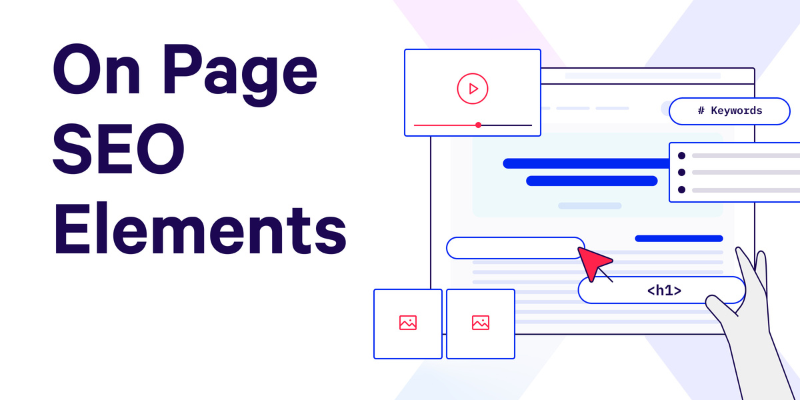
Technical on-page elements are the behind-the-scenes optimizations that search engines use to understand, index, and rank your content. These items are non-negotiable — even the most brilliant content will underperform if technical on-page elements are missing or broken.
| 18 | Optimize All Images: Alt Text, File Names & Compression. Images are invisible to search engines without proper optimization. Every image needs: (1) a descriptive alt text containing a relevant keyword where natural (‘warehouse-management-software-dashboard’ not ‘image1.jpg’), (2) a descriptive file name before uploading (dashboard-logistics.webp not IMG_0034.jpg), (3) compression — use WebP format (30-50% smaller than PNG/JPEG with equivalent quality) and compress to under 100KB for blog images. Unoptimized images are one of the leading causes of poor Core Web Vitals scores, which directly impact rankings. | PRIORITYCritical |
| 19 | Add Schema Markup Appropriate to Your Page Type. Schema markup (structured data) is the most underused on-page SEO element among Pakistani businesses — which makes it one of the highest-leverage opportunities right now. Match your schema type to your page: Article schema for blog posts, FAQPage schema for FAQ sections, HowTo schema for tutorial content, Product schema for product pages, LocalBusiness schema for location pages, Review/AggregateRating schema for pages with ratings, BreadcrumbList schema sitewide. Test your schema with Google’s Rich Results Test before publishing. AI search engines like Perplexity heavily prioritize schema-structured content for citation. | PRIORITYCritical |
| 20 | Verify Mobile Responsiveness Across Devices. Google uses mobile-first indexing — it primarily crawls and ranks the mobile version of your page. Test every page on Google’s Mobile-Friendly Test tool (search.google.com/test/mobile-friendly) before publishing. Check: text is readable without zooming, buttons and links are easily tappable (minimum 44x44px touch targets), content doesn’t overflow horizontally, form fields work correctly on mobile keyboard inputs, and load time on mobile 3G is under 3 seconds. A page that works perfectly on desktop but breaks on mobile will rank below its mobile-optimized competitors. | PRIORITYCritical |
| 21 | Check Page Speed — Core Web Vitals Must Be Green. Page speed is a confirmed Google ranking factor and a direct conversion rate driver. Run your page through Google PageSpeed Insights and Google Search Console’s Core Web Vitals report. Aim for: LCP (Largest Contentful Paint) under 2.5 seconds, FID/INP (Interaction to Next Paint) under 200ms, CLS (Cumulative Layout Shift) under 0.1. Common fixes: enable browser caching, use a CDN, compress images to WebP, defer non-critical JavaScript, and remove unused CSS. Every 1-second improvement in load time increases conversions by approximately 7%. | PRIORITYCritical |
| 22 | Set Up Internal Linking — Both To and From This Page. Internal links serve two purposes: they pass ‘link equity’ (ranking power) between pages, and they help Google’s crawlers discover and understand the relationship between your pages. Before publishing, do two things: (1) Link FROM this new page to 2-4 relevant existing pages on your site using descriptive anchor text containing keywords, and (2) go back to your 3-5 most relevant existing pages and add a link TO this new page using keyword-rich anchor text. The second step is commonly skipped, and it’s critical — new pages with zero internal links pointing to them are effectively invisible to Google. | PRIORITYHigh |
| �� CATEGORY 5: AI Search & GEO Optimization (3 items) |
Generative Engine Optimization (GEO) is the newest dimension of on-page SEO — and the one most businesses are completely ignoring. AI search engines like Perplexity, ChatGPT’s search mode, and Google’s AI Overviews are rapidly growing as traffic sources. The content that gets cited in AI answers follows predictable structural patterns. These three items specifically optimize for AI search citation.
| 23 | Write Direct-Answer Paragraphs for AI Citation. AI search engines extract and cite specific passages from web pages — not entire articles. To be cited, your content must contain clear, self-contained passages that directly answer specific questions. Immediately after each major H2 heading, write a 40-80-word direct-answer paragraph that summarizes the key point without requiring context from surrounding text. This is sometimes called a ‘position zero paragraph’ — it’s written for the AI to extract and quote, while the surrounding detailed content serves the human reader who clicks through. | PRIORITYCritical |
| 24 | Add Precise Data Points, Dates & Attribution. AI search engines prioritize content with verifiable, specific data over vague generalizations. Include: precise statistics with source attribution (‘According to HubSpot’s 2025 State of Marketing report, 67% of marketers…’), specific dates and timeframes, named methodologies and frameworks, and quantified outcomes. Sentences like ‘AI search is growing quickly’ will not be cited. Sentences like ‘Perplexity reached 15 million daily active users by Q3 2025, a 380% increase year-on-year (TechCrunch, 2025)’ will be. Be the source of specificity in your industry. | PRIORITYHigh |
| 25 | Structure Content With E-E-A-T Signals Throughout E-E-A-T (Experience, Expertise, Authoritativeness, Trustworthiness) is Google’s content quality framework — and it’s increasingly influencing AI search citation decisions. On every page: include author name and credentials (a named expert beats ‘Staff Writer’ every time), link to authoritative external sources for claims, include first-person experience signals where relevant (‘In our work with 150+ clients, we’ve found…’), cite your company’s credentials and track record, use precise industry terminology that demonstrates domain expertise, and include a clear publication date and ‘last updated’ date. EEAT is not a checkbox — it’s embedded throughout the content. | PRIORITYCritical |
The Full Checklist at a Glance: All 25 Items
Use this table as your pre-publish checklist. Print it, screenshot it, or add it to your content team’s Notion/Asana workflow.
| # | Checklist Item | Category | Priority |
| 01 | Define Primary Keyword & Search Intent | Keyword & Intent | Critical |
| 02 | Validate Search Volume & Difficulty | Keyword & Intent | Critical |
| 03 | Identify 3-5 LSI/Semantic Keywords | Keyword & Intent | High |
| 04 | Analyze Top 5 Ranking Pages | Keyword & Intent | High |
| 05 | Check for Keyword Cannibalization | Keyword & Intent | Medium |
| 06 | Write Click-Worthy Title Tag (50-60 chars) | Title, Meta & URL | Critical |
| 07 | Write Persuasive Meta Description (150-160) | Title, Meta & URL | Critical |
| 08 | Create a Clean, Keyword-Rich URL Slug | Title, Meta & URL | High |
| 09 | Set Canonical Tag | Title, Meta & URL | High |
| 10 | Verify Open Graph & Social Meta Tags | Title, Meta & URL | Medium |
| 11 | Nail H1 Tag — One Per Page, Keyword Included | Content & Structure | Critical |
| 12 | Use Logical H2/H3 Heading Hierarchy | Content & Structure | Critical |
| 13 | Fully Satisfy the Search Intent | Content & Structure | Critical |
| 14 | Include Primary Keyword in First 100 Words | Content & Structure | High |
| 15 | Add Unique Data, Research or Original Insights | Content & Structure | High |
| 16 | Write a Clear FAQ Section | Content & Structure | High |
| 17 | Ensure Readability — Short Paras, Clear Language | Content & Structure | Medium |
| 18 | Optimize Images: Alt Text, Filenames & Compression | Technical On-Page | Critical |
| 19 | Add Schema Markup for Your Page Type | Technical On-Page | Critical |
| 20 | Verify Mobile Responsiveness | Technical On-Page | Critical |
| 21 | Core Web Vitals Must Be Green | Technical On-Page | Critical |
| 22 | Set Up Internal Linking (Both Directions) | Technical On-Page | High |
| 23 | Write Direct-Answer Paragraphs for AI Citation | AI / GEO | Critical |
| 24 | Add Precise Data Points, Dates & Attribution | AI / GEO | High |
| 25 | Build E-E-A-T Signals Throughout Content | AI / GEO | Critical |
Going Beyond the Checklist: Advanced On-Page Optimization
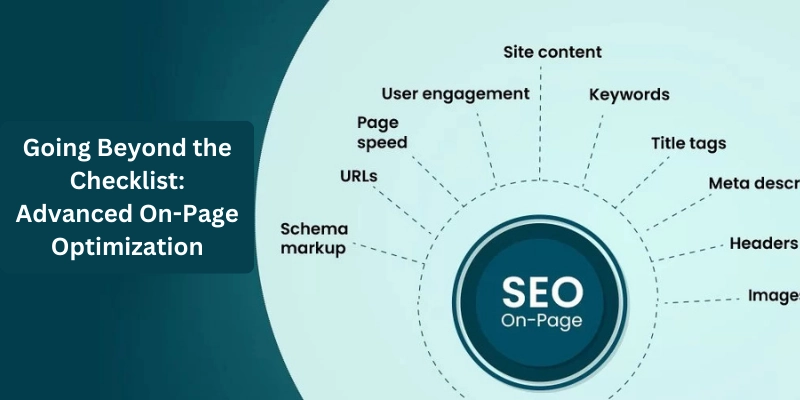
Once you’ve mastered all 25 items above, these advanced techniques will push your pages to the top of competitive SERPs and keep them there.
Content Refreshing: The Most Underrated SEO Activity
Publishing great content is not a one-and-done activity. Google’s algorithm actively tracks content freshness — a page that was last updated in 2023 is increasingly at a disadvantage against a competitor who updated theirs in 2025. Every 6-12 months, revisit your highest-traffic pages and ask: Are all statistics current? Have any tools, platforms, or processes referenced changed? Are there new subsections worth adding based on related keyword opportunities? Can the FAQ section be expanded? Refreshing content consistently outperforms publishing brand-new content for maintaining and growing rankings on established pages.
Content Depth vs. Competing Pages: The Skyscraper Mindset
The Skyscraper Technique, coined by Brian Dean of Backlinko, is a simple framework: find the best-performing content for your target keyword, create something measurably better, then promote it. ‘Better’ means: more comprehensive (covers more subtopics), more specific (includes original data and examples rather than generalities), more current (includes 2026 data and trends), more usable (better formatting, clearer structure, more actionable advice), and more trustworthy (stronger EEAT signals). Content that is the definitive resource on a topic earns rankings and backlinks passively over time.
Conversion Optimization Within SEO Pages
The best on-page SEO strategy in the world only produces revenue if traffic converts into leads or sales. Embed conversion elements within your content naturally: inline CTAs relevant to the specific section a reader is in (don’t just put a CTA in the header and footer), lead magnets that extend the value of the content (a downloadable checklist version of a blog post, for example), exit-intent offers for high-bounce-rate pages, and social proof elements (client quotes, case study links, trust badges) near conversion points. Treat every page as a conversion asset, not just a ranking asset.
| CLICKMASTERS CHECKLIST PRINCIPLE | We apply all 25 items on this checklist before publishing any page for any client. The result: our clients’ pages consistently outrank competitor pages published around the same time, with the same domain authority, because they’re better optimized across every dimension from day one. |
Conclusion: On-Page SEO Is Your Controllable Competitive Advantage
Link building takes months. Technical SEO infrastructure requires developers. But on-page SEO? That’s entirely in your hands, and every single page you publish is an opportunity to do it right from day one.
The 25 items on this checklist are not theoretical — each is a ranking factor, a user experience improvement, or an AI search citation signal with documented impact on organic performance. Businesses that apply them consistently, on every piece of content they publish, build a compounding SEO advantage that competitors playing fast and loose cannot easily overcome.
At Clickmasters, we follow this exact checklist for every client page we publish. The result is content that ranks faster, ranks higher, and generates qualified traffic for longer than pages that skipped the fundamentals. If you want us to apply this framework to your website, start with a free SEO audit.
Get a Free On-Page SEO Audit from Clickmasters

Get a Free Consultation Call
We’ll run your website through all 25 items on this checklist and show you exactly which issues are suppressing your rankings — and how to fix them.
Frequently Asked Questions About On-Page SEO
How long should a blog post be for SEO in 2026?
A: Word count is secondary to completeness. That said, for competitive informational keywords, 1,500-3,500 words are typically required to cover a topic comprehensively enough to rank. For transactional/commercial pages (service pages, product pages), 800-1,500 words is usually sufficient. Never pad content to hit an arbitrary word count — Google’s Helpful Content System specifically demotes content that appears written for length rather than value.
How often should I update my on-page SEO?
A: Review and refresh your top 20 organic traffic pages every 6 months. Update statistics, add new examples, expand FAQ sections, and check for broken links. For fast-moving industries (tech, finance, digital marketing), quarterly refreshes are advisable. For more stable industries, annual refreshes are sufficient.
Does keyword density still matter in 2026?
A: Keyword density (the percentage of times a keyword appears in your content) is no longer a meaningful optimization metric. Google’s NLP algorithms understand context and semantic meaning — they don’t count keyword frequencies. Focus on natural, contextually relevant keyword usage rather than hitting any specific density percentage. If a keyword appears in your title, H1, first paragraph, a few subheadings, and naturally throughout the body, you’re sufficiently optimized.
What is the most important on-page SEO element?
A: Content quality and search intent match are the most important on-page elements in 2026, above title tags, meta descriptions, and even schema markup. A page that perfectly satisfies the searcher’s intent will rank even if other on-page elements are imperfect. A technically perfect page with mediocre, unhelpful content will not rank well regardless of how meticulously it’s optimized.
Can I do on-page SEO without technical knowledge?
A: Yes — most on-page SEO can be done through your CMS (WordPress with RankMath or Yoast, Webflow, Shopify, etc.) without touching code. Schema markup is the exception — it requires either a plugin (RankMath handles it automatically for most page types) or manual JSON-LD implementation. If you’re on a custom site without schema plugin support, contact your developer or Clickmasters.
How quickly will on-page SEO improvements show results?
A: Technical fixes (page speed, mobile responsiveness) can show ranking improvements within 2-4 weeks once Google recrawls your pages. Content improvements and new content typically take 6-16 weeks to show meaningful ranking movements. Schema markup improvements can appear in search results within days. Internal linking improvements show gradual effects over 4-8 weeks.