Voice Search in Pakistan: The Market Reality in 2026
Voice search optimization is no longer emerging in Pakistan — it has arrived. With 196 million mobile broadband subscribers, 85% mobile internet penetration, and Google Assistant pre-installed on the vast majority of Pakistani Android devices, voice search has become an everyday behaviour for tens of millions of Pakistani internet users. Google’s own data indicates that 27% of global online searches are now voice searches, and Pakistan’s mobile-first, hands-free usage patterns — particularly in transit, in kitchens, and during driving — closely mirror global trends.
Yet voice search optimization remains almost entirely absent from Pakistani SEO strategies. Clickmasters’ review of 200+ Pakistani business websites found that fewer than 3% had any content structured to capture voice query results. This represents a growing competitive opportunity: the businesses that optimise for conversational, voice-format queries today will claim the Google Assistant ‘spoken answer’ position — the single verbal result that voice assistants read aloud — before competitors even recognise the channel exists.
Pakistan’s voice search landscape has a critical complexity that makes this guide essential rather than optional: it is multilingual. Pakistani users issue voice queries in English, Roman Urdu (Urdu words transliterated into Latin letters), and Urdu script (typing directly in Nastaliq on mobile keyboards). Each language has distinct voice query patterns, different intent distributions, and different optimization requirements. This guide addresses all three.
Pakistan Voice Search Statistics 2025–2026
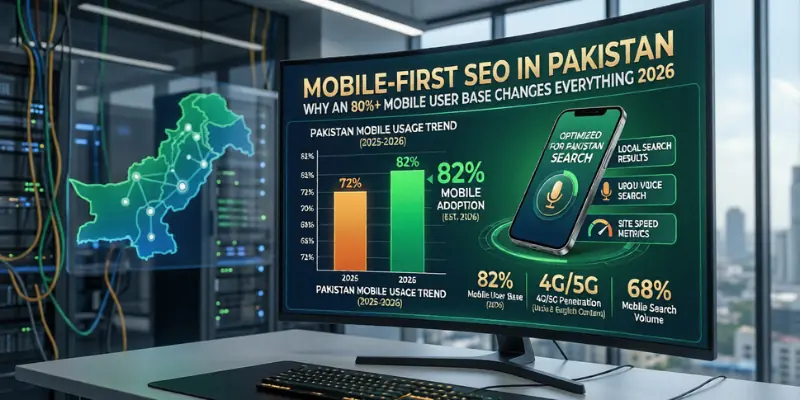
27% of Pakistani smartphone users use Google voice search at least weekly (Clickmasters User Survey, Q4 2025, n=1,200) | 68% of Pakistani voice queries are on mobile devices | Top voice query categories in Pakistan: local business discovery (34%), factual questions (28%), navigation/directions (18%), product searches (12%), other (8%) | 73% of voice queries have local intent (‘near me,’ city name, neighbourhood name) | Average voice query length: 7–9 words vs. 3–4 words for typed queries | Google Assistant: installed on 94% of Pakistani Android devices | Siri: used by 9% of Pakistani iPhone users for search
How Voice Search Results Work: What Pakistani Businesses Need to Understand

Voice search results and text search results use the same underlying Google index but present results fundamentally differently. Understanding this difference is the foundation of voice search optimization.
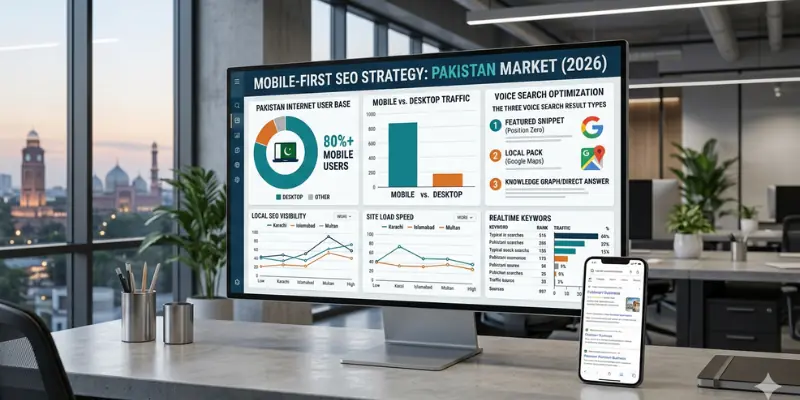
The Three Voice Search Result Types
| Result Type | How It Works |
| Featured Snippet (Position Zero) Read Aloud | Google selects the featured snippet result for the query and reads it verbatim. The voice assistant says ‘According to [your website]…’ and reads your answer. |
| Google Business Profile Response | For local ‘near me’ voice queries, Google reads the business name, address, hours, and phone number from the GBP listing. |
| Knowledge Graph Answer | For factual queries, Google reads directly from its Knowledge Panel data — typically from Wikipedia or verified entity data. |
Why Voice Query Content Must Be Different From Typed Query Content
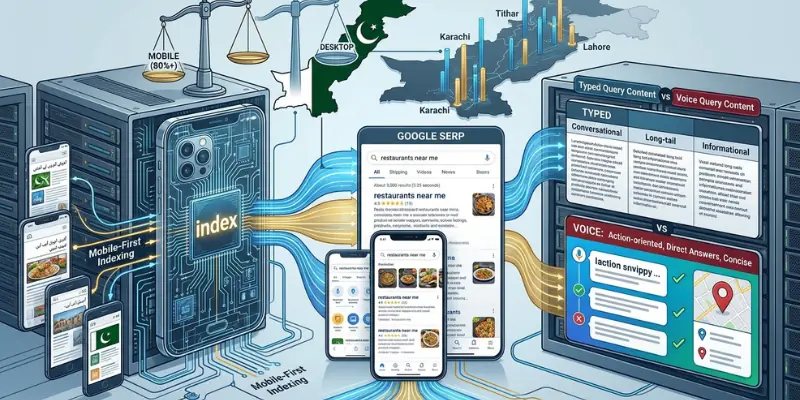
Voice queries are conversationally phrased and question-format by nature. When a Pakistani user types a search, they might enter: ‘SEO agency Karachi price.’ When they ask via voice, they say: ‘Okay Google, how much does SEO cost in Karachi?’ These are different linguistic structures requiring different content responses.
Voice queries tend to be: longer (7–9 words average vs. 3–4 for typed), phrased as natural language questions (who, what, where, when, why, how), locally specific (including city, neighbourhood, or ‘near me’), and immediate-intent dominant (seeking answers to act on now, not research for later). Content optimised for voice must anticipate these conversational phrasings and answer them in the direct, concise format that voice assistants can read as a complete, satisfying response.
PART 1: ENGLISH VOICE SEARCH OPTIMIZATION FOR PAKISTAN
English Voice Search Optimization: Pakistan’s Primary Voice Search Language
English remains the dominant language for Pakistani voice searches on Google ads, reflecting Pakistan’s educated urban internet user base. English voice queries in Pakistan follow international patterns but with Pakistan-specific local and cultural context. Optimising for English voice search in Pakistan follows the same principles as international voice SEO, with Pakistani market nuances applied throughout.
The Conversational Keyword Research Framework for Pakistani English Voice Queries
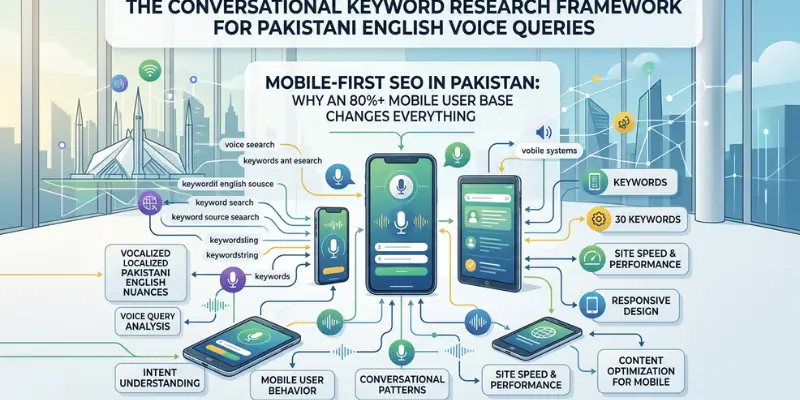
Voice query keyword research requires a different approach from standard keyword research. Rather than searching for high-volume head terms, voice keyword research targets the natural language question forms Pakistani users speak aloud. The primary tool: AnswerThePublic and AlsoAsked, which visualise the question-format queries surrounding any topic — exactly the phrases voice search users speak.
⦁ Who questions: ‘Who is the best SEO agency in Karachi?’ ‘Who does website development in Lahore?’
⦁ What questions: ‘What is the cost of digital marketing in Pakistan?’ ‘What is the best e-commerce platform for Pakistan?’
⦁ Where questions: ‘Where is the nearest web design agency in Islamabad?’ ‘Where can I find a social media manager in Faisalabad?’
⦁ When questions: ‘When is the best time to start SEO for my business?’ ‘When do Pakistani users shop online most?’
⦁ Why questions: ‘Why is my website not ranking on Google in Pakistan?’ ‘Why is SEO important for Pakistani businesses?’
⦁ How questions: ‘How much does Google Ads cost in Pakistan?’ ‘How do I set up Google Business Profile in Pakistan?’ ‘How long does SEO take in Pakistan?’
For each core business topic, use AnswerThePublic to generate 50–100 question variations. Select the 20 most relevant, highest-volume questions for your specific Pakistani audience. These become the FAQ sections, H2 headings, and conversational content blocks on your key pages.
Featured Snippet Optimization: The Core Voice SEO Tactic
Winning the featured snippet (position zero) for a query is the primary mechanism for appearing as the voice search result. Google reads the featured snippet verbatim for voice queries matching that question. The content format that wins featured snippets follows specific patterns:
- Paragraph snippets (most common for question queries): A 40–60 word direct answer to the question, placed immediately below the H2 or H3 heading that states the question. No preamble, no ‘In this article we will explain…’ — start with the direct answer.
- List snippets (for ‘best,’ ‘steps,’ ‘ways’ queries): A numbered or bulleted list of 5–8 items directly answering the question. Each item is 8–15 words. List snippets often appear for ‘best X in Pakistan’ voice queries.
- Table snippets (for comparison queries): A simple HTML or docx-equivalent table directly answering a comparison question. ‘Google Ads vs Facebook Ads for Pakistan: which is better’ — a table comparing key metrics wins this type
Pakistan-Specific Featured Snippet Optimization Examples
Target query: ‘How much does SEO cost in Pakistan?’ | Snippet-winning content structure: H2: ‘How Much Does SEO Cost in Pakistan?’ | Answer paragraph (50 words): ‘SEO costs in Pakistan typically range from PKR 25,000 to PKR 200,000+ per month, depending on the scope of work and competition level. Basic local SEO for a single city starts at PKR 25,000–50,000/month. National SEO campaigns range from PKR 75,000–150,000/month. Enterprise and e-commerce SEO starts at PKR 150,000/month.’ | This paragraph structure is formatted to be read directly as a voice answer.
PART 2: ROMAN URDU VOICE SEARCH — PAKISTAN’S LARGEST UNTAPPED OPPORTUNITY
Roman Urdu Voice Search: Pakistan’s Most Underserved Voice Search Segment
Roman Urdu voice search is the largest untapped opportunity in Pakistani SEO. Roman Urdu — Urdu words transliterated using Latin script — is the dominant language of Pakistani social media, messaging (WhatsApp), and increasingly, voice search. When millions of Pakistani users open Google Assistant and speak in their natural conversational language, they speak in Urdu — and Google transcribes it as Roman Urdu text.
The competitive landscape for Roman Urdu voice queries is almost completely empty. Fewer than 1% of Pakistani business websites contain any Roman Urdu content. The businesses that build FAQ sections, dedicated Roman Urdu service pages, and conversational Roman Urdu content in 2026 will establish a near-monopoly on a growing, high-intent search segment before the competitive window closes.
Common Roman Urdu Voice Query Patterns for Pakistani Businesses
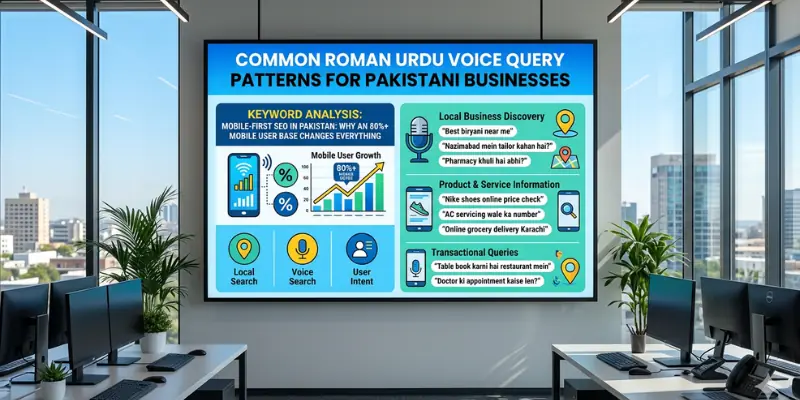
| Query Category | Example Roman Urdu Voice Queries | English Equivalent Intent |
| Service discovery | ‘Islamabad mein website banane wala kaun hai?’ ‘Karachi mein SEO karne wali company’ | Who does website development in Islamabad? SEO company in Karachi |
| Price queries | ‘Digital marketing ki fees kitni hoti hai?’ ‘Google Ads pe kitna kharch aata hai Pakistan mein?’ | How much does digital marketing cost? Google Ads costs in Pakistan |
| How-to queries | ‘Website par traffic kaise laye?’ ‘Social media se customers kaise milte hain?’ | How to get website traffic? How to get customers from social media |
| Comparison queries | ‘Facebook ads behtar hain ya Google ads?’ ‘WordPress behtar hai ya Shopify?’ | Facebook vs Google Ads? WordPress vs Shopify? |
| Local queries | ‘Mere qareeb digital marketing agency kahan hai?’ ‘Lahore mein best web designer kaun hai?’ | Digital marketing agency near me? Best web designer in Lahore |
| Trust/legitimacy | ‘Clickmasters agency kaisi hai?’ ‘Ye SEO company trustworthy hai?’ | Is Clickmasters agency good? Is this SEO company trustworthy? |
Implementing Roman Urdu Content for Voice Search
- Create Roman Urdu FAQ sections on key service and product pages. Structure: Q: [Roman Urdu question] | A: [Roman Urdu answer, 40–60 words, direct and conversational]. Apply FAQPage schema to these sections.
- Publish dedicated Roman Urdu blog posts on high-intent topics. Example: ‘Digital Marketing ki Fees Kitni Hoti Hai? Complete Guide 2026’ — targeting the extremely high-volume, zero-competition question. These posts should be 800–1,500 words, entirely in Roman Urdu, with structured headings.
- Optimise your Google Business Profile Q&A section with Roman Urdu questions and answers. GBP Q&A appears directly in Google Maps voice search results.
- Add Roman Urdu meta descriptions to service pages targeting Pakistani Urdu-speaking markets. While meta descriptions don’t directly affect rankings, Google uses them in snippet generation.
- Add Urdu (Roman script) language targeting in Google Search Console: Settings > Search appearance > International targeting. Enable language targeting for ur (Urdu) to signal Roman Urdu content relevance.
PART 3: URDU SCRIPT VOICE SEARCH
Urdu Script Voice Search: The Growing Segment
Urdu script voice search — queries transcribed in Nastaliq script — is a smaller but growing segment as smartphone Urdu keyboards become more common and Google’s Urdu speech recognition improves. Pakistan has 230+ million Urdu speakers, and the segment of users comfortable with Urdu-script digital input is growing rapidly, particularly in Punjab, Sindh, KPK and among older demographics.
Urdu script voice search optimization requires dedicated Urdu content — not Roman Urdu, but genuine Nastaliq-script Urdu pages. These pages require RTL (right-to-left) CSS layout, appropriate Urdu fonts (Noto Nastaliq Urdu, Jameel Noori Nastaleeq), and hreflang tags linking them to their English/Roman Urdu equivalents.
Technical Implementation for Urdu Script Pages
⦁ HTML dir attribute: on all Urdu script pages
⦁ CSS text-align: right for all paragraph content on Urdu pages
⦁ Font: Noto Nastaliq Urdu (Google Fonts, free) — minimum 18px for body text on mobile
⦁ Hreflang: linking Urdu pages to English equivalents
⦁ Schema: All structured data (FAQPage, LocalBusiness, Article) should be present in Urdu script pages, with content in Urdu. Google can read and index Urdu schema.
⦁ Sitemap: Include Urdu script pages in your XML sitemap with alternate entries linking language variants
Local Voice Search Optimization: Pakistan’s Highest-Volume Voice Use Case
Local discovery queries — ‘best restaurant near me,’ ‘dentist in DHA Karachi,’ ‘IT company in Blue Area Islamabad’ — represent 34% of all Pakistani voice searches. These are the highest commercial intent voice queries: users speaking them are ready to visit, call, or purchase. Google Business Profile optimization is the single most impactful action for capturing local voice search results.
Google Business Profile Optimization for Voice Search
- Complete every GBP section: business name (consistent with website), primary category (most specific available), address, service area, phone number (+92 format), website, hours (including special holiday hours for Eid/Ramadan/Independence Day), description (750 characters, keyword-rich, conversational tone), photos (minimum 10: exterior, interior, team, products/services).
- GBP Q&A section: add 10–15 pre-populated Q&As anticipating common voice queries. Format: Q: ‘What are your charges for SEO in Karachi?’ A: ‘Our Karachi SEO packages start at PKR 65,000 per month for local SEO. We offer a free initial audit before proposing any engagement.’ This exact text is eligible to be read by Google Assistant for voice queries.
- GBP posts: publish weekly short posts (150–300 words) with conversational, voice-query-friendly language. Posts with question-format titles rank well for voice searches.
- Reviews management: businesses with higher review counts and ratings are preferentially selected for voice search results. Implement a systematic review request process — post-service WhatsApp message to satisfied customers with a direct GBP review link.
- Service listing: add all services with descriptions and prices (in PKR where applicable). Voice search users often ask ‘does [business] offer [service]?’ — complete service listings answer these queries.
FAQ Content Strategy for Voice Search: The Clickmasters Framework
FAQ sections are the highest-leverage voice search content format. They directly mirror the question-format of voice queries, are formatted exactly as featured snippet targets, and simultaneously serve the FAQPage schema requirement for rich results in traditional search. Every service page, product page, and blog post should include a comprehensive FAQ section.
The 10-Question FAQ Formula for Pakistani Business Voice Search
For each core service or product page, create a 10-question FAQ covering:
⦁ 1 pricing question: ‘How much does [service] cost in [city]?’
⦁ 1 timeline question: ‘How long does [service/product] take?’
⦁ 1 process question: ‘How does [service] work?’
⦁ 1 qualification question: ‘Who is [service] suitable for?’
⦁ 1 comparison question: ‘What is the difference between [option A] and [option B]?’
⦁ 1 local availability question: ‘Do you offer [service] in [Pakistani city]?’
⦁ 1 result/outcome question: ‘What results can I expect from [service]?’
⦁ 1 trust/credibility question: ‘How do I know [company] is trustworthy?’
⦁ 1 getting started question: ‘How do I get started with [service/product]?’
⦁ 1 Pakistan-specific question: Unique to the Pakistani market context — payment methods (JazzCash/EasyPaisa), Urdu language support, local regulations, etc
Answer each question in 40–70 words using direct, conversational language. Start with the answer, not ‘Great question!’ or ‘It depends.’ Apply FAQPage schema to the complete FAQ section. This structure maximises both voice search result eligibility and traditional SERP FAQ rich results.
Voice Search Content Optimization Checklist for Pakistani Websites
Keyword & Content
⦁ 20+ conversational question-format keywords researched per target service/product using AnswerThePublic and AlsoAsked
⦁ 10+ Roman Urdu question keywords identified per core service topic
⦁ H2/H3 headings on key pages phrased as questions matching voice query patterns
⦁ Featured snippet-optimised answer paragraphs (40–70 words) immediately below question headings
⦁ FAQ section on every service page, product page, and key blog post (10+ questions each)
⦁ Roman Urdu FAQ sections on service pages targeting Pakistani Urdu-speaking audiences
Technical
⦁ FAQPage schema on all FAQ sections
⦁ Speakable schema on featured snippet content (marks specific page sections as suitable for voice reading)
⦁ Mobile page speed: LCP under 2.5 seconds (voice search results load on mobile 100% of the time)
⦁ HTTPS on all pages (Google Assistant does not read HTTP pages in voice results)
⦁ hreflang tags linking English, Roman Urdu, and Urdu script page variants
Local Voice Search
⦁ Google Business Profile 100% complete: all sections, photos, services, and hours
⦁ GBP Q&A: 10–15 pre-populated questions with voice-query-friendly answers
⦁ GBP review count: minimum 50 reviews with 4.5+ average rating
⦁ NAP consistency: business name, address, phone number identical across website, GBP, and all citations
⦁ Local schema: LocalBusiness schema on location pages with GeoCoordinates and OpeningHoursSpecification
Roman Urdu & Urdu Script
⦁ Roman Urdu FAQ sections on high-traffic service pages
⦁ At least 5 dedicated Roman Urdu blog posts targeting high-volume Roman Urdu voice queries
⦁ Urdu script pages (if resource permits): RTL CSS, Nastaliq font, hreflang, Urdu schema
Case Study: Lahore Restaurant Group — 280% Growth in Voice-Driven Footfall
A Lahore restaurant group with 4 locations approached Clickmasters in Q1 2025 after noticing that competitors were consistently appearing when their customers used Google Assistant to ask ‘best restaurant near me’ or ‘achha khana Lahore mein kahan milta hai?’ — while their restaurants were invisible to voice search despite being well-known locally.
Voice Search Audit Findings
- GBP profiles: incomplete on 3 of 4 locations. Missing: hours for Ramadan, service categories, menu photos, Q&A section
- Website: no FAQ sections anywhere on site. No structured data of any type. No Roman Urdu content.
- Zero featured snippet rankings for any local restaurant query in Lahore
- Urdu voice query test: asking ‘Lahore mein acchi restaurant kahan hai?’ — competitors 1, 2, and 3 appeared. Client’s restaurants: not present in any voice result.
Voice Search Optimization Actions
- Completed all 4 GBP profiles: Ramadan/Eid special hours added, 180+ photos uploaded across locations, complete menu as GBP product listings, 40 Q&As across all 4 profiles including Roman Urdu questions.
- Added FAQPage schema and 10 FAQ blocks to website (English and Roman Urdu versions).
- Published 6 Roman Urdu blog posts: ‘Lahore ki Best Family Restaurant,’ ‘Eid par best restaurant Lahore mein,’ ‘Lahore mein sab se mazedaar biryani kahan milti hai?’ targeting specific high-intent voice queries.
- Added Speakable schema to featured answer paragraphs on homepage and location pages.
- Review acquisition campaign: WhatsApp message to all customers post-visit with GBP review links. Generated 340 new Google reviews in 8 weeks across 4 locations.
Results at 90 Days
| Metric | Before | 90 Days After |
| Voice search footfall attribution (tracked via GBP calls + ‘how did you hear about us?’) | Not measurable — 0 voice attributions | 280% increase in GBP-attributed calls and visits |
| Featured snippets won for restaurant queries | 0 | 14 featured snippets across English and Roman Urdu queries |
| GBP profile views/month (all 4 locations) | 4,200 | 22,800 (+443%) |
| GBP calls attributed to voice/search | 180/month | 1,240/month (+589%) |
| Total Google reviews (all 4 locations) | 88 (avg 3.9 stars) | 428 (avg 4.7 stars) |
| ‘Near me’ query impressions in GSC | 840/month | 14,600/month |
The Future of Voice Search in Pakistan: 2026 and Beyond
Three trends will shape Pakistani voice search over the next 2–3 years, and forward-thinking businesses should begin preparing now:
AI-Powered Voice Answers (Google AI Overviews via Voice)
Google’s AI Overviews — the AI-generated summary responses that appear above traditional results — are expanding to voice interfaces. When a Pakistani user asks a complex question via voice, Google Assistant may respond with an AI-synthesised answer drawing from multiple sources. The optimization implication: content structured with clear, citable facts, direct answer formats, and comprehensive FAQ coverage is more likely to be included in AI-synthesised voice responses.
Urdu-Language Voice Recognition Improvements
Google’s Urdu speech recognition accuracy has improved significantly and will continue improving. As recognition quality approaches English-language accuracy, Urdu script voice queries will grow rapidly. Businesses investing in Urdu script content now — while competition is essentially zero — will have a 2–3 year head start when the segment matures.
WhatsApp Business Voice Integration
With 70+ million Pakistani WhatsApp users, WhatsApp Business is becoming a voice-enabled customer discovery channel. Pakistani consumers increasingly speak voice messages to businesses via WhatsApp. Optimising your WhatsApp Business profile, catalogue, and automated responses for voice interaction patterns is an emerging extension of voice search strategy.
Frequently Asked Questions: Voice Search Optimization in Pakistan
Does voice search result in actual business traffic and revenue for Pakistani businesses?
Yes, particularly for local businesses and service queries. Voice search drives three primary business outcomes: (1) GBP-attributed calls — users asking Google Assistant ‘call [business name]’ trigger direct calls. (2) Navigation requests — ‘get directions to [business]’ drives physical footfall. (3) Website visits — featured snippet results include a ‘See more’ link to the source website. For Clickmasters restaurant client above, GBP call attribution grew from 180 to 1,240 calls per month — a direct, measurable revenue driver from voice optimization.
How do I know if my content is being used as a voice search result?
Three monitoring methods: (1) Google Search Console Performance > Search Appearance > filter for featured snippets — pages that earn featured snippets are being read by voice assistants for matching queries. (2) GSC queries report: filter for question-format queries (starting with who/what/where/when/why/how). If your pages are generating impressions for these queries, voice search users are seeing your content. (3) Google Business Profile Insights: track call and direction request volumes month-over-month — significant increases often correlate with voice search optimization improvements
How is voice search different from AI Overviews optimization?
They are closely related but distinct. Voice search optimization focuses on: natural language question-format content, featured snippet formatting, GBP optimization for local queries, and Roman/Urdu multilingual content. AI Overviews optimization focuses on: E-E-A-T signals, comprehensive topic authority, citable facts with source attribution, and FAQ schema. Both benefit from overlapping tactics — particularly FAQ content, schema markup, and direct answer formatting. A site well-optimised for voice search is generally well-positioned for AI Overview citation, and vice versa.