Why Keyword Research for Pakistan Is Categorically Different
Every SEO textbook, every Moz guide, every Ahrefs tutorial was written for English-speaking, Western markets where users type their queries in a single, standardized language and search volumes are large, reliable, and consistent. Pakistan operates under none of those conditions.
Pakistani search behaviour is a complex, multilingual, culturally layered phenomenon—something every marketer must understand when learning how to do keyword research for a Pakistan market: a step-by-Step Framework. A single topic generates queries in formal English (“digital marketing services Karachi”), Roman Urdu (“digital marketing agency Karachi mein”), Urdu script, and hybrid mixed-language phrases that no international keyword tool models accurately. Google Keyword Planner’s Pakistan data significantly underestimates actual search volumes due to incomplete mobile query sampling. Moreover, the intent behind Pakistani queries frequently differs from superficially identical international searches—“digital marketing course” in the UK signals professional upskilling, while in Pakistan it often reflects a search for freelance income opportunities.
This framework solves all of it. Clickmasters’ top SEO agency has developed this keyword research methodology over 4 years of managing SEO campaigns for 300+ Pakistani businesses, continuously refining it with every Google algorithm update, new tool feature, and Pakistan-specific search data insights. What you’re reading is a complete, field-tested playbook, not imported theory, but a proven system built for real results.
Table of Contents
What This Guide Delivers
By the end of this guide, you will have:
(1) A complete understanding of Pakistan’s unique search landscape — multilingual intent, volume data limitations, and seasonality patterns.
(2) A step-by-step Ahrefs + Google Search Console keyword research workflow specifically calibrated for Pakistani markets.
(3) A method for identifying and targeting Urdu, Roman Urdu, and mixed-language keyword opportunities your competitors miss.
(4) A keyword classification and prioritization framework you can apply to any Pakistani business immediately.
(5) A repeatable process for discovering new keyword opportunities as Pakistan’s search landscape evolves
Understanding Pakistan’s Unique Search Landscape
The Three-Language Reality of Pakistani Search
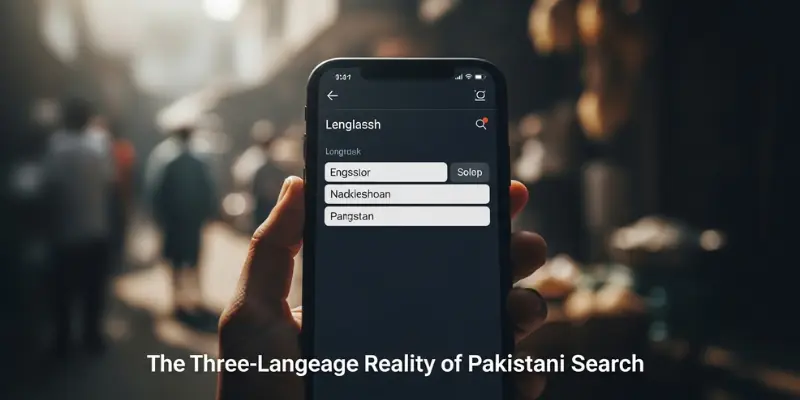
Pakistan’s search queries exist in three distinct linguistic modes — and a complete keyword research strategy must address all three:
| Query Language | Characteristics | Volume & SEO Priority |
| English | Standard international English. Higher commercial value per click. Preferred by urban professionals, B2B buyers, and higher-income demographics. | Largest volume for commercial queries. Primary focus for B2B and premium brands. Well-measured by international tools. |
| Roman Urdu (Urdu in Latin script) | Urdu words written in English letters: ‘best doctor paas mein,’ ‘mobile price kya hai’, ‘ghar banana ka tarika.’Dominant on mobile. Conversational tone. | Rapidly growing. Huge untapped opportunity. Significantly under-reported by keyword tools. Often 2–4x higher actual volume than tools show. |
| Urdu Script | Proper Urdu in Arabic script. Growing with improved mobile keyboard adoption. Particularly strong in informational and entertainment verticals. | Underestimated by all tools. Requires Urdu script keyword research using native speakers + Google Trends Urdu interface. |
Pakistan’s Search Volume Data Problem
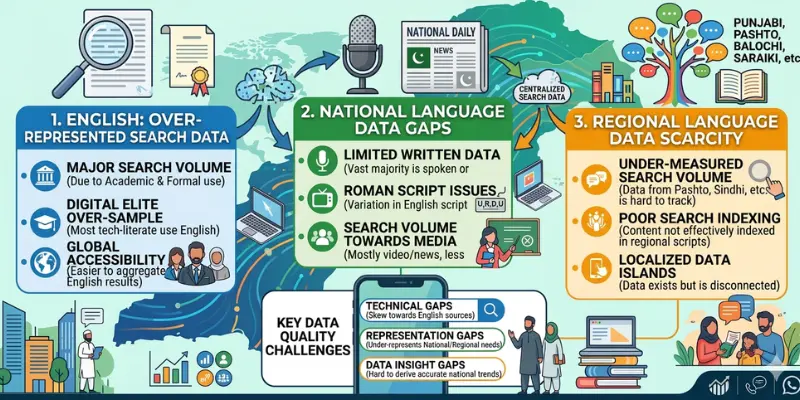
Every Pakistani SEO professional must understand this fundamental limitation: keyword tools dramatically undercount Pakistani search volumes.
The reason: Google Keyword Planner and third-party tools like Ahrefs and Semrush build their Pakistan volume estimates from a sample of Google search data. In Pakistan, where a significant portion of mobile searches occur on 2G/3G connections, in private browsing mode, or through apps with limited tracking, the sample is incomplete. Clickmasters’ internal analysis comparing GKP volume estimates against Google Search Console actual impression data shows that for many Pakistani queries, actual search volume is 1.5x to 4x higher than tools report.
Practical implication: Do not dismiss keywords with low reported volumes in Pakistan. A keyword showing 500 monthly searches in GKP may generate 1,500–2,000 actual impressions if you rank for it. Always validate using Google Search Console impression data for keywords your site already appears for, and use Google Trends Pakistan comparisons to contextualize relative search interest.
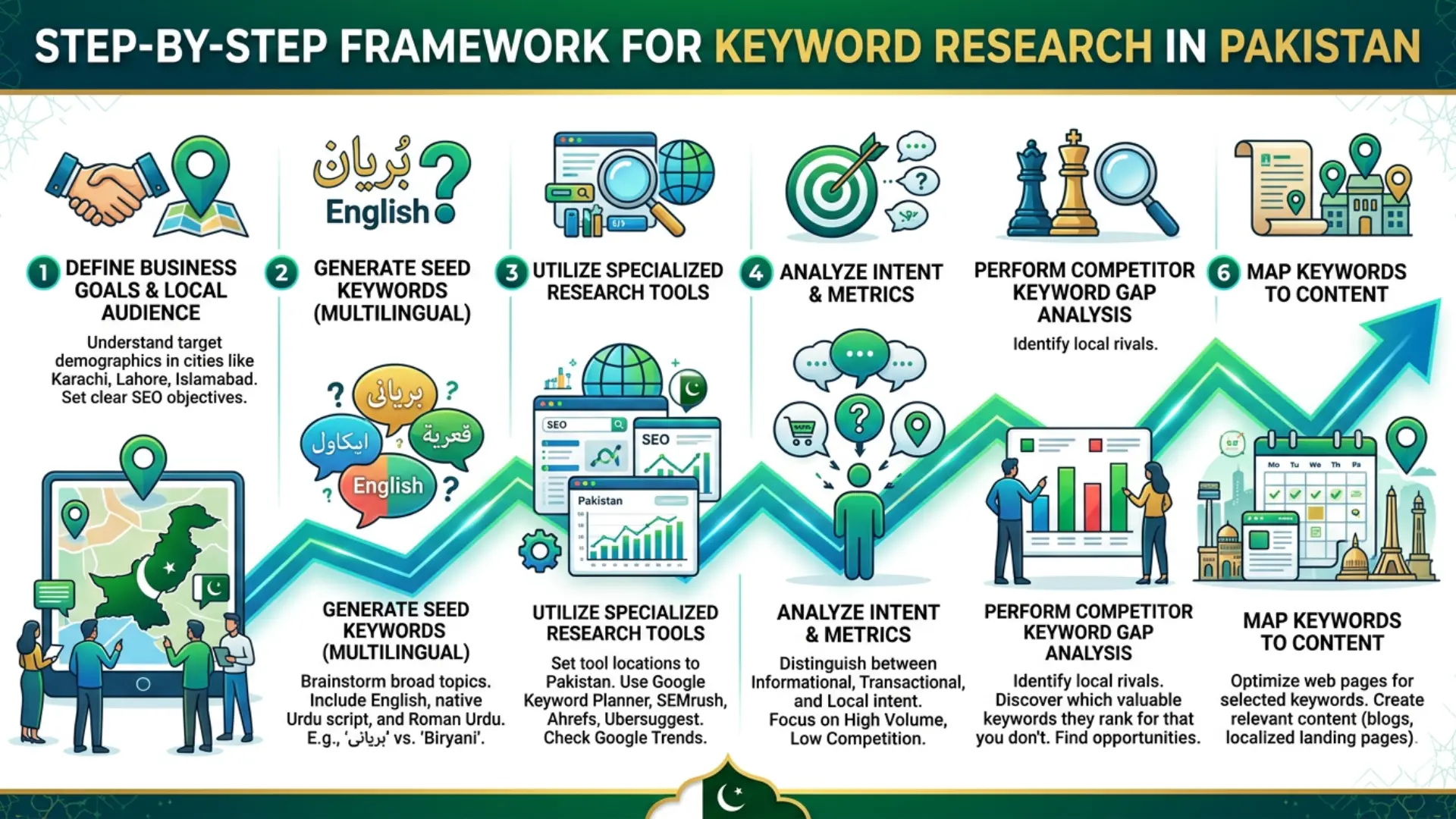
THE 7-STEP PAKISTAN KEYWORD RESEARCH FRAMEWORK
Step 1: Define Your Keyword Universe — Seed Keywords & Topic Mapping
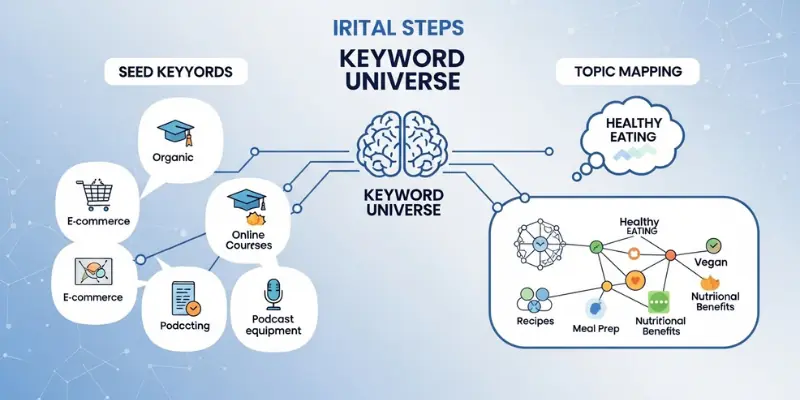
Every keyword research project begins with seed keywords — the core terms that define your business, products, or content topics. For Pakistani businesses, seed keyword generation requires thinking in all three language modes simultaneously.
The Seed Keyword Generation Process

- Business descriptor seeds: What words describe exactly what your business does? Avoid jargon — use customer language. A digital marketing agency’s seeds: ‘digital marketing,’ ‘SEO services,’ ‘social media marketing,’ ‘Google Ads,’ ‘website design.’
- Customer problem seeds: What problems do your customers search to solve? A digital marketing agency: ‘website not ranking Google,’ ‘how to get more customers online,’ ‘Google ranking Pakistan.’
- Product/service name seeds: Exact names of your products or services as your customers would search them — not your internal naming conventions.
- Location seeds: Your city, neighbourhood, and region names combined with service seeds: ‘Karachi,’ ‘DHA Lahore,’ ‘Islamabad F-7,’ ‘Pakistan.’
- Roman Urdu equivalents: Manually generate Roman Urdu versions of your English seeds. For ‘digital marketing agency’: ‘digital marketing agency Karachi mein,’ ‘online marketing service Pakistan,’ ‘website SEO karana hai.’ Use native Urdu speakers on your team.
- Competitor brand seeds: Your primary competitors’ brand names — what people searching for them might also search for your offering.
Pakistan-Specific Seed Keyword Modifiers

These modifiers are searched at high volumes in Pakistan and should be combined with your core seeds during expansion: ‘price in Pakistan,’ ‘in Karachi / Lahore / Islamabad,’ ‘Pakistan mein,’ ‘with COD,’ ‘original / authentic,’ ‘online,’ ‘near me,’ ‘best in Pakistan,’ ‘2026,’ ‘free delivery,’ ‘PTA approved’ (mobile devices), ‘government approved’ (professional services), ‘registered company
Step 2: Ahrefs Keyword Expansion — Building Your Master List
With seed keywords established, the expansion phase uses Ahrefs Keywords Explorer (set to Pakistan geo, or ‘All countries’ with Pakistan filter) to build a comprehensive master keyword list. The Clickmasters Ahrefs expansion workflow:
Ahrefs Keywords Explorer — Pakistan Workflow
- Action 1: Enter all seed keywords into Ahrefs Keywords Explorer. Set country filter to Pakistan.
- Action 2: Export: Matching Terms — all keywords containing your seed. Filter: Volume minimum 50 (remember: actual volume is often 2–4x this).
- Action 3: Export: Related Terms — semantically related keywords Ahrefs’ AI identifies. Often surfaces Roman Urdu variants and question-format keywords.
- Action 4: Export: Search Suggestions — keywords from Google’s autocomplete for your seeds. Extremely valuable for Pakistani intent patterns.
- Action 5: Export: Also Rank For — keywords that pages ranking for your seed also rank for. Reveals the full topic cluster around each seed.
- Action 6: For each seed, check Parent Topic — the higher-volume, broader keyword that Ahrefs identifies as the ‘parent’ of your seed. Sometimes the parent topic is a better target than the seed itself.
Google Keyword Planner — Pakistan Volume Validation
After Ahrefs expansion, validate and supplement with Google Keyword Planner (GKP). GKP has direct access to Google’s first-party data for Pakistan, making it particularly valuable for discovering keywords that Ahrefs’ panel-based methodology misses in Pakistani markets.
- Set GKP location to Pakistan. Set language to English (for English queries) and Urdu (for Urdu/Roman Urdu queries — requires Urdu language setting).
- Enter your Ahrefs-expanded master list into GKP’s ‘Get search volume and forecasts’ function. Compare GKP volumes against Ahrefs volumes — discrepancies above 50% indicate which tool is more reliable for specific keyword clusters.
- Use GKP’s ‘Discover new keywords’ with your seed list. GKP often surfaces high-volume Pakistani keywords that Ahrefs misses due to mobile query sampling gaps.
- Pay attention to GKP’s ‘Top of page bid (low range)’ metric even for organic research — high CPC indicates high commercial intent and monetisation potential.
Step 3: Google Search Console — Mining Your Existing Opportunity
Google Search Console is the most underutilised keyword research tool in Pakistan. While Ahrefs shows potential keyword opportunities, GSC shows actual data from your own domain: queries where Google is already showing your pages to Pakistani searchers, your current position, and the performance gap between impressions and clicks.
The GSC Keyword Mining Workflow
- Step 1: Open GSC > Performance > Search Results. Set date range to last 3 months. Set country filter to Pakistan.
- Step 2: Sort by Impressions (descending). These are the queries where Google currently considers your site relevant — your existing keyword footprint.
- Step 3: Filter: Position > 10 AND Impressions > 100. These are your ‘page 2 opportunity’ keywords — queries where you are ranking but not on page 1. Improving these to page 1 delivers immediate traffic gains with minimal effort.
- Step 4: Filter: CTR < 2% AND Position < 5. These are keywords where you rank well but users are not clicking. Metadata optimisation (compelling title tags and meta descriptions) can dramatically improve CTR without changing your position.
- Step 5: Export the full query list and add to your master keyword list. These are all real Pakistani queries generating real impressions on your domain.
- Step 6: Look for unexpected keywords in your GSC data — queries you are ranking for accidentally. These often reveal content gaps: topics your audience is searching that you have partial content for, suggesting high-opportunity expansion pieces.
Step 4: Competitor Keyword Gap Analysis
Your competitors’ keyword rankings represent the most reliable signal of what drives traffic and revenue in your market. Systematically analysing competitors reveals keywords you are missing, content types that rank, and quick-win opportunities where their ranking content is thin and beatable.
Ahrefs Competitor Keyword Gap Workflow
- In Ahrefs, navigate to Competitive Analysis > Content Gap (formerly Keyword Gap).
- Enter your domain in the first field. Add your top 3–5 Pakistani competitors in the subsequent fields.
- Run the analysis. The results show keywords that competitors rank for but you do not — your keyword gaps.
- Filter: Volume > 100. Sort by Traffic value (the estimated monthly clicks the keyword drives to ranking pages). Prioritise keywords with high traffic value.
- Export and categorise the gap list: (a) Keywords you can rank for with existing content improvements, (b) Keywords requiring new content, (c) Keywords where competitors are too strong for immediate targeting
Pakistan-Specific Competitor Intelligence Note
When doing competitor analysis for Pakistani businesses, include both Pakistani competitors (local websites targeting Pakistani market) and international competitors that rank in Pakistan for your keywords. International sites frequently rank for Pakistani queries despite no local optimisation — because they have high domain authority. These are often the easiest competitors to displace: create more Pakistan-specific, localised content with equivalent keyword targeting and you provide Google better relevance signals for Pakistani searchers
Step 5: Search Intent Classification — The Most Critical Keyword Research Step
Search intent — the underlying reason behind a search query — determines what type of content Google will rank for each keyword. Getting intent wrong is the most common keyword research failure: creating a product page for an informational query, or writing a blog post for a transactional query. Mismatched intent means Google will not rank your content regardless of its quality.
| Intent Type | Pakistani Query Examples | Correct Content Type |
| Informational (Know) | ‘what is SEO,’ ‘how to start online business Pakistan,’ ‘digital marketing kya hota hai’ | Blog posts, guides, explainers, how-to articles, FAQs |
| Commercial Investigation (Compare) | ‘best digital marketing agency Karachi,’ ‘Ahrefs vs Semrush Pakistan pricing,’ ‘top SEO tools comparison’ | Comparison pages, listicles, review articles, buyer guides |
| Transactional (Do) | ‘buy iPhone 16 online Pakistan,’ ‘hire SEO expert Karachi,’ ‘digital marketing services price’ | Product pages, service pages, pricing pages, contact/enquiry pages |
| Navigational (Go) | ‘Clickmasters login,’ ‘Dawn newspaper website,’ ‘HBL online banking’ | Homepage, brand pages, direct landing pages |
| Local (Visit) | ‘dentist DHA Karachi,’ ‘restaurant near Gulberg Lahore,’ ‘ATM near me Islamabad’ | Google Business Profile, location pages, local landing pages |
How to Determine Intent: The SERP Analysis Method
The fastest and most reliable method to determine a keyword’s intent is to Google it in Pakistan (or use a VPN/proxy set to Pakistani IP) and analyse the current top 5 results. Google has already determined intent for each query — the content format dominating the results tells you exactly what type of content Google wants to rank.
- All results are blog posts or guides: Informational intent. Your content must be editorial.
- Results show product/category pages: Transactional intent. Your content must be a product or service page.
- Results include comparison sites (Clutch, G2, CompareAgency): Commercial investigation intent. Create comparison-format content.
- Results show Google Maps/local pack: Local intent. Optimise GBP and create local landing pages.
- Results show a mix: Intent is ambiguous or shifting. Create content that serves multiple intents simultaneously.
Step 6: Keyword Prioritisation — The Clickmasters Scoring Matrix
With a master keyword list of potentially hundreds or thousands of keywords, you need a systematic prioritisation framework. Trying to target all keywords simultaneously spreads resources too thin and produces mediocre results across the board. The Clickmasters Keyword Priority Score (KPS) matrix ranks keywords on four dimensions:
| Keyword | Search Volume Score (1-5) | Keyword Difficulty Score (1-5, inverted) | Commercial Value Score (1-5) | Overall KPS |
| ‘SEO services Pakistan’ | 4 (2,900/month) | 2 (KD 65, hard) | 5 (direct service) | 11/20 — Medium |
| ‘local SEO Karachi’ | 3 (880/month) | 4 (KD 28, easy) | 5 (direct service) | 12/20 — High |
| ‘what is digital marketing’ | 5 (18,000/month) | 2 (KD 72, very hard) | 2 (informational) | 9/20 — Low-Med |
| ‘social media marketing company Lahore’ | 3 (720/month) | 5 (KD 18, very easy) | 5 (direct service) | 13/20 — High |
| ‘keyword research Pakistan’ | 3 (590/month) | 4 (KD 25, easy) | 4 (content lead gen) | 11/20 — Medium |
| ‘Google Ads agency Pakistan’ | 3 (1,200/month) | 3 (KD 42, medium) | 5 (direct service) | 11/20 — Medium |
Scoring methodology: Volume Score — 1 (under 100/mo) to 5 (5,000+/mo). Difficulty Score — Inverted: 1 (KD 80+) to 5 (KD under 20). Commercial Value — 1 (pure entertainment/no conversion path) to 5 (direct service/product query). Overall KPS = sum of three scores. Prioritise KPS 12+ for immediate targeting; KPS 9–11 for medium-term planning; KPS under 9 for long-term authority building.
Step 7: The Urdu & Roman Urdu Keyword Strategy
This step is unique to Pakistan and is entirely absent from international keyword research guides. Optimising for Urdu and Roman Urdu search queries is one of the highest-opportunity, lowest-competition SEO investments available to Pakistani businesses in 2026.
Why Urdu SEO Is Underexploited
Despite Pakistan’s 230 million population with Urdu as the national language, the vast majority of Pakistani business websites publish exclusively English-language content. This creates a structural keyword opportunity: Urdu search queries with significant search volumes have no — or very few — well-optimised Pakistani websites competing for them. The competitive landscape for Urdu keywords is dramatically less crowded than English equivalents.
Urdu & Roman Urdu Keyword Research Process
- Step 1: Roman Urdu seed generation: Take your top 20 English keywords and work with a native Urdu speaker to generate natural Roman Urdu equivalents. ‘How to start an online business’ becomes ‘online business kaise shuru karen,’ ‘online business Pakistan mein,’ ‘ghar se paisa kaise kamayein.’
- Step 2: Google Autocomplete mining: Type Roman Urdu seeds into Google Search (set to Pakistan location). The autocomplete suggestions are gold — they represent actual Pakistani queries that Google has seen enough of to suggest. Record every suggestion.
- Step 3: Google Trends Pakistan — Urdu comparison: Enter both English and Roman Urdu versions of your keywords in Google Trends, filtered to Pakistan. Compare relative search interest over 12 months. For many consumer categories, Roman Urdu versions outperform English versions by 2–5x in interest.
- Step 4: GSC Urdu query audit: In your Google Search Console, filter queries by language (Settings > Geographies, or search for Roman Urdu character patterns). Identify any Roman Urdu queries already generating impressions on your domain.
- Step 5: Competitive analysis for Urdu keywords: Use Ahrefs to check who is currently ranking for your target Roman Urdu keywords. In most cases, international sites (Wikipedia, generic how-to sites) dominate because no Pakistani business has created dedicated Urdu content. This is your opportunity.
Implementing Urdu & Roman Urdu Keywords
| Content Type | Urdu / Roman Urdu Implementation Approach |
| Blog posts / guides | Create dedicated Roman Urdu versions of your top English guides. A translated, localised Urdu guide targeting the Roman Urdu keyword version. Include Urdu script heading alongside Roman Urdu heading. |
| FAQ sections | Add FAQs in Roman Urdu on existing English pages. ‘Keyword research kaise hoti hai?’ as an FAQ section heading with English answer. This targets bilingual searchers and voice search queries. |
| Meta descriptions | Include Roman Urdu phrases in meta descriptions for pages targeting mixed-language searchers: ‘Best digital marketing agency | Pakistan mein #1 choice for growing businesses.’ |
| Product/service pages | Add a ‘Pakistan market overview’ section in Roman Urdu and English on service pages. Increases relevance signals for Roman Urdu search intent without separate page creation. |
| Dedicated Urdu pages | For highest-volume Urdu keywords, create dedicated hreflang-tagged Urdu pages. Link to/from English equivalents. Proper RTL implementation required. |
Pakistan Keyword Research: Seasonality & Trend Patterns
Pakistani search behaviour has distinct seasonal patterns driven by the Islamic calendar, national holidays, and cultural events. Keyword research must account for these patterns to align content publication with peak search demand.
| Season / Event | Keyword Research & Content Implications |
| Ramadan (varies annually) | Massive spikes in: ‘Ramadan deals Pakistan,’ ‘iftar recipes,’ ‘online shopping Eid sale,’ ‘Ramadan timing 2026.’ E-commerce and food businesses must publish content 4–6 weeks before Ramadan starts. |
| Eid-ul-Fitr & Eid-ul-Adha | Fashion (‘Eid dresses 2026’), food, gifts, and travel searches spike 3–4 weeks before Eid. These are the highest commercial-value seasonal keywords in Pakistan. |
| Back to School (Jan & Aug) | Education, stationery, electronics, and uniforms searches peak in January and August before new school terms. |
| Pakistan Independence Day (Aug 14) | National celebration, deals, and promotional content drives significant search volume for retail businesses. |
| PSL Season (Feb–March) | Cricket-related content, live streaming searches, and brand-related cricket sponsorship searches spike dramatically. |
| Year-end / Tax Season (Jun) | Financial services, accounting software, and compliance-related queries peak in June around Pakistan’s fiscal year end. |
| Winter / Summer Fashion | Lawn season searches peak March–April. Winter clothing searches peak October–November. Fashion brands must publish content 6–8 weeks before peak. |
The Keyword Research Stack: Tools for Pakistani Marketers
| Tool | Role in Pakistan Keyword Research & Pakistan-Specific Notes |
| Ahrefs Keywords Explorer | Primary expansion tool. Set to Pakistan geo. Use Matching Terms, Related Terms, and Search Suggestions. Best for competitive analysis and difficulty scoring. Annual plan: ~$108/month. |
| Google Search Console | Free. Most accurate data for your existing keyword performance in Pakistan. Essential for Page 2 opportunity mining and CTR gap analysis. |
| Google Keyword Planner | Free. First-party Google data for Pakistan volumes. More accurate for Pakistan than Ahrefs/Semrush for certain mobile query clusters. Requires Google Ads account. |
| Google Trends (Pakistan) | Free. Indispensable for seasonal patterns, Roman Urdu vs. English relative interest comparison, and emerging keyword trend identification. Set geography to Pakistan or specific cities. |
| Semrush Keyword Magic Tool | Good alternative to Ahrefs. Strong keyword clustering feature. Pakistan data comparable to Ahrefs. ~$117/month. |
| AnswerThePublic / AlsoAsked | Question-format keyword discovery. Enter your seeds and get all the ‘what,’ ‘why,’ ‘how,’ ‘when,’ and ‘where’ questions Pakistani users ask. Essential for FAQ and voice search content. |
| Ubersuggest (free tier) | Free option for bootstrapped businesses. Less comprehensive than Ahrefs/Semrush but provides Pakistan-filtered keyword data and basic competitive analysis. |
| Google Autocomplete + People Also Ask | Free. The most direct window into what Pakistani users are actually searching. Manual but invaluable for Roman Urdu discovery and intent verification. |
Keyword Research Case Study: Pakistani HR Software Company
In Q1 2025, Clickmasters conducted keyword research for a Lahore-based HR software startup targeting Pakistani SMEs and enterprises. Their existing keyword strategy: targeting ‘HR software Pakistan’ and ‘HRMS Pakistan’ — both highly competitive, DA 60+ competitors dominating page 1.
Keyword Research Findings
| Keyword Type | Examples Discovered | Opportunity Assessment |
| Missed long-tail English | ‘payroll software for construction companies Pakistan,’ ‘HR software for NGOs Pakistan,’ ‘attendance management system price Pakistan’ | Low KD (15–25), clear buyer intent, no strong competitors. 12 keywords identified, combined volume ~4,800/month. |
| Roman Urdu opportunities | ‘salary slip banana ka tarika,’ ’employee leave management Pakistan mein,’ ‘HR department kaise banayein’ | Zero competition. Estimated actual volume 3x tool data. 8 Roman Urdu content pieces planned. |
| Question-format gems | ‘how to calculate provident fund Pakistan,’ ‘EOBI contribution rate 2026,’ ‘how to fire an employee legally Pakistan’ | High intent — exactly the questions HR managers and business owners ask before buying HR software. 15 FAQ/guide pieces mapped. |
| Competitor gap keywords | Competitor A ranked for ‘biometric attendance system Pakistan.’ Competitor B ranked for ’employee performance appraisal software.’ Neither had Roman Urdu content. | 34 competitor gap keywords identified where creating better or Urdu-targeted content could capture their rankings. |
Results After 8 Months of Implementation
- New keyword rankings (Top 10): 0 at start, 412 after 8 months
- Organic monthly traffic: 340 sessions to 14,200 sessions (+4,076%)
- Roman Urdu content: 8 pieces ranking for 47 Roman Urdu queries — zero competition
- Inbound demo requests from organic: 0 to 19 per month
- Cost per acquisition vs. paid ads: PKR 12,800 (organic) vs. PKR 68,000 (Google Ads)
Frequently Asked Questions: Keyword Research for Pakistan
Q: How often should I redo keyword research for my Pakistani business?
Conduct a full keyword research refresh every 6 months — Pakistan’s digital landscape evolves rapidly, new competitors emerge, and search volumes shift with economic and social changes. Additionally, conduct a lightweight monthly ‘opportunity audit’ using GSC: check for new queries generating impressions, monitor position changes for target keywords, and identify new questions appearing in People Also Ask boxes for your core topics
Q: Should I target Karachi, Lahore, and Islamabad separately or as ‘Pakistan’?
Both, strategically. For service businesses with physical locations or strong city preferences: create dedicated city-specific pages targeting ‘[service] Karachi,’ ‘[service] Lahore,’ etc. For national e-commerce or B2B services: target ‘Pakistan’ as the geographic modifier while using GSC to identify which cities generate the most impressions and optimise accordingly. For B2B software and professional services, Karachi dominates commercial search intent; for consumer goods, Lahore shows the highest transaction intent in our data.
Q: What keyword difficulty is realistic for a new Pakistani website to target?
New websites (DA under 15) should focus exclusively on KD 0–20 keywords (Ahrefs scale). With 6–12 months of consistent content production and basic link building, you can target KD 20–40. Competitive head keywords (KD 50+) typically require DA 35+ and strong topical authority to compete effectively. The keyword difficulty ‘sweet spot’ for growing Pakistani websites is KD 15–35 — enough competition to indicate real search volume, low enough to rank within 3–6 months