
Pakistan’s Mobile Internet Reality: The Data Every Website Owner Must Know
Pakistan is one of the most mobile-dominated internet markets on earth. With 196 million mobile broadband subscribers (PTA Annual Report 2025), 85.3% of all website traffic in Pakistan arriving via mobile devices, and smartphone penetration growing at 14% annually, Pakistan’s internet is mobile. The desktop-first website is not a viable product for the Pakistani market. It is a competitive disadvantage.
Yet the majority of Pakistani business websites were designed desktop-first and only later adapted for mobile devices. This outdated approach creates major problems for businesses trying to compete online today. Issues such as slow mobile load times, broken navigation on smaller screens, fonts that are too small to read, and tap targets placed too close together all damage user experience and search visibility. These are exactly the types of problems a professional digital marketing agency in Pakistan focuses on solving through modern mobile-first SEO strategies.
Clickmasters’ analysis of 200+ Pakistani websites shows the scale of the problem: 73% have mobile LCP above 4 seconds (Google’s ‘Poor’ threshold is 4 seconds), 61% have mobile usability errors identified in Google Search Console, and 88% are not optimised for touch interaction. This guide is the complete corrective — explaining exactly how Google’s mobile-first indexing works, what Pakistan’s specific mobile challenges are, and providing a comprehensive mobile SEO implementation checklist.
Table of Contents
Pakistan Mobile Internet Statistics 2025–2026

Pakistan’s digital landscape has shifted rapidly toward mobile usage, creating new challenges and opportunities for businesses trying to rank in search results. According to PTA (2025), Pakistan now has over 196 million mobile broadband subscribers, and nearly 85.3% of website traffic comes from mobile devices. Despite this massive mobile audience, the average mobile page load time on Pakistani websites is around 6.8 seconds, far slower than the 2.2-second global benchmark, which significantly impacts search rankings and user experience. These performance gaps highlight why businesses increasingly rely on professional SEO services in Pakistan to improve mobile optimisation, technical SEO, and overall website performance.
Mobile connectivity continues to expand, with 4G coverage reaching 87% of populated areas and 5G rollout beginning in major cities like Karachi, Lahore, Islamabad, and Faisalabad between 2024 and 2025. At the same time, smartphone penetration has reached 54% of the population and is growing at nearly 14% annually, making mobile-first website optimisation more important than ever. Most Pakistani users browse on devices with screen widths between 360px and 390px, accounting for nearly 80% of mobile traffic, while the most commonly used browsers include Chrome for Android (68%), Samsung Internet (18%), and Safari on iOS (9%).
For businesses aiming to capture this rapidly growing mobile audience, implementing mobile-first design, faster page speeds, and structured technical improvements through expert SEO services in Pakistan is essential for achieving higher rankings, better user engagement, and sustainable online growth.
Mobile-First Indexing: How Google’s Mobile-First Approach Affects Pakistani Rankings
Google switched to mobile-first indexing globally in 2023 — meaning Google now primarily uses the mobile version of a website for indexing and ranking purposes. If your mobile site has less content than your desktop site, lower-quality HTML, missing structured data, or slower performance, it is your mobile version that determines your Google rankings — not the premium desktop experience you may have invested in.
What Mobile-First Indexing Means in Practice
- Content parity is mandatory: Any content on your desktop site that is hidden, abbreviated, or absent on mobile is invisible to Google’s indexing. Tabs, accordions, and expandable sections that require user interaction on mobile must still be indexable.
- Images on mobile must have proper ALT text: Google indexes your mobile HTML — if your responsive design swaps desktop images for lighter mobile images without ALT text, those missing ALT texts affect your image SEO.
- Structured data must be present on mobile: If your schema markup is implemented only in the desktop page template, Google’s mobile-first indexing will not recognise it. Verify the schema is present in your mobile HTML using the URL Inspection tool in GSC.
- Mobile page speed is your ranking page speed: Your desktop page may load in 1.2 seconds. If your mobile page loads in 6.8 seconds, 6.8 seconds is the performance Google evaluates for Page Experience ranking signals.
- Mobile-specific penalties: Intrusive interstitials (pop-ups that cover the main content on mobile), content blocked by cookie consent banners, and app install banners that push content off-screen are all mobile-specific Google penalties.
PART 1: CORE WEB VITALS ON MOBILE — PAKISTAN’S BIGGEST SEO CHALLENGE
Core Web Vitals on Mobile: Pakistan-Specific Benchmarks and Fixes
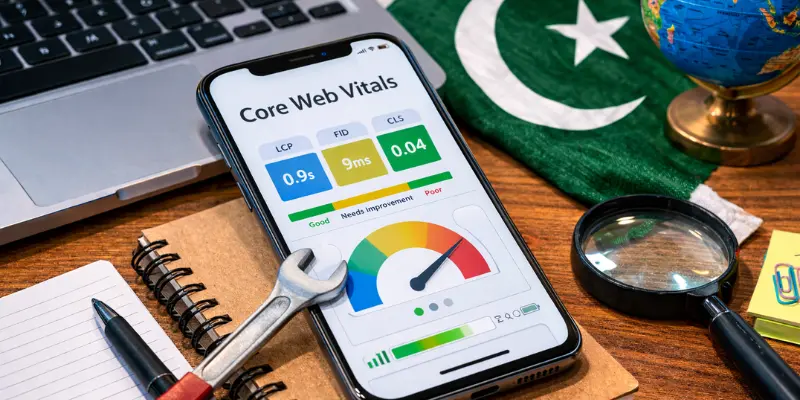
Core Web Vitals (CWV) — Largest Contentful Paint (LCP), Interaction to Next Paint (INP), and Cumulative Layout Shift (CLS) — are Google’s quantified page experience metrics. They directly influence rankings via the Page Experience signal. On mobile devices in Pakistan, where connections are slower and CPU performance is lower than international benchmarks, CWV scores are consistently poor across the market.
Largest Contentful Paint (LCP) — Pakistan’s Most Widespread Mobile Failure
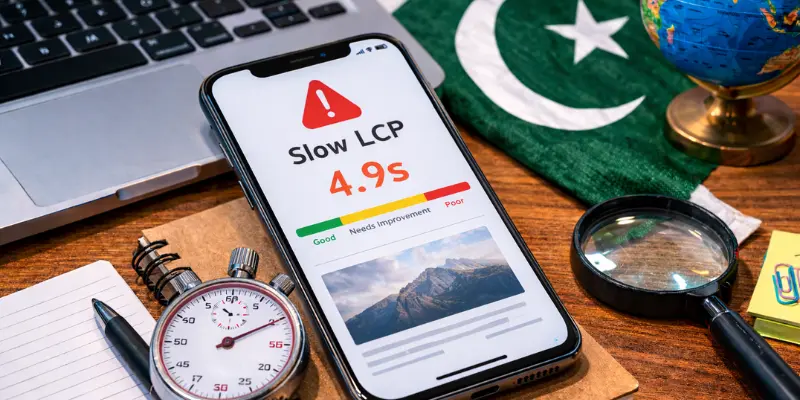
LCP measures how long it takes for the largest visible element on the page — typically the hero image, the H1 heading, or a large block of text — to load and render on screen. Google’s benchmark: Good = under 2.5 seconds. Needs Improvement = 2.5–4 seconds. Poor = over 4 seconds.
Pakistan-specific LCP benchmark from Clickmasters’ CrUX analysis of 200+ Pakistani websites: Average mobile LCP = 6.8 seconds. Only 7% achieve ‘Good’ status (under 2.5 seconds). The primary causes in Pakistan:
- Unoptimised hero images: Full-resolution photography (2–4MB) loaded without compression, WebP conversion, or lazy loading. A 3MB JPEG hero image on a Pakistani 4G connection (average 12 Mbps download) takes 2+ seconds to download before rendering even begins.
- Render-blocking resources: CSS and JavaScript files that must fully load before the page can render. Unoptimised WordPress themes load 8–15 CSS/JS files before the first pixel appears.
- Server response time: Pakistani shared hosting typically delivers TTFB (Time to First Byte) of 800ms–2.5 seconds. Cloudflare’s Pakistan PoP reduces TTFB to 80–200ms for sites behind Cloudflare — a 4–10x improvement.
- No image CDN: Images are served from the origin server in Pakistan rather than a CDN with Pakistani edge nodes.
LCP Fix Protocol for Pakistani Websites
- Convert all hero and above-the-fold images to WebP format. Compress to under 100KB for hero images. Use srcset for responsive image sizes.
- Implement Cloudflare (free tier sufficient): eliminates the TTFB problem for most Pakistani websites overnight.
- Preload the LCP element: Add your hero image in the HTML. This tells the browser to begin downloading the LCP image immediately, before parsing CSS.
- Eliminate render-blocking CSS: Load critical CSS in-line, defer non-critical CSS. Use WordPress’s built-in asset management or a plugin like WP Rocket.
- Defer JavaScript: Add defer or async attributes to all non-critical JavaScript. Move scripts to the bottom of the page body where possible.
INP (Interaction to Next Paint) — Pakistan’s Emerging Mobile Challenge
INP replaced FID (First Input Delay) as a Core Web Vital in March 2024. It measures the responsiveness of a page to all user interactions — taps, clicks, and keyboard input — throughout the entire page visit. Good = under 200 milliseconds. Poor = over 500 milliseconds.
Pakistani mobile websites face INP challenges primarily from JavaScript-heavy frameworks (Vue.js, React, Angular) that execute long JavaScript tasks on low-powered Android devices. The most common mid-range Pakistani smartphones (Tecno Spark, Infinix Hot, Samsung Galaxy A-series) have significantly lower CPU performance than the high-end devices used to test websites during development.
⦁ Fix heavy JavaScript: Audit total JavaScript payload using Chrome DevTools Performance panel. Remove unused JavaScript libraries. Split large JS bundles into smaller, lazily-loaded chunks.
⦁ Avoid synchronous third-party scripts: Facebook Pixel, Google Analytics, WhatsApp chat widgets — each adds JavaScript execution time. Load all third-party scripts asynchronously.
⦁ Optimise event listeners: Throttle scroll and resize event handlers. Use passive event listeners for touch events (addEventListener with {passive: true}).
CLS (Cumulative Layout Shift) — The Invisible UX Killer
CLS measures visual instability — how much the page layout shifts unexpectedly as it loads, causing users to accidentally click the wrong element. Good = under 0.1. Poor = over 0.25. Common CLS causes on Pakistani websites:
- Images without width and height attributes: The browser doesn’t know the image dimensions until it loads, causing content below to jump downward. Fix: always specify width and height on all img elements.
- Dynamically injected ad units: Pakistani websites using Google AdSense or local ad networks that insert ads after page load cause layout shifts. Fix: reserve space for ad units with CSS min-height.
- Web fonts causing FOUT (Flash of Unstyled Text): Text rendered in a fallback font, then shifting to the custom font. Fix: font-display: swap and preload critical fonts.
- Cookie consent banners: Banners that appear after initial render shift all page content. Fix: reserve space in the layout for the banner, or use non-layout-affecting notification designs.
PART 2: MOBILE DESIGN & UX FOR PAKISTANI USERS
Mobile UX for Pakistani Users: Design Principles That Drive SEO
Mobile UX and mobile SEO are inseparable in 2026. Google’s user engagement signals — dwell time, bounce rate, return visits — are fundamentally determined by whether Pakistani mobile users find your website easy and pleasant to use on their phones. Poor mobile UX is not just a user experience problem; it is an SEO problem.
Typography for Pakistani Mobile Users
Pakistani mobile users access websites on screens ranging from 5 to 6.7 inches, at resolutions from 720p to 1080p. The minimum legible body text size on mobile is 16px — and Pakistani web developers frequently use 12–14px body text copied from desktop stylesheets. The result: text that requires users to pinch-zoom, increasing bounce rate dramatically.
| Typography Element | Mobile Standard for Pakistani Websites |
| Body text minimum size | 16px (1rem). Never below 14px on mobile. Use rem units for scalability. |
| Heading sizes (H1–H3) | H1: 26–32px mobile. H2: 22–26px. H3: 18–22px. Smaller headings lose visual hierarchy on mobile. |
| Line height | 1.6–1.8 for body text on mobile. Tight line height (1.2–1.4) is hard to read on small screens. |
| Paragraph width | Maximum 75 characters per line on mobile. Wider paragraphs require horizontal eye movement that slows reading. |
| Urdu/Arabic script text | Minimum 18px for Urdu Nastaliq fonts. Noto Nastaliq Urdu at 16px is often illegible. Direction: RTL with dir=’rtl’ and text-align: right. |
| Contrast ratio | WCAG AA minimum: 4.5:1 contrast ratio for body text. Many Pakistani websites fail this with light-grey text on white backgrounds. |
Touch Target Optimisation: The Most Overlooked Mobile UX Factor
Human fingers have an average contact area of 10mm x 10mm on a touchscreen. Google’s minimum recommended tap target size is 48×48 CSS pixels, with 8px minimum spacing between adjacent targets. Pakistani websites almost universally violate this standard — cramming navigation links, social icons, and form fields into spaces that require precise tapping and generate frequent accidental clicks.
- Navigation links: Mobile nav items must be a minimum of 48px tall. Full-width tap targets (width: 100%) are ideal for navigation lists.
- Call-to-action buttons: Minimum 48px height, 120px+ width. Use padding rather than height/width to ensure text scales with the button.
- Form input fields: Input height minimum 48px. Label size minimum 16px. Adequate vertical spacing between form fields.
- Phone number links: All Pakistani phone numbers on mobile should be wrapped in tel: links —. This enables one-tap calling, the highest-converting action from mobile local search.
- WhatsApp business link: Pakistani users overwhelmingly prefer WhatsApp for business enquiries. Add a fixed WhatsApp Business button (wa.me/92XXXXXXXXXX) visible on all mobile pages. This single element can increase mobile enquiry rates by 40–120% for local service businesses.
Mobile Navigation Architecture for Pakistani Websites
Desktop navigation — wide horizontal menus, multi-column dropdowns, complex mega-menus — is non-functional on mobile screens. Pakistani websites that have not rebuilt their navigation for mobile create severe usability and crawlability problems.
- Hamburger menu: The standard mobile navigation pattern. Ensure the hamburger icon is a minimum of 44px x 44px and positioned top-right where Pakistani mobile users expect it.
- Flat navigation structure: Mobile navigation depth maximum 2 levels. Three-level dropdown menus on mobile are unusable. Simplify your information architecture for mobile.
- Sticky header: A lightweight sticky header with your logo, primary CTA (Call Now / WhatsApp), and hamburger menu ensures navigation is always accessible without scrolling back to the top.
- Bottom navigation bar: For Pakistani e-commerce and app-like websites, a bottom navigation bar (Home, Categories, Search, Cart, Account) mirrors the app interaction patterns Pakistani mobile users are trained on from apps like Daraz and Foodpanda.
- Breadcrumbs on mobile: Always visible, always clickable. Essential for e-commerce category navigation. Minimise breadcrumb text length for mobile display.
PART 3: MOBILE TECHNICAL SEO FOR PAKISTAN
Mobile Technical SEO: Pakistan-Specific Implementation Requirements
Viewport Meta Tag — Non-Negotiable Foundation
The viewport meta tag tells mobile browsers how to scale and render your page. Every Pakistani website must have this tag in the :
Without this tag, mobile browsers render your page at desktop width and scale it down — producing tiny, unreadable text that users immediately abandon. Google Search Console’s Mobile Usability report will flag ‘Viewport not set’ as an error. This is the most basic mobile technical requirement and remains absent from 12% of Pakistani websites audited by Clickmasters.
Mobile Page Speed: The Pakistani Network Reality
Speed optimisation for Pakistani websites must account for Pakistan’s network infrastructure. While 4G is widespread, actual delivered speeds in Pakistani urban areas average 12–18 Mbps download — significantly slower than the theoretical maximum. In suburban and rural areas, speeds frequently drop to 3–5 Mbps. Speed optimisation targets for Pakistani websites should be more aggressive than global benchmarks to account for this:
| Metric | Global ‘Good’ Target | Clickmasters Pakistan Target |
| LCP (mobile) | Under 2.5 seconds | Under 2.0 seconds |
| TTFB | Under 800ms | Under 300ms (Cloudflare required) |
| Total page size (mobile) | Under 1.5MB | Under 800KB |
| JavaScript payload | Under 300KB | Under 150KB parsed |
| Number of HTTP requests | Under 50 | Under 30 |
| Image load time (hero) | Under 500ms | Under 300ms (WebP + CDN) |
| First Contentful Paint | Under 1.8 seconds | Under 1.2 seconds |
AMP (Accelerated Mobile Pages): Should Pakistani Websites Use It?
AMP was Google’s initiative to create near-instant-loading mobile web pages using a restricted HTML subset. While AMP pages historically appeared in Google’s Top Stories carousel with a lightning bolt indicator, Google removed the AMP requirement for Top Stories in 2021 — replacing it with Core Web Vitals as the performance standard.
Clickmasters’ recommendation for Pakistani websites in 2026: do not invest in AMP. The development overhead of maintaining separate AMP and non-AMP page versions, combined with AMP’s restrictions on JavaScript and monetisation, outweighs the marginal performance benefit for the majority of Pakistani websites. Instead, invest the same effort in CWV optimisation of your primary mobile pages — you will achieve equivalent or better performance scores with more flexibility and less maintenance burden.
Exception: Pakistani news publishers (Dawn, Tribune, TechJuice) that have already invested in AMP infrastructure should maintain it — the existing Google News AMP benefits remain relevant for news content.
Mobile Intrusive Interstitials: Google’s Mobile Penalty
Google penalises mobile pages that show intrusive interstitials — pop-ups, overlays, or banners that cover the main content before users can access it. Pakistani websites frequently violate this with newsletter sign-up pop-ups, app download banners, and cookie consent overlays that Google classifies as intrusive.
Penalised interstitial types: Pop-ups covering the main content immediately after page load, standalone interstitials requiring dismissal before content access, and above-the-fold banners that push content below the visible area.
Acceptable formats (not penalised): Cookie consent banners occupying a small bottom-screen strip, age verification for legal requirements, login overlays for private content, and small banners that don’t cover significant content.
Mobile SEO Audit Checklist for Pakistani Websites
Use this 30-point mobile SEO audit checklist to identify and prioritise mobile optimisation opportunities on your Pakistani website:
Foundation (Must Have)
- Viewport meta tag is present on all pages
- No horizontal scrolling on screens narrower than 360px
- All text minimum 16px — no pinch-zoom required to read body content
- Tap targets minimum 48x48px with adequate spacing
- Mobile LCP under 4 seconds (target: under 2.5 seconds)
- No intrusive interstitials on mobile load
- HTTPS on all pages
Performance (High Impact)
- Hero images in WebP format, under 100KB, with width and height attributes
- Cloudflare or equivalent CDN configured with Pakistani edge nodes
- Total JavaScript payload under 200KB
- Critical CSS inlined — no render-blocking CSS in
- All third-party scripts are loaded asynchronously
- Font files preloaded for critical typography
- Lazy loading on all images below the fold
Mobile UX (SEO Impact)
- Hamburger menu functional — all links accessible on 360px width
- All phone numbers are clickable tel: links
- WhatsApp Business contact button is present and functional
- Form inputs have a minimum 48px height with visible labels
- Navigation maximum 2 levels deep on mobile
- Breadcrumbs are visible and functional on mobile screens
Content (Mobile-Specific)
⦁ Schema markup present in mobile HTML (verify via URL Inspection in GSC)
⦁ FAQ sections present on all key pages — FAQPage schema implemented
⦁ Table content has horizontal scroll or is reformatted for mobile
⦁ Videos embed with responsive sizing (no fixed width)
⦁ Maps embed a functional on mobile (embedded Google Map, not a static image)
Testing & Monitoring
⦁ Google Mobile-Friendly Test: passing
⦁ Google Search Console Mobile Usability: zero errors
⦁ Core Web Vitals (mobile): Good status for LCP, INP, CLS
⦁ Real user testing on an actual Pakistani mid-range Android device (Samsung Galaxy A-series or Tecno Spark class)
⦁ PageSpeed Insights mobile score: targeting 70+ (excellent: 90+)
Mobile SEO Case Study: Islamabad Real Estate Agency — 520% Mobile Traffic Growth
In mid-2024, Clickmasters audited a 5-year-old real estate agency website based in Islamabad. The agency had an attractive desktop website but appalling mobile performance: 8.2-second LCP, 47% of GSC mobile usability errors, and a mobile bounce rate of 84% vs. 31% on desktop.
Key Findings
⦁ Hero image: 4.1MB uncompressed JPEG. Delivered from origin server in Islamabad (no CDN)
⦁ Google Maps embed: standard iframe embed loading full Google Maps JS on every page load — adding 2.3 seconds to LCP
⦁ Property listing pages: data-heavy tables not reformatted for mobile — horizontal scrolling required
⦁ Contact form: input fields 28px height, label text 11px — nearly unusable on touchscreens
⦁ No WhatsApp integration despite 100% of enquiries coming via WhatsApp in the agency’s own tracking
Mobile Optimisation Actions
- Hero image converted to WebP (92KB, down from 4.1MB). Cloudflare deployed.
- Google Maps replaced with lightweight embed using Maps Embed API with lazy loading — reduced load contribution from 2.3s to 0.18s
- Property listing tables replaced with mobile-friendly card layouts using CSS grid
- Contact form inputs rebuilt to 52px height with 18px labels — with WhatsApp CTA button added
- All property photography converted to WebP with srcset for mobile/desktop variants
Results at 90 Days
| Metric | Before | 90 Days After |
| Mobile LCP | 8.2 seconds | 1.7 seconds |
| Mobile Usability Errors (GSC) | 47 errors across 180 pages | 0 errors |
| Mobile Bounce Rate | 84% | 38% |
| Mobile Organic Sessions/Month | 1,240 | 7,680 (+520%) |
| Property Enquiries via WhatsApp (monthly) | Not tracked — button absent | 214 WhatsApp enquiries |
| PageSpeed Insights Mobile Score | 18/100 | 84/100 |
GET IN TOUCH
Get 1 Free Consultation Call
Frequently Asked Questions: Mobile-First SEO in Pakistan
My website looks fine on my iPhone — why is Google reporting mobile usability errors?
iPhones represent approximately 9% of Pakistani mobile web traffic. The majority of Pakistani users access your website on mid-range Android devices (Samsung Galaxy A-series, Tecno, Infinix, Xiaomi Redmi) with smaller screens (360–390px wide), lower CPU performance, and slower connections. Test your website on an actual mid-range Android device at 4G speeds, or use Chrome DevTools device emulation at 360px width to see what your typical Pakistani mobile user experiences.
Does having a mobile app replace the need for mobile SEO?
No. Mobile apps and mobile websites serve different discovery functions. Users who already know your brand use your app. Users discovering your business through Google Search — your highest-intent new customer acquisition channel — land on your website. Your app has zero presence in Google Search results. A mobile-optimised website is how you acquire new customers; the app is how you retain existing ones
How do I test my website’s mobile performance specifically for Pakistani users?
Use three tools in combination: (1) Google Search Console > Core Web Vitals — shows real user CWV data from Pakistani Chrome users visiting your site. (2) PageSpeed Insights — enter your URL and select the Mobile tab. Enables throttling simulation at 4G speeds. (3) Chrome DevTools — Network tab > set throttling to ‘Fast 3G’ (simulating typical Pakistani urban 4G). Device emulation at 360px x 800px (common mid-range Android). Test on a real Tecno Spark or Samsung Galaxy A14 if available — emulation is good but not perfect.