Think about the last time you Googled something. Did you scroll through links, or did you just read the AI answer at the top and move on?
That’s exactly what your customers are doing right now.
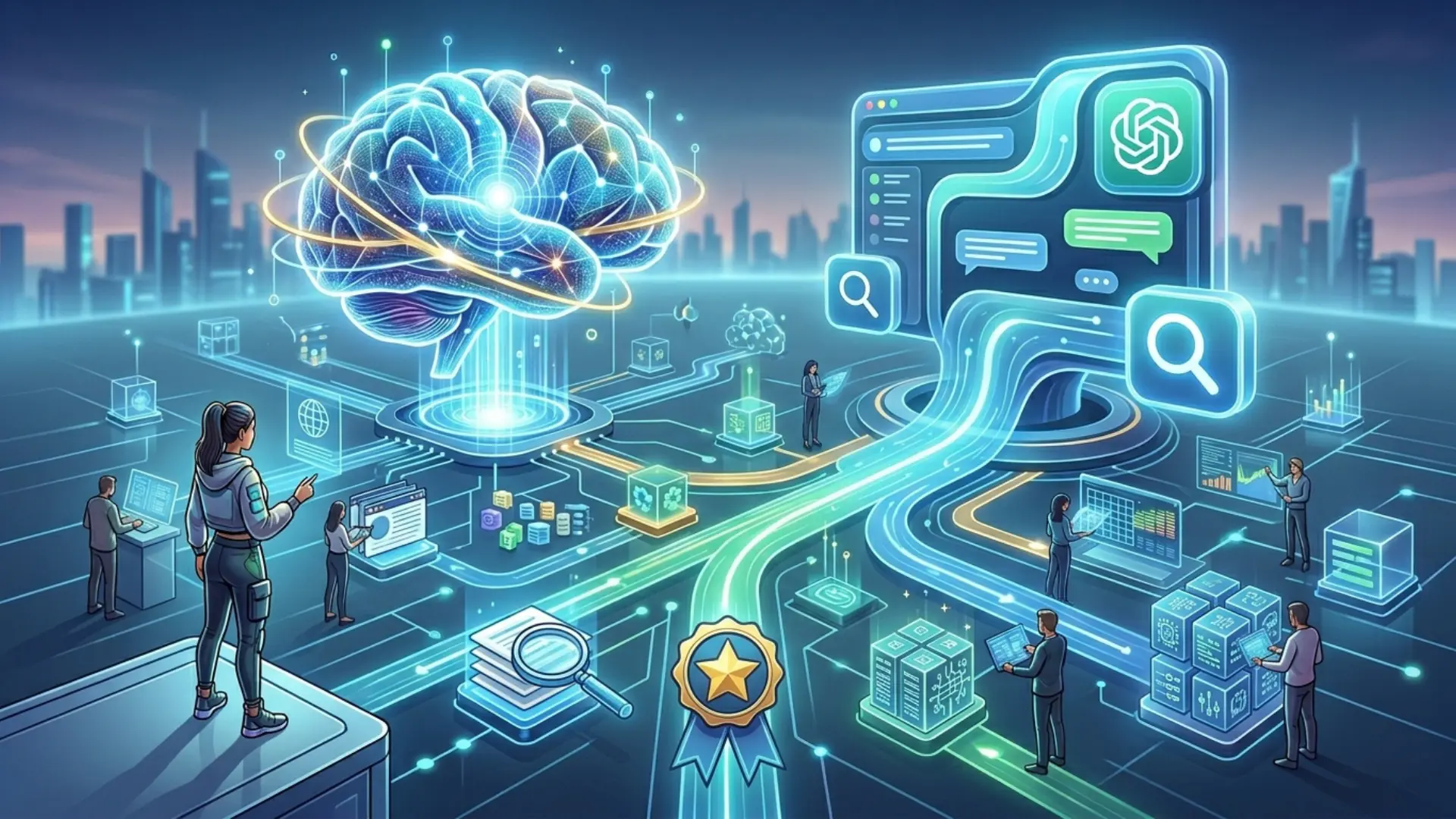
In 2026, Google ads, ChatGPT, and Perplexity don’t just show a list of websites anymore. They read the web, pick the best sources, and hand users a ready-made answer. If your business isn’t one of those sources, you’re invisible no matter how good your product or service is.
This is where Generative Engine Optimization (GEO) comes in—and it’s also the core idea behind How to Rank in Google’s AI Overviews. Businesses that understand this shift are the ones getting featured directly in AI-generated answers while others are left behind in traditional search results.
And it’s why businesses across Pakistan, from e-commerce stores in Karachi to service companies in Lahore and Islamabad, are losing customers to competitors who figured this out first.
At Clickmasters, we’ve already helped businesses get cited in Google AI Overviews, appear in Perplexity answers, and show up inside ChatGPT Search results. In this guide, we’re going to show you exactly how it works and what it takes to win.
Table of Contents
GEO vs SEO: Same Game, Completely Different Rules
Everyone knows SEO. You write good content, build links, and try to rank on page one of Google. That still matters, but it’s no longer enough on its own.
Generative Engine Optimization (GEO) is the new skill on top of SEO. Instead of trying to rank in a list of links, you’re trying to get your content included inside the AI’s answer. That’s a very different challenge.
Here’s the key difference: search engines rank pages. AI engines summarize them. Google AI Overviews, ChatGPT Search, and Perplexity all read your content, extract the most useful parts, and build an answer with or without giving you credit. Your job is to make sure they pick you, quote you, and link back to you.
Traditional SEO vs. Generative Engine Optimization Side by Side
| What Matters | Traditional SEO | GEO |
| Your goal | Rank on page 1 | Get cited inside AI answers |
| How you’re measured | Keyword positions, clicks | AI citation rate, brand mentions |
| Content style | Keyword-optimized articles | Answer-first, question-based content |
| Authority signals | Backlinks, domain rating | E-E-A-T, original data, topical depth |
| Technical needs | Fast pages, crawlability | Schema markup, semantic HTML |
| How often to update | Occasionally | Frequently AI loves fresh content |
| Who you’re writing for | Google bots + humans | AI models + humans |
Your Customers Have Moved to Three New Platforms Are You There?
Most businesses are still optimizing only for Google search. But here’s what’s actually happening:
● Google AI Overviews now appear on the majority of informational searches. Users see an AI-written summary before they ever reach the links below it.
● ChatGPT Search has hundreds of millions of users actively searching the web through ChatGPT. It favors clear, conversational, well-structured content.
● Perplexity is the platform serious researchers use. It shows citations next to every answer, meaning your brand name appears right alongside the response.
If someone in Pakistan searches for “best digital marketing agency in Karachi” or “how to run Facebook ads in Pakistan” and the AI pulls from a competitor’s website instead of yours, you’ve lost that customer before they even reached the search results.
At Clickmasters, we don’t just optimize for one platform. We build your visibility across all three because that’s where your customers are looking.
The 6 Things That Make AI Pick Your Content Over Everyone Else’s
You don’t need to guess what AI systems look for. These six principles work across Google, ChatGPT, and Perplexity:
Real expertise, not just words:
AI systems are trained to spot genuine experience. They favor content written by people who actually know the subject, not generic articles that could have been written by anyone. At Clickmasters, every piece of content we create is backed by real campaign data and client results from the Pakistani market.
Clear structure that AI can actually read:
Proper headings, short paragraphs, bullet points, and tables make it easy for AI to extract and cite your content. If your page is a wall of text, AI will skip it.
Fresh, up-to-date information:
Perplexity in particular heavily favors recent content. If your blog posts are from 2022 and haven’t been touched since, you’re losing ground every day. Regular updates signal that your content is current and trustworthy.
Original data and insights no one else has:
AI systems prefer sources that offer something unique: your own survey results, client case studies, industry observations specific to Pakistan. Generic information that exists on a hundred other websites won’t get you cited.
Proper citations and sources:
When you reference a statistic or claim, link to where it came from. This builds trust with AI systems and mirrors the way they present information themselves.
Topical depth, not one-off articles:
One great article on a topic helps. Ten well-linked articles on that topic makes you an authority. AI systems reward websites that cover a subject comprehensively, not those with a single page.
Here’s How Clickmasters Optimizes Your Content for AI Step by Step
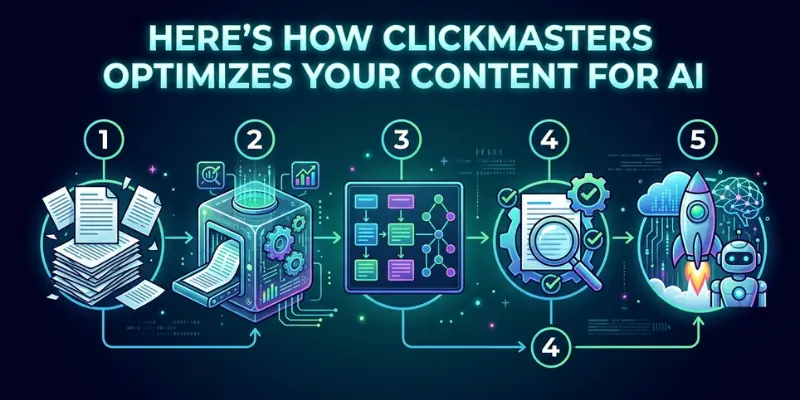
This is the exact process we follow for our clients.
Step 1: Answer the Question Before Anything Else
The #1 mistake most businesses make is burying the answer. They write long intros, give lots of background, and finally get to the point three paragraphs in.
AI systems don’t have patience for that. They want the answer in the first sentence or two, then the explanation after it.
We rewrite content so the most important information comes first. This is called “answer-first writing,” and it dramatically increases how often AI platforms cite your pages.
Step 2: Structure Everything So AI Can Scan It
Great content with bad structure won’t get cited. We ensure every page uses:
● H2 and H3 headings written as questions or clear statements
● Numbered steps for any process or how-to content
● Bullet points for lists of features, factors, or tips
● Tables for any comparisons or structured data
When AI can clearly see what each section is about, it’s far more likely to pull from your page.
Step 3: Add Real Data and Pakistan-Specific Insights
This is what separates good GEO from great GEO. We help you add:
● Specific statistics with clear sources
● Results and case studies from your actual clients
● Local market observations: Pakistani consumer behavior, local pricing, regional trends
● Year-stamped data so AI knows your content is current
Content with original, verifiable data gets cited. Generic content gets ignored.
Step 4: Build Content Around the Questions Your Customers Ask
We research every question your target customers are typing into Google, ChatGPT, and Perplexity. Then we build content that answers those questions directly with question-based headings, detailed explanations, and FAQ sections.
When an AI gets asked that question, it finds your page and cites it. That’s how you get in front of customers who never even clicked a traditional search result.
Step 5: Tailor the Approach to Each Platform
Every AI platform is different. Here’s how we handle each one:
| Platform | What It Prioritizes | How Clickmasters Optimizes for It |
| Google AI Overviews | E-E-A-T, domain authority, structured data | Schema markup, author credentials, strong content clusters |
| ChatGPT Search | Clear explanations, conversational tone, depth | Answer-first structure, plain English, comprehensive coverage |
| Perplexity | Fresh sources, citations, original data | Regular updates, explicit sourcing, unique local insights |
One-size-fits-all doesn’t work for GEO. Clickmasters builds a strategy tailored to all three platforms simultaneously.
The Technical Side That Most Agencies Skip (But We Don’t)
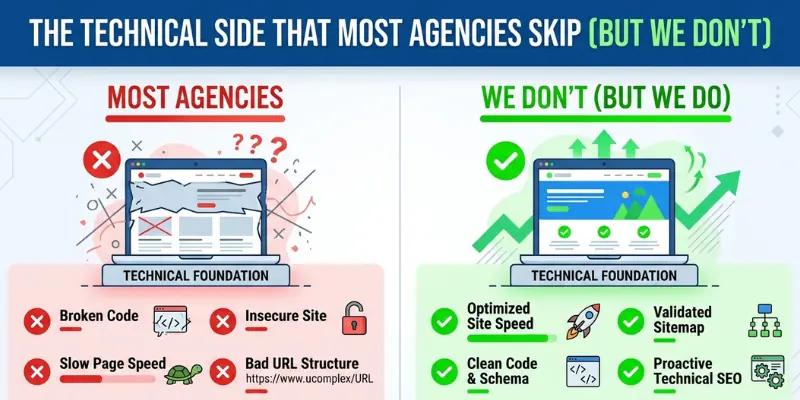
Good content alone won’t get you cited if the technical foundation is broken. Here’s what we fix:
AI bots need to be able to reach your pages
We audit your robots.txt and crawl settings to make sure Google’s AI crawler, PerplexityBot, and GPTBot can all access your content without being accidentally blocked.
Schema markup is one of the most powerful GEO tools available, and most Pakistani websites don’t use it. We implement:
● FAQ Schema tells AI exactly which parts of your page are questions and answers
● HowTo Schema flags step-by-step content for direct extraction
● Article Schema communicates authorship, publish dates, and content type
● Organization Schema establishes your brand identity and credibility
● Local Business Schema essential for any Pakistani business targeting local searches
Heading structure, semantic HTML, page speed, and mobile experience all feed into your overall authority score. A slow, poorly structured website signals low quality to AI systems, and they’ll pick a faster, cleaner competitor instead.
This is the technical groundwork Clickmasters lays before anything else. Without it, all the great content in the world won’t perform the way it should.
The Big Five: The AI Models Powering the 2026 Search Revolution
To successfully optimize your content for Generative Engine Optimization (GEO), you need to understand the engines actually processing your website’s data. The AI frontier moves fast, but the landscape is dominated by five core models that dictate how your customers find you online.
1. OpenAI’s GPT-4o / GPT-5 Series
- What it powers: ChatGPT, ChatGPT Search, and Microsoft Copilot.
- The Strength: The gold standard for broad, all-purpose internet search ecosystem integration. It features an advanced editing and iterative reasoning layer that rewards highly structured data.
- How to win it: Use “answer-first” writing. This engine favors conversational depth and clear, plain English summaries that resolve a user’s question within the first two sentences.
2. Anthropic’s Claude
- What it powers: Claude.ai, Artifacts, and widely adopted developer ecosystems.
- The Strength: Unmatched at processing dense, nuanced context and writing highly natural, human-sounding prose. It heavily penalizes generic, poorly structured text walls.
- How to win it: Focus on topical depth. Claude prefers content clusters that explore a topic comprehensively, rather than shallow, one-off keyword articles.
3. Google DeepMind’s Gemini
- What it powers: Google AI Overviews and Google Workspace search tools.
- The Strength: A multimodal powerhouse built to analyze massive datasets simultaneously (text, video, audio, and code). It sits directly on top of the traditional Google indexing system.
- How to win it: Double down on E-E-A-T and Schema markup. Gemini relies heavily on author credentials, trusted external citations, and technical backend schemas (like FAQ and Local Business markup) to verify facts.
4. Perplexity AI (Sonar Models)
- What it powers: Perplexity Search engine.
- The Strength: Built strictly as a real-time answer and research engine. It skips conversational fluff and pulls current, live web data, displaying clear citation links directly next to its answers.
- How to win it: Provide fresh, original data. Perplexity favors the most recently updated content and uniquely sourced local market insights over static, outdated web pages.
5. xAI’s Grok
- What it powers: X (formerly Twitter) platform searches and real-time social data feeds.
- The Strength: The absolute king of real-time information retrieval, live trend tracking, and parsing breaking social commentary.
- How to win it: Focus on speed and local relevance. Publishing swift, current industry analysis with localized context makes your brand highly visible to this model’s rapid learning architecture.
How We Use AI Tools to Create Better Content (Without the Shortcuts)
AI tools like Claude, ChatGPT, Grok, and Perplexity are part of our content workflow. But we use them the right way as assistants, not replacements.
Here’s how our team uses each tool:
● Perplexity for research. Finding the latest data, checking what competitors are covering, and identifying sources worth citing.
● Claude / GPT-4o for structure and clarity. We use these to build answer-first outlines, tighten explanations, and make sure every section directly addresses the question.
● Grok / Gemini for finding unique angles and generating Pakistan-specific examples that make content locally relevant and harder to replicate.
Our Hybrid Workflow: Human Expertise + AI Efficiency
1. Research: Use Perplexity to map the topic and find current data
2. Outline: Use Claude or GPT-4o to build an answer-first content structure
3. First draft: Write with AI assistance, guided by the outline
4. The human layer: Our team adds real client results, local market knowledge, original observations, and Pakistani context; this step cannot be automated
5. Review: Run the draft through an AI tool to check clarity and completeness
6. Publish: Add citations, verify every fact, apply schema markup, and push live
Why we never publish raw AI content: AI can write fast, but it can’t replace genuine expertise. Unedited AI content is generic; it reads like every other article on the internet. AI systems are increasingly trained to recognize and deprioritize it. More importantly, your customers can tell the difference. Everything we publish has a real human layer of expertise, local knowledge, and original insight on top of it.
Getting Other Websites to Mention You: The GEO Off-Page Strategy
What other websites say about you matters just as much as what your own website says. AI systems track brand mentions across the internet to decide how credible and authoritative a source is.
Here’s how Clickmasters builds your off-page GEO presence:
● Brand mentions in reputable sources: getting your business named in industry publications, news sites, and high-authority blogs, even without a direct link
● Features in Pakistani media: coverage in Dawn Business, Profit by Pakistan Today, and sector-specific Pakistani platforms carries strong local authority signals
● Original research that earns natural citations: we help you publish surveys, data reports, or market analyses that other websites want to reference
● Shareable assets: infographics, statistics, and unique data points that other sites link to and cite
● Consistent business information everywhere: your business name, address, phone number, and description must be identical across every platform so AI systems can confidently identify and reference you
The goal is simple: the more reputable sources mention your brand, the more AI systems trust you as a reliable source and the more they cite you.
7 GEO Mistakes That Are Costing Pakistani Businesses and Customers Right Now
We audit a lot of websites. Here are the mistakes we see over and over again:
1. Publishing thin AI content with no human value.
Hundreds of businesses are now flooding the web with AI-generated articles. They read the same as every other AI-generated article. AI search systems are getting better at identifying and skipping this content. If there’s nothing unique on your page, you won’t be cited.
2. Writing for only one platform.
Optimizing only for Google while ignoring Perplexity and ChatGPT Search means missing a growing share of search traffic. Your GEO strategy needs to cover all three.
3. Ignoring Perplexity entirely.
Perplexity is particularly valuable because it shows citations right next to the answer. That means your brand name appears visibly alongside the response free brand exposure to a high-intent audience. Most Pakistani businesses aren’t even thinking about it yet.
4. Never updating old content.
AI systems prefer recent information. An article from 2022 that hasn’t been touched will lose ground to a similar article refreshed in 2025 or 2026. Content maintenance isn’t optional anymore.
5. No E-E-A-T signals.
No author bio, no credentials, no evidence of real-world experience. Anonymous content gets dismissed by AI systems. Show who wrote the content and why they’re qualified to write it.
6. Skipping schema markup.
This is the single most underused technical GEO tool in Pakistan. Almost no local business websites have proper FAQ, HowTo, or LocalBusiness schema, which means a massive opportunity for those who do.
7. Treating GEO as a one-time project.
GEO is not a checkbox. It’s an ongoing strategy. AI platforms update constantly. Content needs to be refreshed. New questions need to be answered. Businesses that treat GEO as a one-time fix fall behind within months.
How Do You Know If Your GEO Is Actually Working?
Traditional SEO gave you rankings. GEO gives you a different set of numbers to watch, and Clickmasters tracks all of them for our clients.
Here’s what real GEO success looks like:
● Your content appears inside Google AI Overviews when target queries are searched
● Perplexity cites your website when users ask questions in your industry
● ChatGPT Search references your brand or pulls from your pages
● Referral traffic from AI platforms (ChatGPT.com, Perplexity.ai) starts showing up in your analytics
● Your brand gets mentioned in AI-generated answers even when users didn’t search for you by name
We use tools like SE Ranking’s AI Overview tracker, Profound, and manual citation monitoring to measure exactly how visible your brand is inside AI answers, and we report on it regularly.
The goal isn’t just traffic. It’s becoming the source AI systems trust and cite in your industry. That kind of authority compounds over time, and it’s very hard for competitors to copy once you’ve built it.
Your Competitors Won’t Wait. Neither Should You.
GEO adoption in Pakistan is still low, giving early movers a major advantage. Every time AI platforms cite your content, your authority grows—leading to more visibility, more trust, and more future citations.
The businesses that invest in GEO today will be the ones AI recommends tomorrow.
At Clickmasters, we help Pakistani businesses build AI citation authority and become the trusted sources that Google AI Overviews, ChatGPT, and Perplexity rely on.
The opportunity is open right now. The question is: will your business claim it before your competitors do?
Ready to Find Out If AI Is Ignoring Your Business?
Contact Clickmasters to audit your website for GEO readiness and build you a custom strategy.
We’ll show you exactly where your business stands in Google AI Overviews, ChatGPT Search, and Perplexity, and what it will take to start getting cited.
FAQs!
What is Generative Engine Optimization (GEO)?
GEO is the practice of optimizing your content so AI engines—like Google AI Overviews, ChatGPT Search, and Perplexity—extract, quote, and link to your website inside their summarized answers. While traditional SEO ranks web pages, GEO secures brand citations inside AI-generated responses.
How do Google AI Overviews, ChatGPT Search, and Perplexity differ?
Each AI platform looks for different content signals:
Google AI Overviews: Prioritizes domain authority, strong content clusters, and E-E-A-T.
ChatGPT Search: Favors clear, conversational, “answer-first” writing and depth.
Perplexity: Rewards fresh content, explicit external sourcing, and original local data.
Why is Schema markup critical for AI search optimization?
Schema markup acts as a direct roadmap for AI bots. Implementing FAQ, HowTo, and Local Business schema structures your data so crawlers like GPTBot and PerplexityBot can easily read, parse, and pull your information for direct user answers.
Why is publishing unedited, raw AI content hurting my brand?
Raw AI content is generic, repetitive, and lacks real-world expertise. Modern generative engines are trained to recognize and deprioritize cookie-cutter AI text. To get cited, your content must have a human layer featuring original observations, client case studies, and local data.
What are the biggest GEO mistakes costing businesses customers right now?
The most common mistakes include treating GEO as a one-time project, leaving old content unrefreshed, ignoring Perplexity and ChatGPT Search, omitting author E-E-A-T signals, and failing to audit robots txt files to unblock AI crawlers.
How do I measure the ROI and success of a GEO strategy?
Success is tracked through AI-specific metrics rather than traditional keyword positions. You are winning when your content appears inside Google AI Overviews, your site is actively cited by ChatGPT and Perplexity, and you see direct referral traffic from ChatGPT.com and Perplexity in your analytics.
How does Clickmasters optimize content to win AI citations?
Clickmasters uses a hybrid workflow that builds authority across all three major platforms. We implement “answer-first” writing (answering queries in the first two sentences), use highly scannable formatting (tables and bullet points), inject Pakistan-specific market data, and secure off-page digital PR mentions to build algorithmic trust.