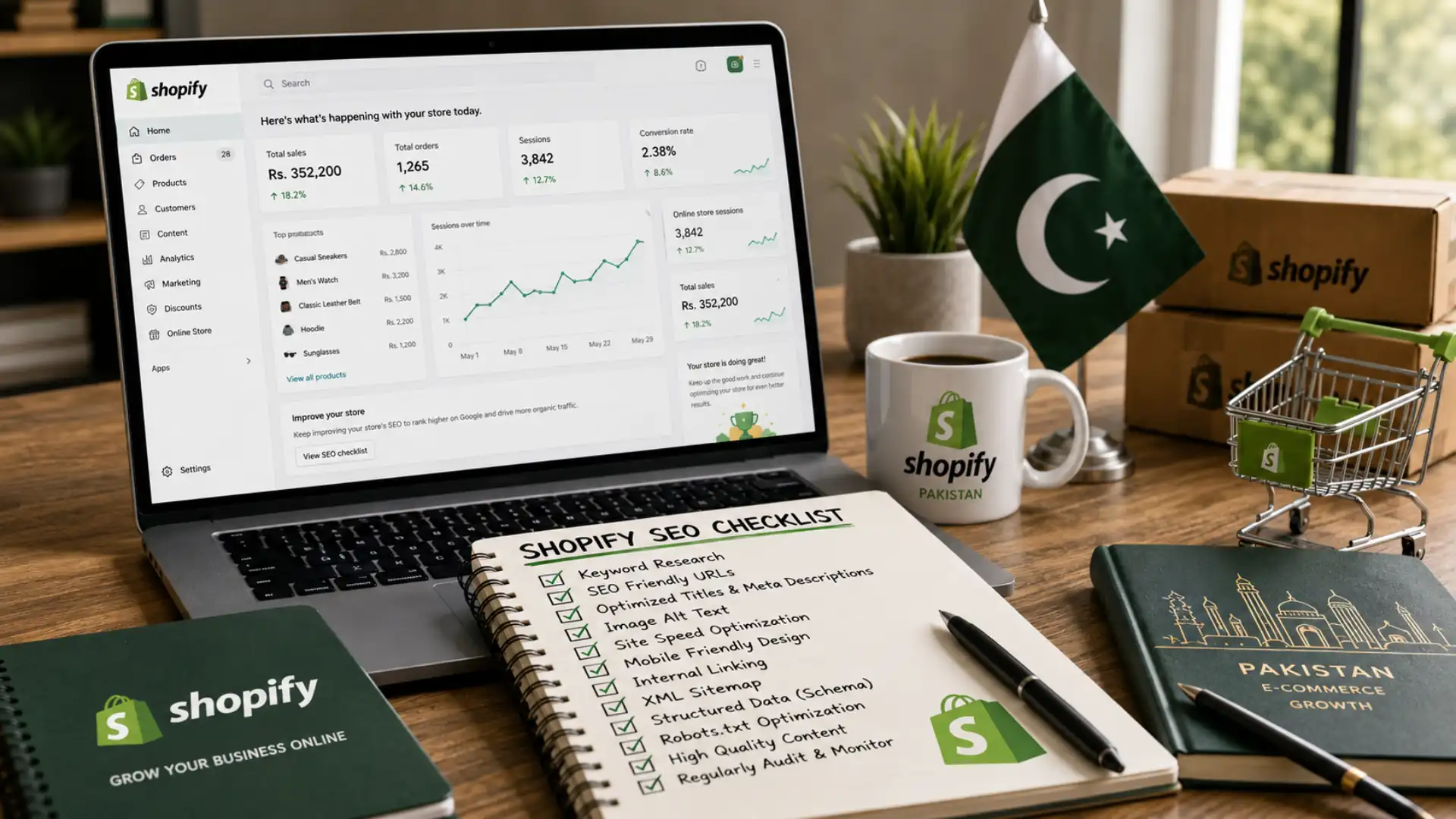
Most Pakistani Shopify stores are built for ads and abandoned by Google. The owner runs Meta ads, gets sales, scales spend — and the day ROAS dips, revenue dips with it. Organic search is the exit from that treadmill, and Shopify gives you 80% of the technical foundation out of the box. The other 20% is where stores in Karachi, Lahore, and Islamabad quietly lose to competitors who did the work.
This checklist covers that 20%: technical setup, product and collection page optimization, and the one problem international guides never touch — COD landing pages that convert Pakistani buyers without poisoning your rankings. Work through it in order. For stores past the DIY stage, this is the same sequence we run inside our full SEO services in Pakistan engagements — audit first, money pages second, content at scale last.
Table of Contents
Part 1: Technical Foundation (Do This First)
Shopify handles hosting, SSL, and mobile responsiveness. You handle the rest:
- ☐ One domain version. Set your primary domain (yourstore.pk or .com) in Settings → Domains and confirm all variants 301-redirect to it. Splitting traffic between www and non-www is split authority.
- ☐ Submit your sitemap. Shopify auto-generates /sitemap.xml. Submit it in Google Search Console and check Coverage monthly — Pakistani stores routinely have half their products sitting in “Discovered, not indexed.”
- ☐ Kill duplicate product URLs. Shopify creates both /products/handle and /collections/name/products/handle. Canonical tags handle most of it, but check your theme links to canonical URLs internally. In product-grid-item. liquid (or your theme’s equivalent), use {{ product.url }} not {{ product.url | within: collection }}.
- ☐ Speed pass. Compress every image to WebP before upload, delete apps you installed and forgot (each one injects scripts), and limit homepage sliders. Test on PageSpeed Insights mobile — that’s how your buyers on Zong and Jazz connections experience you.
- ☐ Structured data. Confirm Product schema outputs price, availability, and review stars (test with Google’s Rich Results tool). If your theme is old, a schema app pays for itself in CTR — a PKR price showing directly in Google results pre-qualifies the click.
- ☐ Fix your currency display. If you sell only in Pakistan, lock PKR. If you sell internationally, use Shopify Markets with proper hreflang output — more on this in the international scaling guide (Spoke 4 in this series).
Part 2: Keyword Mapping — Match Pages to Pakistani Search Behavior
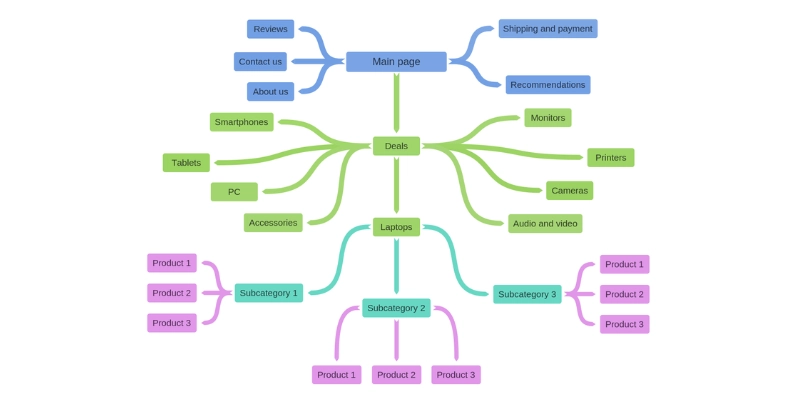
Pakistani ecommerce search has a distinct fingerprint. Buyers search:
- “[product] price in Pakistan” — the single highest-intent modifier in the market
- “[product] online Pakistan” / “buy [product] online”
- City-level queries — “sneakers Lahore,” “abaya Karachi”
- Romanized Urdu — “khussa,” “lawn suits,” “shalwar kameez design”
Map them like this:
| Page Type | Target Pattern | Example |
|---|---|---|
| Homepage | Brand + category | XYZ — Men’s Sneakers Pakistan |
| Collection | Category + “price in Pakistan” | Running Shoes Price in Pakistan |
| Product | Exact product + spec | Air Cushion Runner Grey — Size 40–45 |
| Blog | Informational | How to check original shoes in Pakistan |
Rule: one keyword family per page. If two collections chase “ladies shoes,” Google picks one at random or neither. Merge or differentiate.
Part 3: Collection Pages — Your Real Money Pages
Product pages come and go with stock. Collection pages compound. They deserve the most optimization and get the least:
- ☐ Write 150–300 words of buying guidance on each collection page — sizing advice, material comparison, price ranges in PKR. Place it below the product grid so it informs Google without pushing products down.
- ☐ Handwrite the meta title and description. Default Shopify output (“Collection Name – Store Name”) wastes the most valuable 60 characters you own. Format: Running Shoes Price in Pakistan | Free Delivery & COD — StoreName.
- ☐ Interlink sibling collections (“Also shop: Trainers · Sandals · Formal”) — this distributes authority and lifts pages-per-session.
- ☐ Never let a seasonal collection 404. After Eid or 11.11, redirect the collection to its parent category instead of deleting it. Deleted seasonal pages throw away a year of accumulated links and history.
Part 4: Product Pages That Rank and Convert COD Buyers
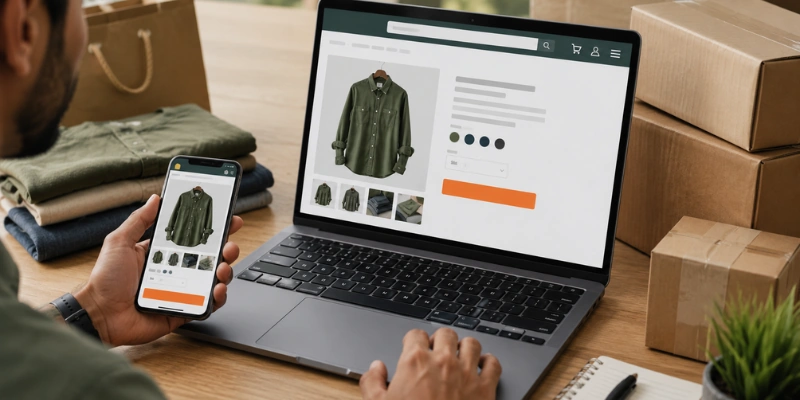
- ☐ Unique descriptions — always. Copy-pasting the supplier’s text puts you in a duplicate pool with fifty other stores. 120+ original words per product: who it’s for, exact measurements, care instructions.
- ☐ Answer the trust questions in the description: Is COD available? What’s the return window? How long to Karachi vs. Quetta? Original or copy? These are conversion objections and long-tail keywords.
- ☐ Alt text on every image — descriptive, not stuffed: “black leather khussa handmade Multan” not “shoe shoe buy shoe.”
- ☐ Enable review collection from day one. Review snippets in search results are the strongest CTR lever a Pakistani store has, because default buyer skepticism is high. Judge.me or Loox with photo reviews — Pakistani buyers trust customer photos over studio shots.
- ☐ Out-of-stock protocol: keep the page live with a restock notification form if it ranks. Only redirect permanently discontinued items to the closest alternative.
Part 5: COD Landing Pages — The Pakistan-Specific Problem
Here’s the situation nobody documents. Pakistani stores running Meta/TikTok ads build dedicated COD landing pages — long-form, single product, order form embedded, no navigation. They convert brilliantly. They’re also an SEO hazard when handled carelessly:
- They duplicate your product page content → cannibalization and duplicate content
- They’re thin, template-generated, and often cloned per campaign → doorway page pattern
- Dozens of near-identical indexed variants dilute crawl budget and can drag down site quality assessment overall
The fix is separation of duties:
- ☐ Noindex every ad landing page. Add noindex via your theme or app on all /pages/offer-* style landers. Their job is converting paid traffic, not ranking.
- ☐ Keep one canonical product page indexed — the SEO asset that ranks for “[product] price in Pakistan.”
- ☐ Don’t run Google Ads to noindexed pages you also want quality-scored — send Google Ads to the real product page; keep the aggressive landers for Meta/TikTok where Google quality score is irrelevant.
- ☐ Borrow the winners. Your COD landers reveal exactly which headlines, badges (“All Pakistan Free Delivery,” “Check Then Pay”), and objection-handlers convert. Fold those elements into the indexed product page — you get the conversion lift and the rankings.
- ☐ UTM-tag all campaign URLs so paid landing traffic never contaminates your organic reporting.
This structure lets the performance team run wild without the SEO team cleaning up penalties later.
Part 6: Local Trust & Authority Signals
- ☐ Google Business Profile — even for online-only stores, a verified profile with your registered address builds entity trust and captures branded map searches.
- ☐ Consistent NAP across Facebook, Instagram, Daraz seller profile, and your footer.
- ☐ Get listed on Pakistani shopping directories and price-comparison sites, and pitch local blogs/YouTubers who review products in your category. Five relevant Pakistani links beat fifty foreign directory links.
- ☐ Publish 2–4 buying-intent blog posts monthly targeting question keywords (“lawn vs cotton — which is better for summer?”) and internally link every post to its matching collection.
The Order of Operations
Weekend one: Part 1 complete. Week two: keyword map + top 10 collections rewritten. Weeks three–four: top 50 products, review app live, COD landers noindexed. Ongoing: blog cadence + link outreach.
Run this sequence, and most Pakistani Shopify stores see measurable movement in 60–90 days — because most competitors have done none of it.
Scaling past what a checklist can hold — hundreds of SKUs, international markets, marketplace + store combined? That’s what our ecommerce SEO team runs as a managed program. And if you also sell on Daraz, start with our Daraz listing optimization guide — the two channels feed each other.
GET IN TOUCH
Get 1 Free Consultation Call
FAQ
Is Shopify good for SEO in Pakistan?
Yes. Hosting, SSL, mobile, and clean sitemaps come standard. Its known limitations (locked URL structure, /products/ prefix) matter far less than execution on titles, collections, and content — where most Pakistani stores haven’t competed yet.
Should COD landing pages be indexed?
No. Noindex ad-specific landers and keep one canonical product page per item indexed. You avoid duplicate content while keeping high-converting pages for paid traffic.
How many keywords should one product page target?
One primary family (product + “price in Pakistan” variants) plus natural long-tails in the description. One page, one intent.
How long until a Shopify store ranks in Pakistan?
New stores: 4–6 months to meaningful traffic. Established stores fixing this checklist: movement in 60–90 days, compounding after.