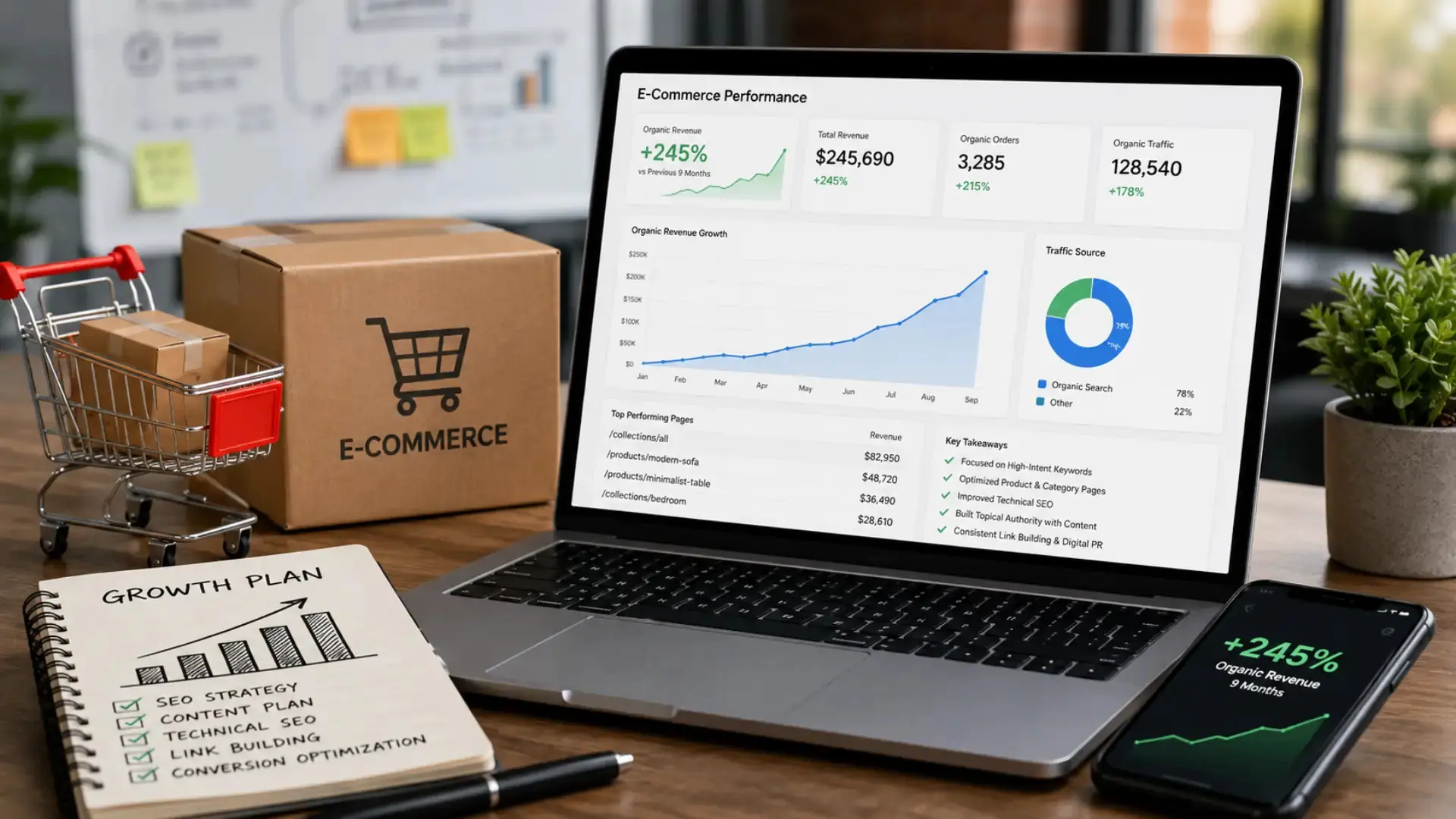
The client — a Pakistani e-commerce brand in the home & lifestyle category, name withheld under NDA — came to us with a familiar profile: PKR 4M+ monthly revenue, 85% of it from Meta ads, and a website that Google treated like it didn’t exist. When ad costs jumped in Q4, margin evaporated overnight. The brief was blunt: build a revenue channel we own.
Nine months later, organic revenue was up 245%, organic sessions had grown 310%, and organic’s share of total revenue had moved from 9% to 31% — while ad spend stayed flat. Here’s the exact sequence, because the sequence is the strategy. It’s the same three-phase system we run across every SEO services in Pakistan engagement: technical remediation first, money pages second, content at scale last. Reversing that order is why most ecommerce SEO fails.
Table of Contents
Starting Position
| Metric | Month 0 |
|---|---|
| Organic sessions/month | ~14,200 |
| Organic revenue share | 9% |
| Keywords in top 10 | 38 |
| Indexed pages | 3,900 (of ~1,200 real pages) |
| Revenue dependence on paid | 85% |
The audit surfaced three compounding problems:
- Index bloat. 3,900 indexed URLs against 1,200 real pages — faceted filter URLs, tag pages, and dozens of cloned COD ad landers all indexed and competing with the pages that mattered.
- Zero collection-page substance. Every collection page was a product grid with a default meta title. The store’s most rankable assets were blank.
- Supplier-copied product descriptions shared word-for-word with a dozen competing stores.
Phase 1 (Months 1–2): Technical Remediation
No content was written in the first eight weeks. The foundation had to stop leaking first:
- Noindexed all faceted/filter URLs, tag archives, and 41 COD ad landing pages that were cannibalizing product rankings
- Consolidated duplicate product URLs to canonical paths and fixed internal links pointing at collection-scoped variants
- Cut mobile load time from 6.8s to 2.9s: WebP conversion across 2,400 images, removal of 9 abandoned apps, theme script cleanup
- Deployed Product, Organization, and FAQ schema; review stars began appearing in results by week 6
- Rebuilt the 404 map — 130+ dead seasonal collection URLs from two years of Eid/11.11 campaigns were 301’d to parent categories, recovering their accumulated equity
Result by end of Month 2: indexed pages down to ~1,150 (clean), impressions already up 40% with no new content — Google was finally seeing the store instead of the noise.
Phase 2 (Months 2–4): Money Pages

With the foundation clean, we rebuilt the 25 highest-opportunity pages, prioritized by (search volume × commercial intent) ÷ difficulty:
- 18 collection pages rewritten with buying guidance, PKR price-range content, and handwritten metas targeting “[category] price in Pakistan” patterns
- 7 hero product pages with original descriptions answering the COD-buyer objections directly: delivery timelines by city, check-then-pay policy, return process
- A review app with photo reviews launched; within 90 days, 400+ reviews were feeding rich snippets
- Internal linking rebuilt so every blog-to-be had a defined money-page target
Result by end of Month 4: top-10 keywords from 38 → 112. The flagship collection page moved from position 28 to position 4 for its primary “price in Pakistan” keyword.
Phase 3 (Months 4–9): Content at Scale

Only now — with technicals clean and money pages live — did content production start:
- 2 buying-intent guides per week (“how to choose,” “X vs Y,” price guides) each linking to its matching collection
- A glossary and size-guide layer capturing long-tail informational queries
- Digital PR: product roundups and expert commentary placed on Pakistani lifestyle blogs and news sites — 34 referring domains added, zero paid links, zero Rs. 10,000 “guest post package” spam
- Answer-formatted content blocks added for AI search surfaces — by month 8 the brand was appearing in AI Overview citations for two category queries
The Numbers at Month 9
| Metric | Month 0 | Month 9 | Change |
|---|---|---|---|
| Organic sessions/month | 14,200 | 58,300 | +310% |
| Organic revenue/month | PKR 360K | PKR 1.24M | +245% |
| Keywords in top 10 | 38 | 340+ | +795% |
| Organic revenue share | 9% | 31% | +22 pts |
| Blended CAC | — | — | −28% |
The number the founder cares about isn’t in the table: when Meta CPMs spiked again in month 7, monthly revenue didn’t move. The business had a second engine.
Why This Worked (And Where Most Stores Fail)
- Sequence discipline. Content published onto a broken foundation is wasted budget. Technical → money pages → scale. Every time.
- Deletion before creation. The biggest early win was removing 2,700 junk URLs, not adding anything.
- COD landers separated from SEO pages. The performance team kept their aggressive ad landers; SEO kept clean canonical pages. Both channels grew instead of fighting.
- Commit less, deliver more. We committed to 150 top-10 keywords by month 9 and delivered 340+. Conservative targets, aggressive execution — the reverse of how cheap SEO packages operate.
Could Your Store Do This?
The honest answer: only if the same conditions hold — a real product, willingness to fix technical debt before chasing content, and a 6–9 month horizon. If someone promises this in 30 days for Rs. 10,000/month, they’re describing a scheme, not a strategy.
If the conditions do hold, this playbook transfers. Start with the free audit — we’ll show you your version of the “3,900 vs 1,200” problem before any commitment. See our full ecommerce SEO services or go straight to the tactical guides in this series: the Daraz listing optimization guide and the Shopify SEO checklist for Pakistani retailers.
GET IN TOUCH
Get 1 Free Consultation Call
FAQ
How long did results take to appear?
Impressions moved within 8 weeks (technical cleanup alone). Revenue-relevant ranking gains started month 3–4, compounding through month 9.
What was the biggest single lever?
Index cleanup. Removing 2,700 junk URLs — including 41 indexed COD ad landers — did more in 60 days than any content could have.
Did the store stop running ads?
No. Ad spend stayed flat; organic grew alongside it. The goal was reducing dependence, not abandoning a working channel.
Is 245% typical?
No result is guaranteed and starting points vary enormously. What’s repeatable is the sequence — stores with similar untapped technical debt and blank money pages have the most room to move.