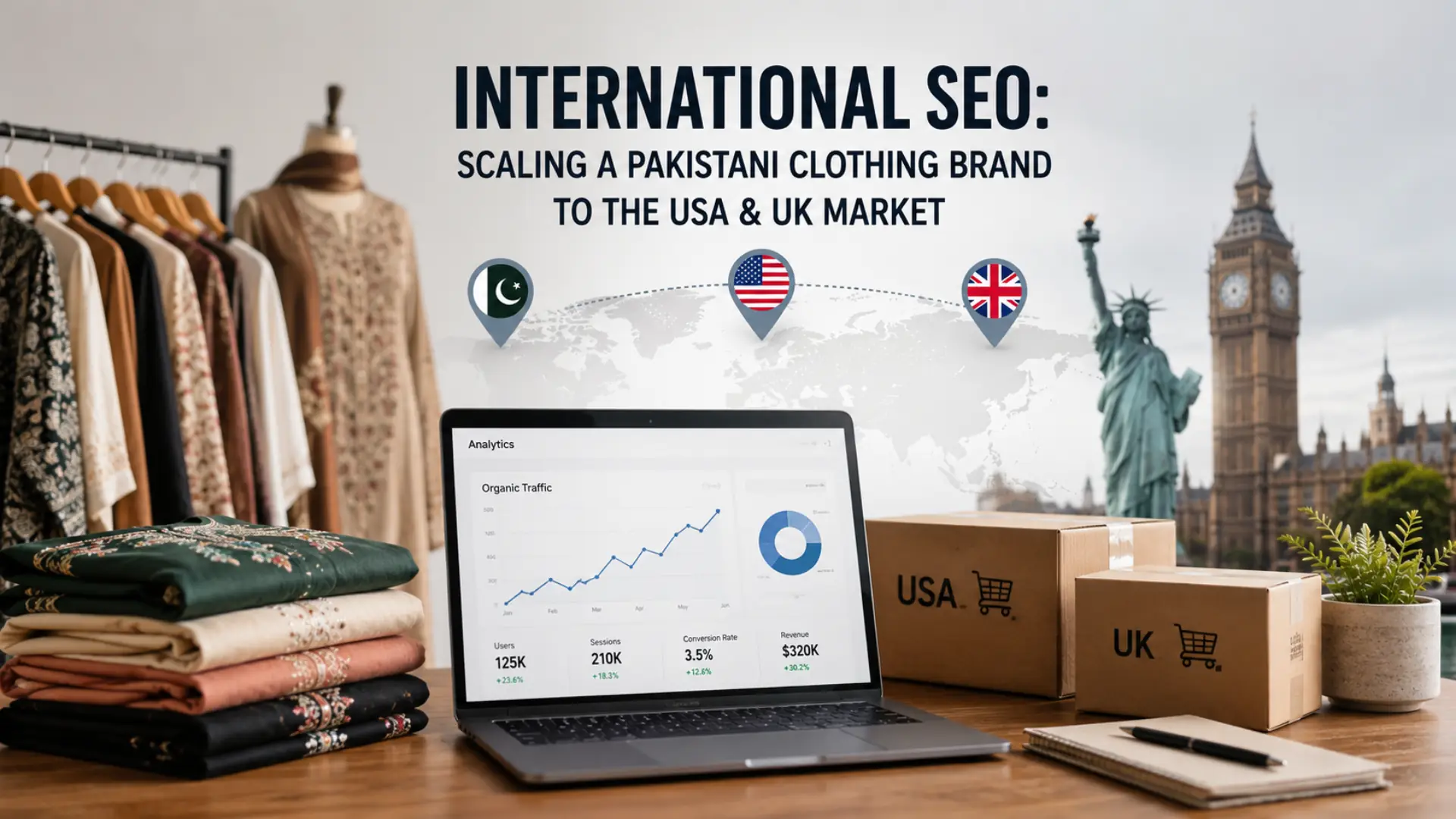
Pakistani fashion has a structural export advantage most industries would kill for: millions of diaspora buyers in the USA and UK actively searching for exactly what you make. “Pakistani lawn suits UK,” “shalwar kameez online USA,” “Pakistani wedding dresses” — these are established, high-volume search markets where the searcher wants a Pakistani brand. You’re not educating a foreign market. You’re answering a standing order.
Yet most brands attempt the jump the wrong way: they run US-targeted Meta ads to a PKR-priced website and wonder why conversion dies at checkout. International SEO fixes the structural problem underneath — making Google serve the right version of your store, in the right currency, to the right country. It’s the international layer of the same discipline we run domestically through our SEO services in Pakistan programs, and the sequencing matters just as much across borders as it does at home.
Table of Contents
Step 1: Choose Your Market Structure Before Touching Content
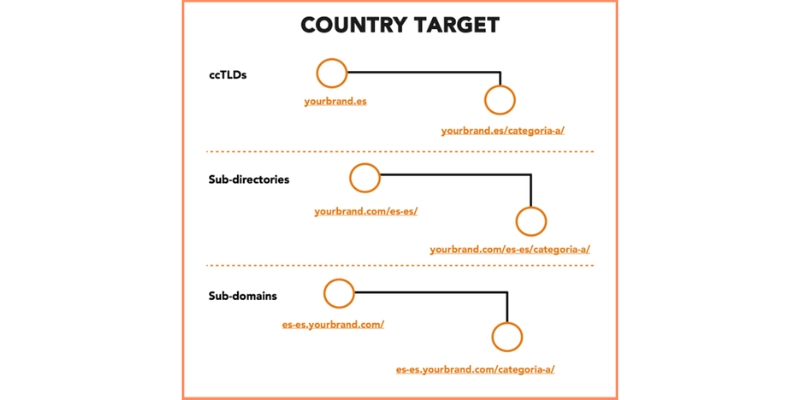
Three viable architectures. Pick once — migrating later is expensive:
| Structure | Example | Best For |
|---|---|---|
| Subfolders | yourbrand.com/us/, /uk/ | Most brands. One domain’s authority serves all markets |
| Subdomains | us.yourbrand.com | Rarely worth it — splits authority |
| ccTLDs | yourbrand.co.uk | Only with serious per-market budget and local operations |
Recommendation for 95% of Pakistani clothing brands: a single .com with subfolders, run through Shopify Markets (or WooCommerce with a multicurrency/geo setup). Your .pk domain keeps the home market; the .com carries international. Every backlink you earn strengthens every market simultaneously — critical when you’re building authority from zero in two new countries.
Set it up properly, and Shopify Markets outputs localized URLs, local currency, and the hreflang tags Google needs. Verify the output — don’t assume it.
Step 2: hreflang — The Tag That Decides Which Buyer Sees Which Page
hreflang tells Google: show /us/ pages to American searchers, /uk/ pages to British searchers. Get it wrong and your UK buyers land on USD pricing — or worse, your PKR home page.
The non-negotiables:
- Target language + country: en-US, en-GB, and en-PK (or x-default for your global fallback)
- Tags must be reciprocal — every version references every other version, including itself
- Every URL referenced must be indexable (no hreflang pointing at noindexed or redirected pages)
- Audit quarterly with Screaming Frog’s hreflang report; broken reciprocity is the most common silent failure
Common Pakistani-brand mistake: creating /us/ and /uk/ versions with identical content and prices. hreflang isn’t a duplicate-content license — it’s a promise that versions are meaningfully localized. Which brings us to Step 3.
Step 3: Localize Like a Merchant, Not a Translator
Both markets speak English. The localization work is commercial, not linguistic:
Vocabulary that changes rankings:
- UK buyers search “Pakistani suits” and “asian clothes UK”; US buyers lean “Pakistani dresses” and “desi clothes USA”
- “Trouser suit” (UK) vs. “pant suit” (US); “dupatta” carries in both but “scarf/shawl” variants differ
- Run separate keyword research per market — set your tool’s location to the US and UK independently. The volumes and phrasings genuinely diverge
Pages that must differ per market:
- Currency: USD and GBP native — never a PKR conversion widget
- Shipping/returns page per market: “7–10 day delivery to the USA, tracked” with duties/taxes handled transparently. Unstated customs charges are the #1 international review-killer for Pakistani brands
- Size guides: UK sizing and US sizing charts against your Pakistani cuts — this is also a long-tail keyword magnet (“Pakistani suit size chart US”)
- Occasion framing: Eid collections work in both markets, but the US market adds strong “Pakistani wedding guest dress” seasonality tied to summer wedding season; the UK has dense Ramadan/Eid commercial peaks around its larger concentrated communities
Step 4: Build the Diaspora Keyword Map
Your international demand splits into three intent layers — each maps to a different page type:
- Direct product demand — “unstitched lawn suits USA,” “Pakistani formal wear UK” → collection pages per market
- Occasion demand — “Eid outfits 2026,” “mehndi dresses,” “walima guest outfit” → occasion collection pages rebuilt annually on the same URLs (never create dated URLs you’ll abandon)
- Trust/informational demand — “best Pakistani clothing brands online,” “is [brand] original,” “lawn vs cotton” → blog + comparison content on the market subfolder
The occasion layer is where Pakistani brands beat generic “modest fashion” competitors: you have native authority on Eid, shaadi season, and mehndi dress codes that a US fast-fashion site can’t fake. Publish that expertise under the market subfolder so it ranks locally.
Step 5: Earn Links in the Target Country
A .com full of Pakistani links ranks in Pakistan. To rank in the US and UK, you need referring domains from those markets:
- Diaspora and South Asian lifestyle media — wedding blogs, cultural publications, and “where to buy Pakistani clothes in [city]” roundups actively seek brand features
- Fashion + modest-wear influencers with blogs (not just Instagram) — a review post with a followed link builds rankings; a story mention doesn’t
- Digital PR angles that travel: craft provenance (“hand-embroidered in Multan”), artisan stories, and Pakistan-to-world pricing transparency are genuinely link-worthy to Western fashion press
- UK/US directory hygiene: local business listings where you have any physical presence (warehouse, returns address)
What to refuse: the Rs. 10,000 “50 DA50+ backlinks” packages. Those links come from farms Google discounted years ago, and on a fresh international subfolder they can hold you back exactly when you need clean signals most.
Step 6: Operational Signals Google Reads as Trust
International rankings compound when buyer signals are healthy — and Pakistani brands lose these on operations, not content:
- Returns reality: a US buyer will not pay return shipping to Karachi. Offer a US/UK returns address (third-party services handle this) and say so on every product page — it lifts conversion and reduces the refund disputes that damage brand searches
- Delivery honesty: stitched-to-order means 3 weeks; state it. “Where is my order” complaints become “brand name + scam” searches, and those poison your branded SERP in a new market
- Reviews per market: collect and display reviews from US/UK buyers specifically — “arrived in Texas in 8 days” converts an American browser better than 500 Lahore reviews
- Payment stack: PayPal and local cards are trust signals in themselves; COD instinct doesn’t export
The 6-Month Rollout Sequence
- Month 1: Market structure live (Shopify Markets), hreflang verified, currency/shipping/size pages built per market
- Months 2–3: Per-market keyword research; top 15 collection pages localized for US and UK; occasion-page architecture created on evergreen URLs
- Months 3–6: 2 informational posts per market monthly; digital PR outreach running; first 15–20 target-country referring domains
- Ongoing: Quarterly hreflang audits, occasion pages refreshed pre-Eid and pre-wedding-season, review velocity per market tracked
Expect first meaningful international organic traction around months 4–6 on an established domain, longer on a fresh .com — which is precisely why the smart play is starting international SEO before international ads have burned three months of budget proving demand you already knew existed.
Where This Fits in Your Full Stack
International SEO is the fourth layer of an ecommerce program that starts at home: marketplace visibility (see our Daraz optimization guide), a technically sound store (the Shopify SEO checklist), a proven domestic playbook (our ecommerce growth case study), and then the border jump. Brands that skip the first three export their problems along with their products.
If you’re ready for the jump — or want us to audit whether your store’s foundation can carry international weight — our ecommerce SEO team runs Pakistan-to-USA/UK expansion as a managed program: structure, localization, content, and target-country link building under one roadmap.
GET IN TOUCH
Get 1 Free Consultation Call
FAQ
Should I use my .pk domain or a .com for international sales?
Keep .pk for the home market; run international on a .com with /us/ and /uk/ subfolders. A .pk domain carries a geographic signal that works against you abroad.
Do I need separate websites for the USA and UK?
No. One .com with localized subfolders, correct hreflang, and per-market currency/shipping pages is the standard and consolidates your authority.
How long before a Pakistani brand ranks in the US or UK?
On an established domain with clean setup: initial traction in 4–6 months, competitive rankings in 9–12. Fresh domains take longer — start before you need the revenue.
Is the diaspora market big enough to justify this?
Yes — and it’s the beachhead, not the ceiling. Brands typically win diaspora searches first (“Pakistani suits UK”), then expand into broader modest-fashion and occasion-wear keywords once authority is established.