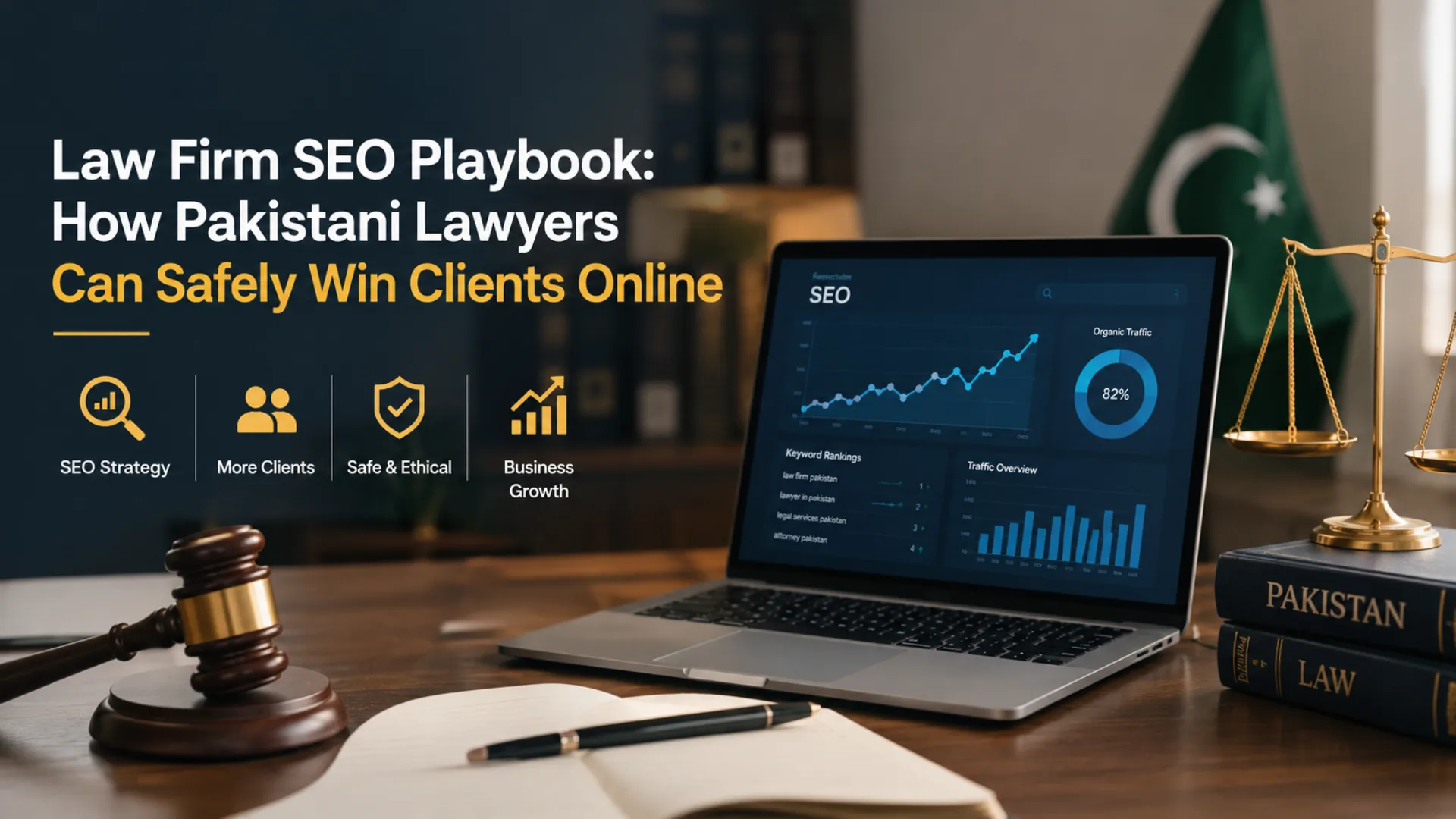
Legal marketing in Pakistan carries a constraint no other niche in this series faces: the profession’s own conduct rules. The Pakistan Bar Council’s Canons of Professional Conduct and Etiquette restrict advocates from advertising and soliciting clients — which is precisely why so many excellent Pakistani lawyers have no meaningful web presence, and why the “SEO for lawyers” packages sold locally (stuffed with “best lawyer in Lahore #1” claims) are professionally radioactive for the advocates who buy them.
Here’s the strategic reading of that constraint: the same rules bind your competitors, most of whom respond by doing nothing online. The firms winning clients from search are the ones who found the compliant lane — educational authority instead of advertisement, findability instead of solicitation. A person searching “khula procedure in Pakistan” at midnight isn’t being solicited when your accurate guide answers them; they’re being served, and they call the author. This playbook builds that lane end to end. One caveat governs everything below: conduct rules and their enforcement evolve, and interpretations vary — have your own Bar Council obligations reviewed before launch, and treat every recommendation here through that filter. That compliance-first sequencing is how we structure legal-sector engagements within our SEO services in Pakistan generally: constraints first, then strategy inside them.
Table of Contents
The Compliance Frame: What Shapes Every Decision Below
Without giving legal advice about legal advertising (the irony is noted), the working principles careful Pakistani firms operate on:
- No self-laudatory claims. “Best lawyer,” “highest success rate,” “guaranteed results” — out. Factual, verifiable statements — practice areas, courts of practice, enrollment year, publications, reported cases — in.
- Information, not inducement. Educational content explaining law and procedure is the profession’s tradition (lawyers have always written); “call now for a discount consultation” urgency copy is solicitation dressed as marketing.
- Dignity of presentation. Restrained design and language aren’t just compliant; in this market they convert better — clients hiring for high-stakes matters distrust lawyers who market like retailers.
- Confidentiality is absolute. No client names, no case specifics identifiable to a matter, ever — including in testimonials and case results. This constraint shapes the trust strategy below more than any other.
Everything that follows is built to work inside this frame.
Keyword Reality: How Pakistanis Search for Legal Help
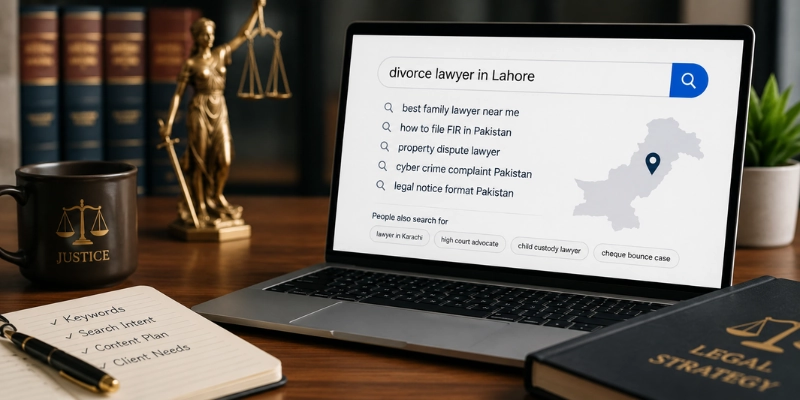
Legal search intent in Pakistan splits into three layers, and the money is in understanding which converts:
Layer 1 — Procedural questions (massive volume, authority-building):
- “khula procedure in Pakistan,” “how to file for divorce in Pakistan”
- “child custody laws in Pakistan,” “inheritance law for daughters in Pakistan”
- “how to register a company with SECP,” “tenant eviction process Punjab”
- “cheque bounce case procedure,” “FIR quashing process”
Layer 2 — Situation + city (the converting core):
- “family lawyer Islamabad,” “property lawyer Lahore,” “corporate lawyer Karachi”
- “advocate for khula case Rawalpindi,” “taxation lawyer Islamabad”
Layer 3 — Urgent/specific (low volume, immediate clients):
- “bail lawyer Karachi,” “NAB case lawyer,” “overseas Pakistani property dispute lawyer”
The overseas segment again deserves separate mention: diaspora Pakistanis with inheritance, property-fraud, and family matters back home search in English from the UK/US/Gulf, need remote handling with power of attorney, and represent the highest-value, least-served client pool in Pakistani legal search. A dedicated content and intake track for them routinely outperforms everything else on a firm’s site.
Romanized Urdu matters throughout (“khula ka tarika,” “wirasat ka qanoon”) — write primary pages in English, weave the Roman-Urdu phrasings naturally into headings and FAQs, and consider parallel Urdu-language guides for the highest-volume family-law topics.
Site Architecture: Practice Areas Are Your Money Pages
| /practice-areas/family-law/ | ← money page |
| /practice-areas/family-law/khula/ | ← sub-service page |
| /practice-areas/corporate-law/ | |
| /lawyers/[advocate-name]/ | ← credential pages |
| /resources/khula-procedure-guide/ | ← authority content |
| /locations/islamabad/ | ← office page(s) |
Each practice-area page carries, in compliant form: what matters the firm handles (factual list), the courts and forums involved, the process a client should expect, who on the team handles it (linked credentials), and an FAQ block answering the procedural questions clients actually bring. No adjectives doing the work facts should do.
Advocate profile pages are your EEAT engine. Bar enrollment (year, council), courts of practice (High Court, Supreme Court), education, publications, reported judgments where citable, languages, professional memberships — marked up with Person and Attorney-type schema. In a YMYL category, Google’s quality systems and clients ask the same question: who exactly is behind this advice? Named, credentialed authors on every guide are the strongest ranking and conversion asset a firm has — and entirely compliant, because credentials are facts.
The Content Engine: Answer the Midnight Questions
Educational content is where the compliance constraint becomes an advantage — it’s both the permitted lane and the highest-performing legal SEO strategy globally:
- Definitive procedure guides for your practice areas: khula/divorce procedure, custody, inheritance shares under Islamic and statutory law, company registration, property transfer disputes, cheque dishonour under Section 489-F. Structure: direct answer up top (40–60 words — the block AI Overviews and answer engines lift), then step-by-step detail, required documents, realistic timelines, court fees where publishable, FAQs
- Accuracy discipline: law changes; guides carry a visible “last reviewed” date and a named reviewing advocate. An outdated legal guide is worse than none — for readers, for liability, and for the trust the whole strategy runs on. Quarterly review cadence, in the calendar, owned by a named lawyer
- What you deliberately don’t publish: case-outcome boasting, client stories (confidentiality), and content promising results. The guide is the marketing; the author box is the pitch
- Format extensions that compound: a legal-terms glossary (Roman Urdu ↔ English ↔ legal English), downloadable document checklists per matter type (“documents required for khula filing”), and — where the firm is comfortable — short explainer videos, which dominate how younger Pakistani clients research family matters
Every guide internally links to its practice-area page. Spokes feed money pages — the architecture this very series demonstrates.
Local Visibility: The Map Pack, Conservatively Run
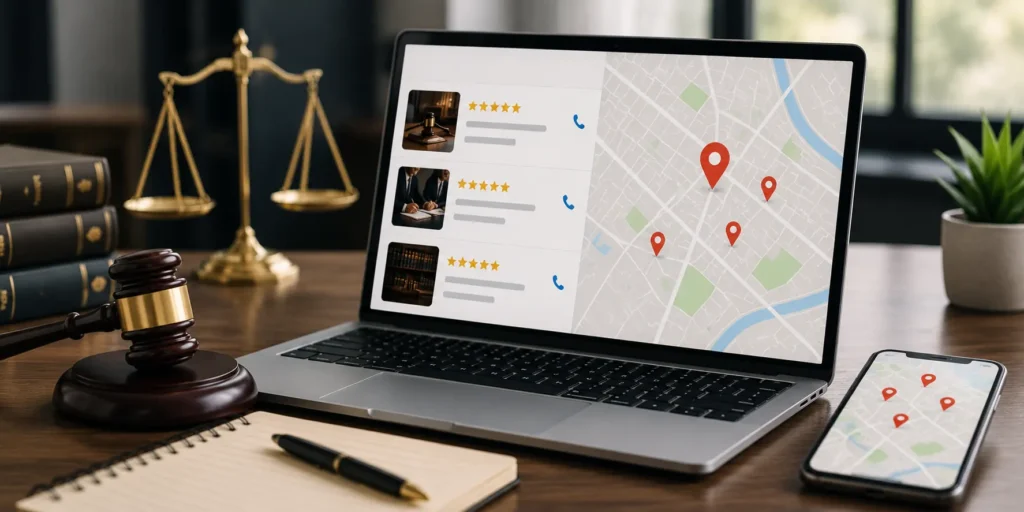
“Lawyer near me” and “advocate [city]” trigger the Local Pack, and law-office profiles follow the full playbook from Spoke 1 of this cluster with extra restraint:
- Exact firm name only; correct primary category (law firm / legal services, with practice-area secondaries); chamber/office address precisely pinned — District Courts and High Court vicinity offices are dense, and a misplaced pin loses “near me” wins to the chamber next door
- Reviews, handled carefully: never solicit reviews mentioning case details or outcomes; responses must never confirm someone was a client (thank the reviewer, address service quality generically, take specifics offline). Review velocity still matters — build the ask into closing formalities as a neutral “feedback on our service” request
- Citations: bar association directories, chamber listings, legal directories, and the general local stack — same master-sheet NAP discipline as any multi-location business (multi-city firms: the franchise-scale rules from Spoke 3 apply directly)
Intake: Where Legal SEO Actually Converts or Dies
Legal leads are perishable and anxious. The conversion layer:
- WhatsApp and phone as primary CTAs — framed as “contact the firm,” not urgency copy. A monitored line with same-business-day response converts multiples better than a form emailed to a shared inbox nobody owns
- Consultation clarity: state plainly how initial consultations work (scheduling, whether fees apply — whatever your practice’s factual policy is). Ambiguity, not fees, kills contact
- Confidentiality signals at the point of contact: a one-line assurance on forms (“your inquiry is treated as confidential”) addresses the #1 hesitation of family-law and dispute clients
- Overseas intake track: time-zone-friendly scheduling, POA process explanation, and video-consultation availability on the diaspora landing page
- Measurement: UTM-tagged GBP links, per-channel tracking, and a simple matter-source field in your intake register — within two quarters the firm knows exactly what a ranked guide is worth in retained matters
The 6-Month Build
- Month 1: Compliance review of all planned copy against current conduct obligations; technical foundation; GBP claimed and built
- Months 2–3: Practice-area and advocate pages live with schema; intake channels wired and owned
- Months 3–6: Two definitive guides per month, prioritized by (search volume × matter value); glossary and checklists layered in; citation stack completed
- Ongoing: Quarterly legal-accuracy reviews, review-response discipline, and content expansion into the long tail of procedural queries
The compounding effect in this niche is unusually strong: legal guides earn citations from journalists, students, and — increasingly — AI answer engines, and every citation deepens the authority of the advocates behind them. Firms that start now are building the profile competitors will be quoting from in three years.
If you want this built with the compliance sensitivity it demands — architecture, guide production with review workflows, local layer, and intake tracking as one program — our law firm SEO services run exactly this playbook. This closes the Local SEO cluster: Map Pack fundamentals, real estate, franchise scale, and legal — four niches, one discipline.
GET IN TOUCH
Get 1 Free Consultation Call
FAQ
Is SEO even allowed for lawyers in Pakistan?
Maintaining an informational web presence and publishing educational legal content sits in a different category from advertisement and solicitation, and it’s how careful firms operate — but conduct rules are the profession’s own domain: review your Bar Council obligations and current interpretations before launching anything, and keep self-promotional claims out of the copy regardless.
What content works best for Pakistani law firms?
Procedural guides answering the questions clients search for before they know they need a lawyer — khula procedure, inheritance shares, company registration, cheque dishonour — written by named, credentialed advocates with visible review dates.
Can law firms show client testimonials and case results?
Confidentiality and conduct constraints make identifiable client stories and outcome-boasting off-limits for most firms. The compliant trust stack is credentials, publications, reported judgments where citable, and carefully handled service reviews.
How long until a law firm sees clients from SEO?
Procedural guides in low-competition topics can rank in 6–10 weeks; city + practice-area terms typically take 4–8 months depending on the city. Family law in Lahore and Karachi is the most contested; specialized practice areas move fastest.