
The monthly report is where SEO agencies either prove their work or hide from it. If yours arrives as a 40-page PDF of screenshots — keyword positions you don’t recognize, traffic graphs with no revenue attached, and a “great progress this month!” summary — you’re not being reported to. You’re being managed. In Pakistan’s SEO market, where a large share of retainers produce no verifiable work at all, the report is your single best audit instrument — if you know what a real one contains.
This guide is the anatomy of an honest report, section by section, with the red flags that expose a hollow one. Use it to evaluate your current provider or to set the reporting standard in your next contract. It reflects exactly how we structure reporting inside our own SEO services in Pakistan engagements — built on a “commit less, deliver more” rule: conservative commitments in the proposal, then reports that show delivery against them. An agency that resists this reporting standard is telling you something; believe them.
Table of Contents
The Governing Principle: Business Outcomes First, Diagnostics Second
A professional report answers three questions in descending order:
- What did SEO contribute to the business this month? (leads, revenue, pipeline)
- What do leading indicators say about next quarter? (rankings, visibility, authority)
- What work was done, and what’s next? (deliverables, plan)
Amateur reports invert this — burying you in diagnostics because diagnostics can’t be judged. Every section below follows that hierarchy.
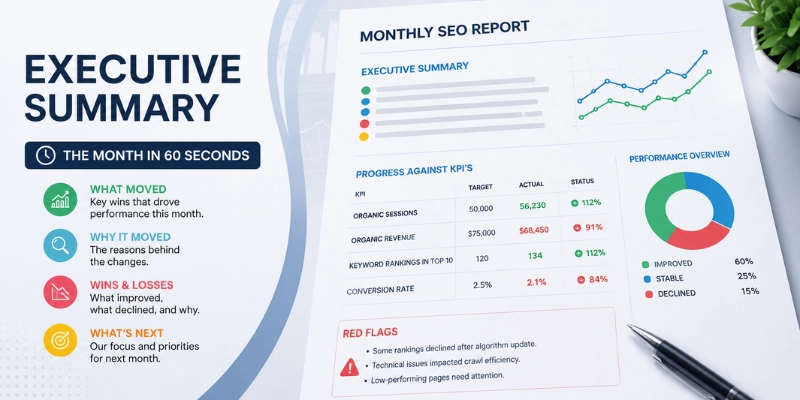
Section 1: Executive Summary (One Page, Plain Language)
- The month in 4–6 sentences a CEO can read in 60 seconds: what moved, why, what’s next
- Wins AND losses. A report that has never once mentioned a ranking drop, a technical setback, or an underperforming page is not a report — it’s a brochure. Google ships algorithm updates constantly; twelve consecutive months of pure good news is statistically a lie
- Progress against the committed KPIs from your contract, stated plainly: target vs. actual
Red flag #1: no reference to previously committed targets anywhere. If the report never mentions what was promised, the promise was decorative.
Section 2: Business Impact — Leads & Revenue from Organic
The section most Pakistani SMB reports omit entirely, because it requires real tracking setup:
- Organic-attributed conversions: form fills, WhatsApp clicks, calls, purchases — from properly configured GA4 events, segmented to organic
- Ecommerce: organic revenue, transactions, AOV vs. prior month and prior year
- Lead gen: organic lead count, and where CRM integration exists, lead-to-customer movement — because 200 leads that never close is a keyword-targeting problem the report should surface, not hide
- Cost-per-lead from organic (retainer ÷ organic leads), trended monthly — this is the number that eventually beats every other channel, and an agency confident in its work wants you watching it
Red flag #2: an agency that has managed your SEO for 6+ months and still can’t report conversions “because tracking isn’t set up.” Setting it up was their week-one job.
Section 3: Organic Traffic — Segmented or It’s Noise
- Organic sessions and users: month-over-month AND year-over-year (Pakistani retail traffic swings with Ramadan, Eid, and 11.11 — MoM-only comparisons manufacture fake wins and fake crises; seasonality context is mandatory)
- Branded vs. non-branded split. This one cut exposes more weak agencies than any other: branded traffic (people searching your name) grows from your ads and reputation — the agency claiming it as SEO output is billing you for your own brand. Non-branded organic growth is what you’re paying for
- Traffic by page group (money pages vs. blog vs. locations) — 90% blog-only growth with flat money pages means content is ranking for trivia, not buyers
- Landing pages gaining/losing, with the “losing” list present and explained
Red flag #3: total-traffic graphs only, no branded split, no segmentation. That graph can grow while the paid work produces nothing.
Section 4: Rankings & Search Visibility
- Positions for the agreed keyword set (the one in your contract — not a shifting list of whatever ranked this month), with movement, search volume, and the URL ranking
- Distribution counts: keywords in top 3 / top 10 / top 20, trended — healthier than obsessing over any single term
- Search Console impressions and clicks for target query families — impressions are the earliest honest signal of expanding visibility, visible months before clicks
- Local businesses: Map Pack positions and GBP metrics (calls, direction requests, profile actions) — per branch for multi-location clients
- Increasingly standard in 2026: AI answer presence — whether your brand appears in AI Overviews and answer-engine citations for money queries (the prompt-audit method from this series’ Future of Search cluster)
Red flag #4: rankings reported for keywords nobody searches (“best quality affordable services provider Islamabad Pakistan”) — position #1 trophies for zero-volume terms are the oldest trick in the Pakistani SEO market.
Section 5: Work Completed — The Accountability Ledger
The section that separates agencies doing work from agencies collecting retainers:
- Content: every piece published this month, with live URLs
- Technical: issues fixed, listed specifically (“canonicals corrected on 14 category pages” — not “technical optimization performed”), with before/after evidence where meaningful
- Links & authority: every acquired link with URL, plus the outreach pipeline status. This list is your quality audit: open five links. If you find casino sites, foreign spam directories, and PBN-pattern blogs, you’ve found where the Rs. 10,000 packages spend their budget — and a future penalty
- On-page changes: pages optimized, what changed
- Hours or deliverables against the contracted scope
Red flag #5: vague verbs. “Performed on-page optimization, built quality backlinks, improved technical health” with zero URLs, zero specifics — the standard text of agencies doing nothing. Every claimed deliverable should be independently verifiable by you in under a minute.
Section 6: Technical Health Snapshot
- Core Web Vitals field status (Search Console, not just lab scores)
- Index coverage: indexed vs. excluded pages, with movement explained — sudden swings either direction are events, not footnotes
- Crawl errors, broken links, new issues surfaced by the monthly/quarterly crawl
- Site changes shipped by your dev team that affect SEO (the report should catch regressions — that’s part of what monitoring means; the dev-team checklist in this series is the standard they should be checking against)
Section 7: Next Month’s Plan + Honest Context
- Specific planned deliverables (content titles, technical tickets, outreach targets) — which become next month’s Section 5, closing the accountability loop
- Anything needing your action, flagged with deadlines (approvals, dev access, content sign-off — agencies also deserve this record when client-side delays stall progress; honesty runs both directions)
- Algorithm and market context where relevant: if Google shipped a core update or a competitor launched aggressively, the report should say so and assess exposure — before you read about it elsewhere
The Meeting Standard
A report without a conversation is a document nobody reads. Professional cadence: report delivered in advance, then a 30-minute call — ten minutes on results, twenty on decisions and next actions. If your agency delivers PDFs into silence month after month, the silence is the service.
The One-Paragraph Standard to Put in Your Next Contract
“Monthly reporting will include: organic conversions and revenue from configured GA4 tracking; organic traffic segmented branded/non-branded with YoY comparison; positions for the contracted keyword set plus top 3/10/20 distribution; all completed deliverables with verifiable URLs (content, technical fixes, and every acquired link); technical health status; and next month’s specific plan — delivered with a monthly review call.”
Any competent agency signs that without blinking, because it describes work they’re already doing. Hesitation is your answer. It’s the standard we hold ourselves to across every SEO engagement — committed KPIs in the proposal, verifiable delivery in the report, every month. Final piece of this buyer’s cluster: what quality SEO actually costs in Pakistan, and the full anatomy of the cheap-package scam economy.
GET IN TOUCH
Get 1 Free Consultation Call
FAQ
How long should a monthly SEO report be?
Five to ten substantive pages beats forty pages of screenshots. Length is not evidence; verifiable specifics are. The executive summary alone should let a founder judge the month in one minute.
What’s the single most important metric in an SEO report?
Organic-attributed leads or revenue, trended against the retainer cost. Everything else — rankings, traffic, links — is a leading indicator feeding that number.
My agency says results take time, so early reports show only activity. Fair?
Fair for months 1–4, if the activity is specific and verifiable (URLs, fixes, published pages) and leading indicators (impressions, index coverage, early rankings) are moving. “Trust the process” with vague deliverables past month 4 is not patience — it’s the scam’s script.
Should I have independent access to the data?
Always. Owner-level access to your own GA4, Search Console, and GBP is non-negotiable — agencies work in your accounts, not the reverse. An agency resisting this is planning to hold your data hostage, and that’s covered in the pricing guide’s red-flag list.