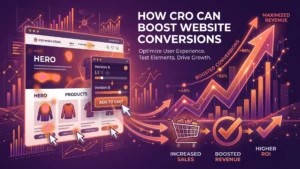
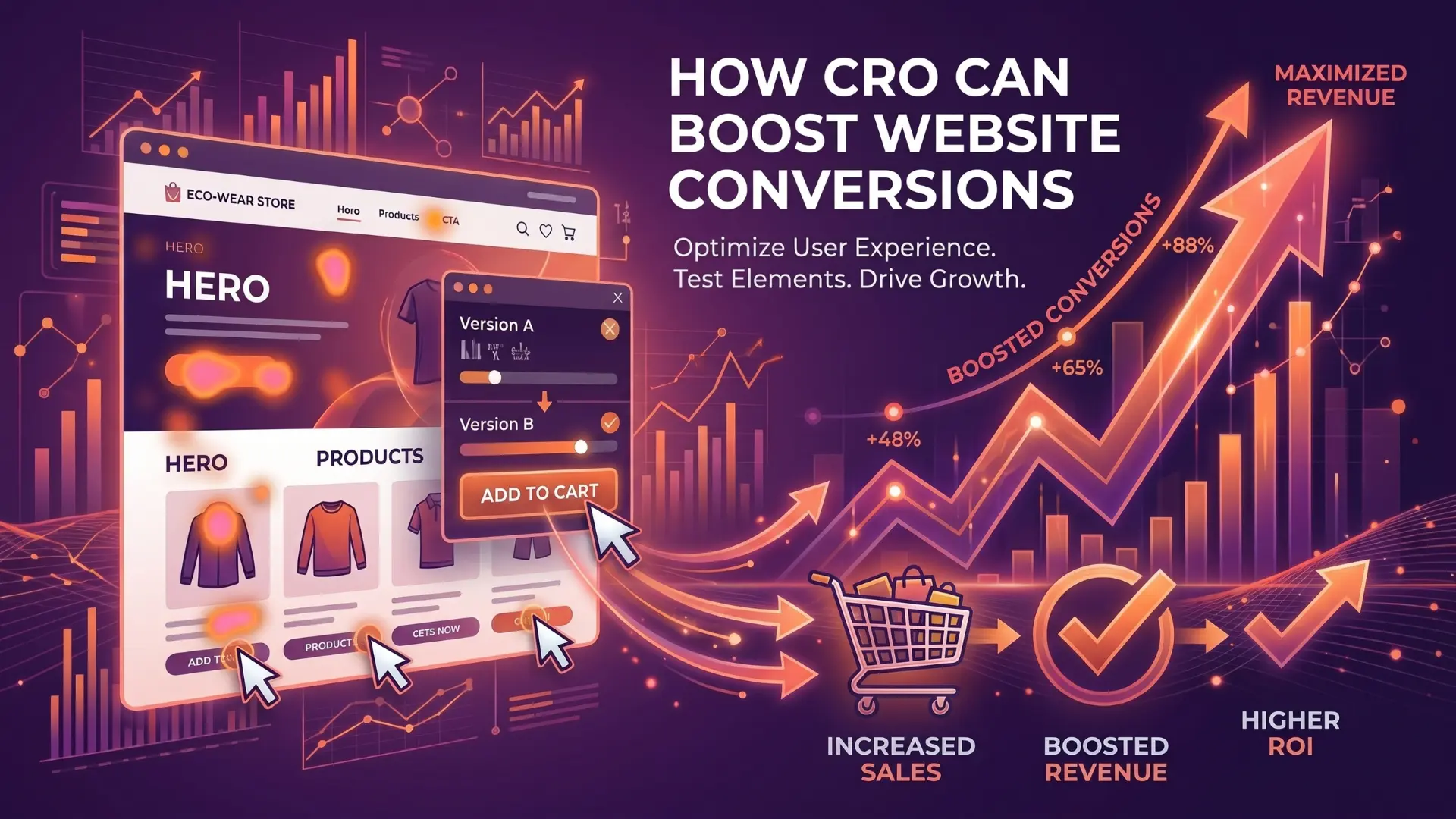
How CRO can boost website conversions is important because driving traffic to your website is only half the battle. You can spend thousands of dollars on ads, SEO, and social media to bring visitors to your site — but if they leave without taking action, that traffic is essentially wasted. This is where Conversion Rate Optimization (CRO) comes in.
CRO helps you turn more of your existing visitors into leads, customers, or subscribers — without spending extra money on acquiring new traffic. In this guide, we’ll break down what CRO is, why it matters, and the proven strategies you can use to boost your website’s conversions.
Table of Contents
What is Conversion Rate Optimisation (CRO)?
Conversion rate optimisation is the systematic process of improving your website through conversion rate optimisation services to increase the percentage of visitors who complete a desired action — whether that’s making a purchase, filling out a form, signing up for a newsletter, or booking a consultation.
The formula is simple:
Conversion Rate = (Total Conversions ÷ Total Visitors) x 100
For example, if your website gets 10,000 visitors a month and 200 of them make a purchase, your conversion rate is 2%. CRO focuses on improving that percentage through data-driven testing and design improvements, rather than simply driving more traffic.
Why CRO Matters for Your Business
Many businesses focus all their energy on traffic generation while ignoring what happens once visitors land on their site. Here’s why CRO deserves equal attention:
- Cost-effective growth: Instead of paying more for ads, you get more value from the traffic you already have. Rather than expanding your acquisition budget every month, CRO helps you extract greater value from visitors you’ve already earned.
- Better ROI: A well-optimised website generates more revenue from the same marketing spend. Every dollar you’ve invested in SEO, PPC, or social campaigns works harder when your site converts at a higher rate.
- Improved user experience: CRO often improves site usability, which keeps visitors engaged longer. A smoother, more intuitive experience doesn’t just drive conversions — it reduces frustration and support queries too.
- Higher customer lifetime value: A smoother journey builds trust, encouraging repeat business. Customers who have a positive first experience are far more likely to return, refer others, and spend more over time.
- Reduced customer acquisition cost (CAC): When more visitors convert, your cost per acquisition naturally drops, freeing up budget for other growth initiatives.
- Data-driven decision-making: CRO forces teams to rely on real user behaviour instead of guesswork, leading to smarter design and marketing choices across the board.
In short, CRO doesn’t just increase sales — it makes your entire marketing funnel more efficient.

Key Elements That Impact Conversion Rates
Before diving into strategies, it’s important to understand which parts of your website most directly affect conversions.
Website Speed & Performance
A slow-loading website frustrates visitors and increases bounce rates. Even a one-second delay in load time can significantly reduce conversions. Studies consistently show that pages loading in under two seconds retain far more visitors than those that take longer, and search engines also factor speed into rankings — making it a win for both users and SEO.
Clear Call-to-Actions (CTAs)
Your CTAs should be visible, action-orientated, and easy to understand. Vague or hidden CTAs confuse visitors and cost you conversions. Strong CTAs use action verbs, create a sense of urgency where appropriate, and stand out visually through contrast in colour and placement so visitors always know the next step to take.
User Experience (UX) & Navigation
If visitors struggle to find what they’re looking for, they’ll leave. Clean layouts and intuitive navigation keep users moving toward conversion. How CRO Can Boost Website Conversions becomes clear through a logical site structure, minimal clicks to reach key pages, and consistent design patterns that reduce friction and help visitors complete their journey without frustration.
Trust Signals
Reviews, testimonials, certifications, and security badges reassure visitors that your business is credible and safe to engage with. Displaying client logos, case studies, money-back guarantees, and verified payment icons near key decision points can noticeably reduce hesitation at checkout or sign-up.
Mobile Optimization
With most web traffic coming from mobile devices, a site that isn’t fully responsive will lose a significant share of potential conversions. This means ensuring tap targets are large enough, text is readable without zooming, and forms are easy to complete on smaller screens.
Content Clarity & Messaging
Confusing or overly technical copy pushes visitors away. Your messaging should clearly communicate what you offer, who it’s for, and why it matters — ideally within the first few seconds of landing on a page.
Proven CRO Strategies to Boost Conversions
A/B Testing
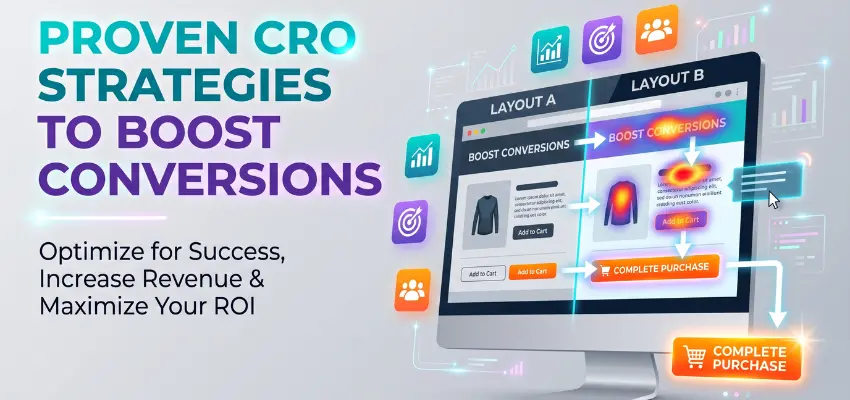
Test two versions of a page element — like a headline, button colour, or layout — to see which performs better. A/B testing removes guesswork and lets data guide your decisions. Run tests for a statistically significant sample size before concluding, and test one variable at a time so you know exactly what drove the change in performance.
Optimizing Landing Pages
Your landing pages should have a single, clear goal. Remove distractions, strengthen your headline, and align your messaging with visitor intent. Professional digital marketing services can help ensure your messaging matches the ad or link that brought visitors to the page, while keeping the layout focused on one primary conversion action.
Simplifying Forms & Checkout Process
Long, complicated forms drive people away. Reduce the number of required fields and streamline your checkout process to minimise drop-offs. Offering guest checkout, auto-fill options, and clear progress indicators can significantly reduce cart and form abandonment.
Using Heatmaps & Analytics
Tools like heatmaps show you exactly where visitors click, scroll, and lose interest — giving you real insight into what needs improvement. Combine heatmap data with session recordings and funnel analysis to understand not just where users drop off, but why.
Personalization & Retargeting
Tailoring content based on user behaviour and retargeting visitors who didn’t convert the first time can significantly increase overall conversion rates. Dynamic content — such as location-based offers or product recommendations based on browsing history — makes the experience feel relevant, increasing the likelihood of conversion.
Building Social Proof Into Key Pages
Adding testimonials, star ratings, and user-generated content near your CTAs reassures hesitant visitors and can shift undecided users toward taking action.
Improving Page Load Speed
Compressing images, leveraging browser caching, and minimising unnecessary scripts all contribute to faster load times — directly supporting higher conversion rates across every page of your site.
Best Tools for CRO
Here are some popular tools businesses use to run effective CRO campaigns:
- Hotjar: Heatmaps and session recordings that show exactly how visitors interact with your pages, including where they click, scroll, and hesitate.
- Crazy Egg: A visual analytics and A/B testing tool that helps identify which page elements draw attention and which get ignored.
- VWO (Visual Website Optimiser): A comprehensive testing and personalisation platform used for running experiments across web and mobile.
- Google Analytics: Behaviour tracking and funnel analysis to understand where visitors drop off along their journey.
- Unbounce: Landing page builder with built-in testing features, ideal for quickly creating and optimising campaign-specific pages.
- Optimizely: An enterprise-grade experimentation platform for running advanced multivariate and A/B tests at scale.
- Google Optimise Alternatives (e.g., AB Tasty, Convert): Since Google Optimise has sunsetted, these platforms offer similar experimentation capabilities with robust reporting.
- Microsoft Clarity: A free tool offering heatmaps and session recordings, useful for smaller businesses just starting with CRO.
Common CRO Mistakes to Avoid
- Testing too many changes at once: This makes it impossible to know which change actually impacted the results. Stick to isolated variables so every test produces a clear, actionable insight.
- Ignoring mobile users: A desktop-only optimisation strategy leaves conversions on the table, especially since mobile traffic now accounts for the majority of visits on most websites.
- Not analysing data properly: Making decisions based on assumptions instead of real user behaviour data often leads teams down the wrong path and wastes valuable testing time.
- Ending tests too early: Stopping a test before it reaches statistical significance can lead to false conclusions and misguided changes.
- Neglecting page load speed during redesigns: Adding new visual elements without checking their impact on performance can quietly undo conversion gains.
- Focusing only on the homepage: High-traffic entry points, such as product pages, blog posts, and landing pages, often have greater optimisation potential than the homepage alone.
Avoiding these mistakes ensures your CRO efforts produce reliable, measurable results.
How Clickmaster Can Help You With CRO
At Clickmaster, we specialise in helping businesses turn their website traffic into real, measurable results. From conducting in-depth CRO audits to running data-backed A/B tests and redesigning high-impact pages, our team focuses on strategies that are proven to increase conversions — not just guesses.
If you’re ready to stop losing potential customers and start maximising your website’s performance, we’re here to help.
Book a free CRO audit today and discover exactly where your website is leaving conversions on the table.
GET IN TOUCH
Get 1 Free Consultation Call
Conclusion
Conversion rate optimisation is one of the most cost-effective ways to grow your business online. By focusing on website speed, clear CTAs, trust signals, and data-driven testing, you can turn more visitors into paying customers — without increasing your marketing budget.
CRO isn’t a one-time fix; it’s an ongoing process of testing, learning, and improving. Start small, track your results, and let the data guide your next move.
Frequently Asked Questions
What is a good conversion rate?
Conversion rates vary by industry, but the average website conversion rate typically ranges from 2% to 5%. However, top-performing websites often achieve much higher rates through consistent CRO efforts.
How long does CRO take to show results?
CRO is an ongoing process. While some changes show quick improvements, meaningful, statistically significant results from testing usually take a few weeks to a few months, depending on your traffic volume.
Is CRO better than SEO or PPC?
CRO isn’t a replacement for SEO or PPC — it complements them. While SEO and PPC bring visitors to your site, CRO ensures that traffic converts into actual business results, maximising the return on your marketing investment.
Do I need a lot of traffic to start CRO?
While higher traffic volumes help you reach statistical significance faster in A/B tests, even smaller websites can benefit from CRO fundamentals — like improving CTAs, simplifying forms, and building trust signals — without needing large-scale testing right away.
How much does CRO cost?
CRO costs vary depending on the scope – from basic audits and quick-win implementations to ongoing testing programmes with dedicated tools and specialists. Many businesses start with a focused audit before committing to a larger, continuous optimisation strategy, as the one Clickmaster offers.
Can CRO help e-commerce websites specifically?
Absolutely. For e-commerce sites, CRO often has an outsized impact — small improvements to product pages, checkout flows, and trust signals can directly translate into higher revenue, since every visitor is already a potential buyer.