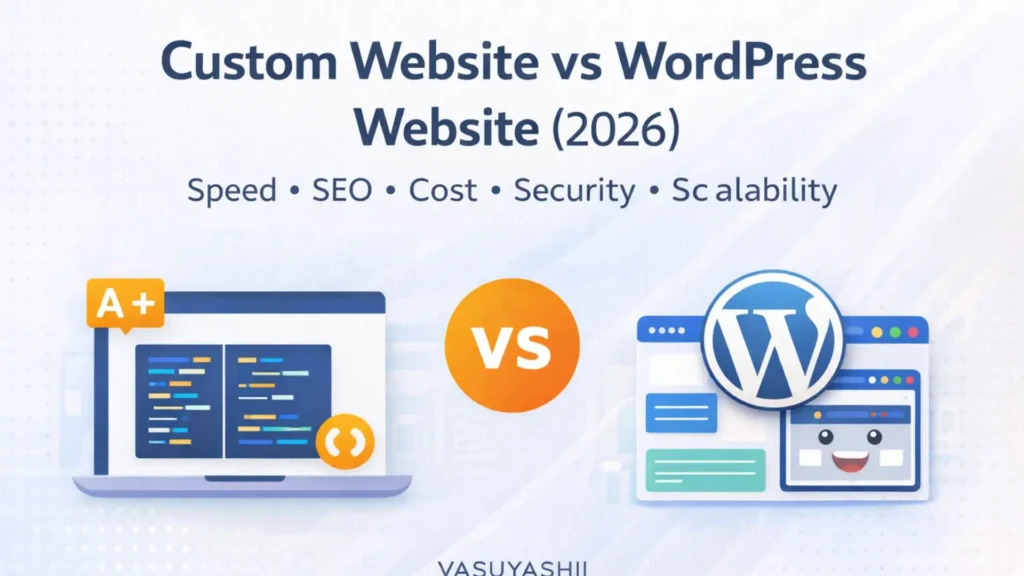
WordPress vs Custom Development: A Complete Guide for Pakistani Businesses in 2026
The WordPress vs Custom Development Question Every Pakistani Business Owner Asks Every Pakistani business owner planning a new website eventually faces this decision: should we use WordPress, or should we build something custom? It sounds like a technical question but it is actually a business question, because the wrong answer has real consequences: overspending on a custom solution that a WordPress theme could have handled perfectly, or under-investing in WordPress when the business actually needed custom functionality that will cost twice as much to retrofit later. Pakistan’s web development market makes this decision more complex than it appears internationally. WordPress developers in Pakistan are abundant and affordable, ranging from PKR 25,000 for a basic theme installation to PKR 400,000 for a fully customised WordPress build. Custom development talent ranges from PKR 150,000 for a simple custom application to PKR 2,500,000 or more for complex enterprise systems. The cost gap is real, but so are the capability gaps in each direction. This guide provides a complete decision framework for Pakistani business owners based on business type, budget, technical requirements, and long-term growth plans. It covers the total cost of ownership across 3 years (not just initial build cost), Pakistani developer availability for both options, performance benchmarks in Pakistan’s hosting environment, and maintenance realities for Pakistani SMEs. At a Glance: WordPress vs Custom Development for Pakistani Businesses WordPress wins for: Information websites, service business brochure sites, blogs, standard e-commerce under 5,000 SKUs, small to mid-size businesses with budgets under PKR 800,000. Custom website development wins for: Complex web applications, marketplaces, SaaS platforms, e-commerce with custom business logic, integrations with Pakistani ERP or banking systems, platforms requiring unique user flows not achievable with WordPress plugins. The answer for 70 percent of Pakistani businesses: WordPress with professional customisation. What WordPress Actually Is — And What It Is Not WordPress powers approximately 43 percent of all websites globally and an estimated 58 percent of Pakistani business websites. It began as a blogging platform in 2003 and has evolved into a full content management system (CMS) capable of running e-commerce stores, membership sites, and complex service portals through its plugin ecosystem. WordPress is not a website builder like Wix or Squarespace — it requires hosting, technical configuration, and meaningful customisation to build a professional Pakistani business website. The misconception that WordPress means cheap and basic is incorrect; Clickmasters has built WordPress sites for Pakistani clients with PKR 600,000 to 1,200,000 build budgets that deliver enterprise-level performance and functionality. WordPress is also not suitable for everything. It is a CMS with a page-based architecture. Building a complex marketplace where Pakistani buyers and sellers transact, a logistics platform with real-time tracking, or an HR SaaS application on WordPress means fighting the platform’s architecture at every step. These use cases require custom development from the ground up. What Custom Development Actually Means for Pakistani Businesses Custom development means building a web application or website from scratch using programming languages such as PHP with Laravel or CodeIgniter, Python with Django or FastAPI, Node.js, or increasingly React and Next.js for frontend-heavy applications. Every feature is built specifically for your requirements rather than adapted from pre-existing templates or plugins. Custom development in Pakistan typically means engaging a local development team or freelancers through Pakistan’s large software talent pool. Pakistan has over 300,000 registered IT professionals and produces 25,000 IT graduates annually, giving Pakistani businesses relatively affordable access to custom development talent compared to Western markets. A custom web application that would cost USD 80,000 to 150,000 in the UK can be built in Pakistan for PKR 800,000 to 2,500,000 (USD 3,000 to 9,000) by a competent local development team. PART 1: SIDE-BY-SIDE COMPARISON WordPress vs Custom Development: The Complete Comparison for Pakistani Businesses Dimension WordPress Custom Development Verdict for Pakistan Initial build cost Pakistan PKR 80,000 to 800,000 for professional build PKR 350,000 to 3,000,000 depending on complexity WordPress wins for most budgets under PKR 1,000,000 Time to launch 4 to 12 weeks for a professional WordPress site 12 to 52 weeks, depending on complexity WordPress wins for faster market entry Ongoing maintenance cost PKR 15,000 to 50,000 per month (hosting, updates, plugin licences) PKR 40,000 to 200,000 per month (developer retainer for bug fixes and updates) WordPress is lower for basic sites; similar for complex builds Pakistani developer availability Extremely high. Thousands of WordPress developers across Pakistan at all price points. High for PHP and JavaScript. Lower for specialised frameworks. Senior custom developers are scarcer. WordPress has a deeper Pakistani talent pool for budget flexibility Scalability Scales well to medium complexity. Struggles above 50,000 SKUs or with highly custom user flows. Unlimited scalability when architected correctly from the start. Custom wins for platforms expecting significant scale or complexity growth SEO capability Pakistan Excellent with Yoast or RankMath. Pakistani SEO agency are uniformly experienced with WordPress. Requires manual SEO implementation. No plug-and-play solution. Quality depends on the developer’s knowledge. WordPress wins for SEO out of the box Security Good with proper hardening. Plugin vulnerabilities are a genuine risk. Requires active management. Better when built with a security-first architecture. No plugin attack surface. Custom wins slightly for security if developer expertise is high Performance on Pakistani hosting Good with proper caching and CDN. Poorly configured WordPress is slow on Pakistani servers. Excellent when architected correctly. No plugin overhead or theme bloat. Custom wins for raw performance; WordPress wins with proper optimisation Custom integrations (JazzCash, EasyPaisa, local APIs) Available via plugins for major Pakistani gateways. Custom integrations require developer work. Full flexibility to integrate any Pakistani payment gateway, API, or system natively. Custom wins for complex integration requirements Total Cost of Ownership: 3-Year Analysis for Pakistani Businesses Pakistani business owners typically evaluate WordPress vs custom development based on the initial build quote. This comparison is incomplete and often misleading. The 3-year total cost of ownership (TCO) tells a more accurate story about which option is actually more economical for each use case. Cost Component WordPress (Professional Build) Custom Development (Mid-Complexity) Initial design and