The Question Every Pakistani Marketer Asks — and the Honest Answer
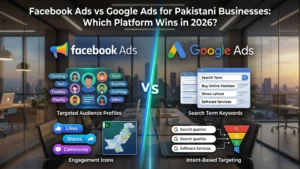
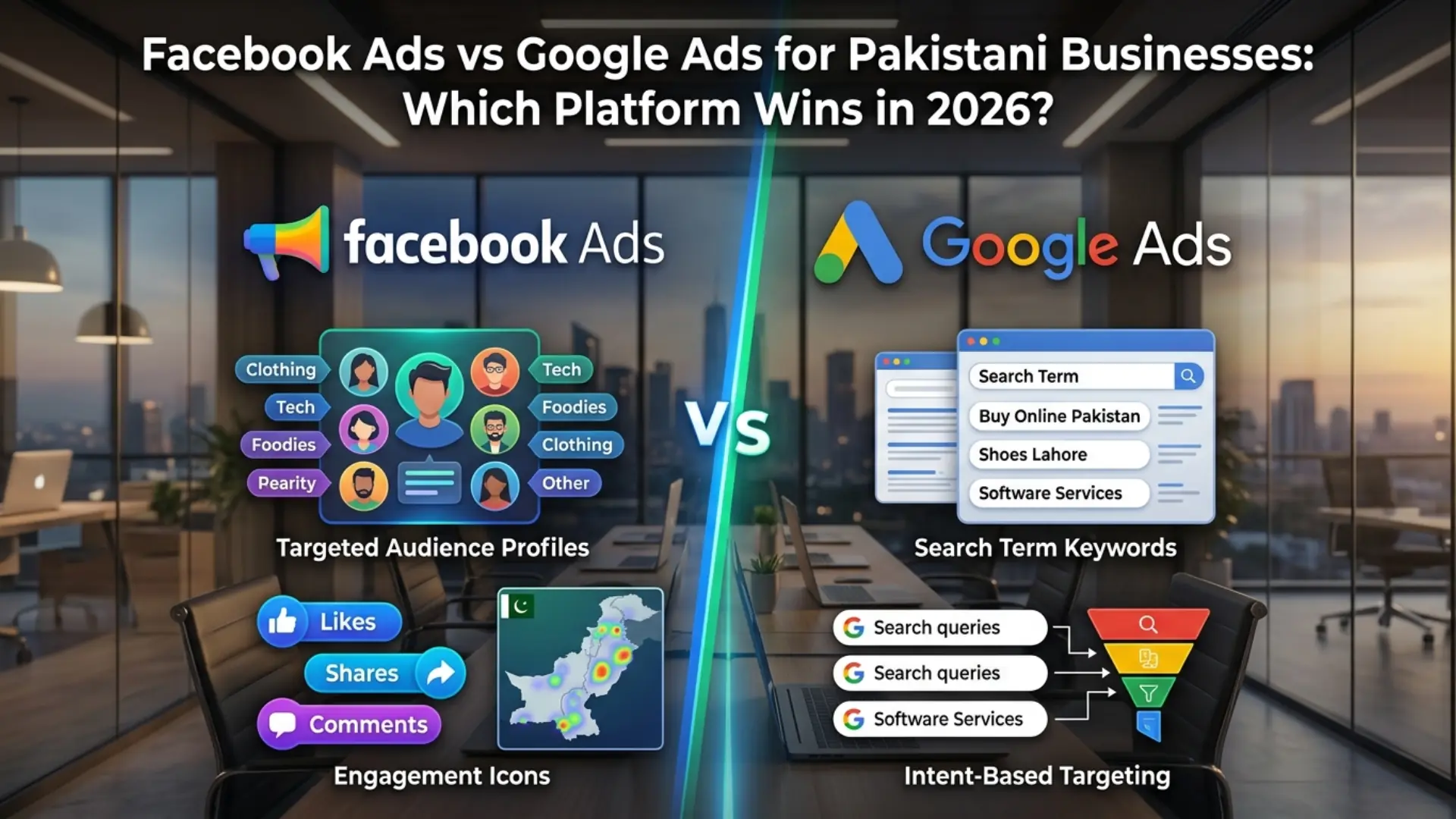
‘Should we run Facebook Ads or Google Ads?’ is the single most common paid advertising question Clickmasters hears from Pakistani business owners. It is also, genuinely, the wrong question — because the correct answer in almost every case is not ‘one or the other.’ It is ‘both, allocated based on your specific business model, audience, and objectives.’
However, we understand that Pakistani businesses working with limited budgets need to start somewhere, and that the platform choice made at launch shapes campaign strategy, creative direction, and team skills development for months or years. This guide gives you the honest, data-backed answer to which platform performs better for different Pakistani business types — drawn from Clickmasters’ management of campaigns across both platforms for 300+ Pakistani clients.
The short answer: Google Ads wins for high-intent, ready-to-buy audiences searching for your product or service. Facebook Ads wins for awareness, brand building, audience development, and consumer products where demand creation matters more than demand capture. For most Pakistani businesses, the optimal strategy is Google Ads for conversion campaigns combined with Facebook Ads for brand building and retargeting.
Table of Contents
Clickmasters Pakistan Paid Media Data (2025 Averages Across Active Client Portfolio)
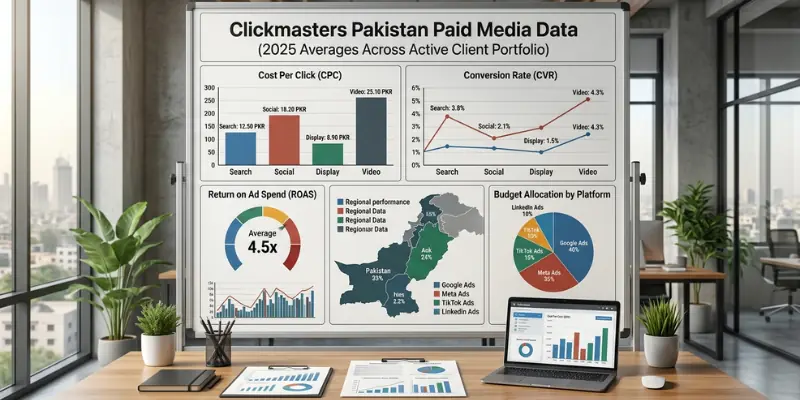
Google Ads average ROAS Pakistan: 340% (PKR 3.40 revenue per PKR 1 spent) | Facebook Ads average ROAS Pakistan: 280% (PKR 2.80 per PKR 1 spent) | Google Ads average CPL (Cost Per Lead) Pakistan: PKR 1,840 | Facebook Ads average CPL Pakistan: PKR 2,310 | Google Search CPC range: PKR 35–720 (varies by industry) | Facebook CPM (Cost Per 1,000 Impressions) Pakistan: PKR 120–480 | Best-performing Google industry (ROAS): E-commerce retail (avg 480%) | Best-performing Facebook industry (ROAS): Consumer lifestyle products (avg 390%)
Platform Fundamentals: The Core Difference
The fundamental difference between Google Ads and Facebook Ads is the intent of the user at the moment your ad reaches them. This single distinction explains why each platform performs better for certain objectives and industries.
| Dimension | Google Ads | Facebook Ads |
| Core mechanism | Demand capture: shows ads to users actively searching for your product/service. User intent is explicit — they typed what they want. | Demand creation: shows ads to users based on demographics, interests, and behaviours. User is not actively looking — your ad interrupts their social feed. |
| User mindset | High commercial intent: the user is in ‘finding mode’ — ready to evaluate options and potentially buy. | Discovery mode: the user is in ‘browsing/entertainment mode’ — not necessarily looking to buy, but may be receptive to well-targeted offers. |
| Ad format | Primarily text ads in search results (Google Search Network) + display/video (Google Display and YouTube). | Primarily visual: image, carousel, and video ads in Facebook/Instagram feeds, Stories, and Reels. |
| Audience targeting | Keyword-based: you target what people search for, not who they are. Extensions allow demographic overlays. | Demographic, interest, and behaviour-based: you target who people are — age, interests, job, income, behaviour patterns. |
| Pakistan usage | Google: 97%+ search market share. 42M+ active Pakistani internet users use Google daily. | Facebook: 44M Pakistani monthly active users. Instagram: 28M Pakistani MAU. WhatsApp Business ads: emerging channel. |
| Minimum effective budget (Pakistan) | PKR 30,000–50,000/month for Search campaigns. Below this, insufficient data for optimisation. | PKR 20,000–30,000/month per ad set. Lower entry point but requires visual creative investment. |
| HEAD-TO-HEAD: 8 KEY COMPARISON DIMENSIONS |
1. Cost Efficiency: CPL and CPC Comparison for Pakistan
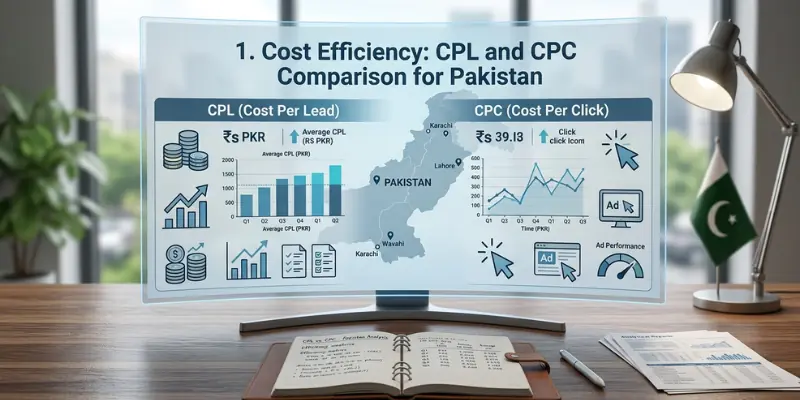
Cost efficiency comparisons between the two platforms are highly industry-dependent. The following benchmarks are drawn from Clickmasters’ active Pakistani client portfolio across 2025 — they represent achievable performance for well-optimised campaigns, not industry averages including poorly managed accounts.
| Industry | Recommended Primary Platform | ||
| Digital Marketing / SEO Services | PKR 2,100 | PKR 3,800 | Google Ads (high search intent for ‘seo agency pakistan’) |
| Web Development | PKR 1,650 | PKR 3,800 | Google Ads (clear search intent) |
| Legal Services | PKR 3,400 | PKR 4,200 | Google Ads (critical decision — high search intent) |
| Healthcare / Medical | PKR 2,800 | PKR 3,100 | Google Ads for appointment booking; Facebook for awareness |
| Real Estate | PKR 4,200 | PKR 3,800 | Split: Google for active searchers, Facebook for retargeting |
| Education / Courses | PKR 1,200 | PKR 3,800 | Facebook Ads (younger demo, visual content, longer nurture) |
| D2C Fashion / Apparel | PKR 890 | PKR 3,800 | Facebook / Instagram Ads (visual product, impulse purchase) |
| Restaurants / Food | PKR 680 | PKR 290 | Facebook / Instagram (visual, local area targeting) |
| B2B SaaS / Software | PKR 5,200 | PKR 6,800 | Google Ads (professional decision-makers search directly) |
2. Audience Reach in Pakistan
| Audience Dimension | Google Ads Pakistan |
| Total reachable audience | 42M+ active internet users conducting Google searches daily |
| Urban vs. rural reach | Strong urban, educated reach through Search. Display network broader. |
| Age demographics | Broad — Google Search is used across all age groups in Pakistan |
| B2B professionals | Strong: LinkedIn-equivalent targeting through job title and industry keywords on Search |
| Income targeting | Not directly available. Location targeting (DHA, Gulberg, F-7) as proxy for income. |
| Language targeting | Keyword-level language targeting. Urdu, Roman Urdu keywords targetable. |
3. Ad Formats and Creative
| Format Dimension | Google Ads |
| Search ads | Creative requirements |
| Visual / image ads | Google Display Network: image banner ads shown on partner websites. Lower engagement than Facebook visual formats. |
| Video ads | YouTube pre-roll and in-feed video ads. Strong reach for video in Pakistan (YouTube is 2nd most visited site). |
| Shopping / product ads | Google Shopping (free + paid) — highly effective for Pakistani e-commerce. Product image, price, and shop name in search results. |
| Creative requirements | Minimal: text headlines and descriptions. No design team required for Search. |
4. Pakistan-Specific Platform Performance Data
Real Campaign Data: Karachi E-Commerce Fashion Brand (Q4 2025)
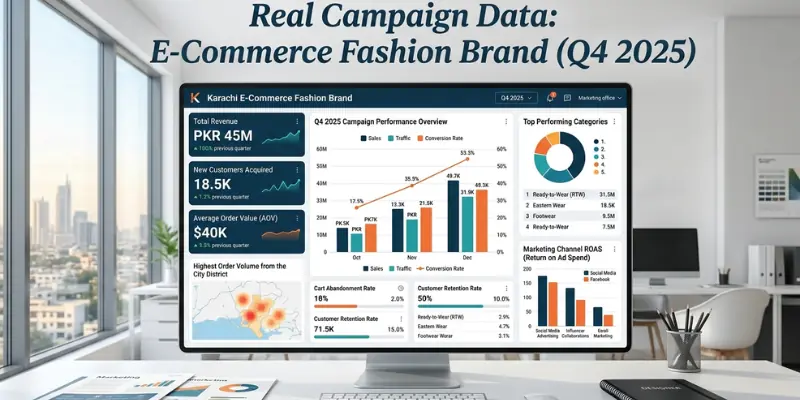
Budget allocation tested: 50% Google / 50% Facebook (each PKR 100,000/month). Google Ads results: 340 conversions at avg PKR 294 CPC, avg conversion value PKR 2,800, ROAS 381%. Facebook ads /Instagram results: 520 conversions at avg PKR 192 CPM, avg conversion value PKR 1,940, ROAS 312%. Conclusion: Google delivered higher average order value and ROAS; Facebook delivered higher volume at lower cost per conversion but lower order values. Final allocation: 40% Google (for high-intent branded + product searches),60% Facebook/Instagram (for discovery, retargeting, and impulse purchases).
Platform Performance by Pakistani City
| Pakistani City | Google Ads Performance | Google Ads Performance |
| Google Ads Performance | Highest search volume. Competitive CPCs. Strong B2B and e-commerce performance. ROI: High. | Highest Meta audience: 14M+ users. Fashion, food, lifestyle: excellent. B2B: moderate. |
| Lahore | Second-highest search volume. Fashion, real estate, education strong. ROI: High. | 13M+ Meta audience. Fashion, food, real estate: excellent. Strong Reels engagement. |
| Islamabad/Rawalpindi | Second-highest search volume. Fashion, real estate, education strong. ROI: High. | Higher-income, professional audience. Premium products, real estate, B2B: above avg. |
| Faisalabad | Manufacturing, textile B2B strong on Google. Lower CPCs than tier-1 cities. | Higher-income, professional audience. Premium products, real estate, B2B: above avg. |
| Other cities (Multan, Peshawar, Quetta) | Lower search volume but low competition = low CPCs. Local service ads effective. | Facebook used as primary internet in some areas. Local brand building effective. |
5. The Consideration Journey: When Each Platform Wins
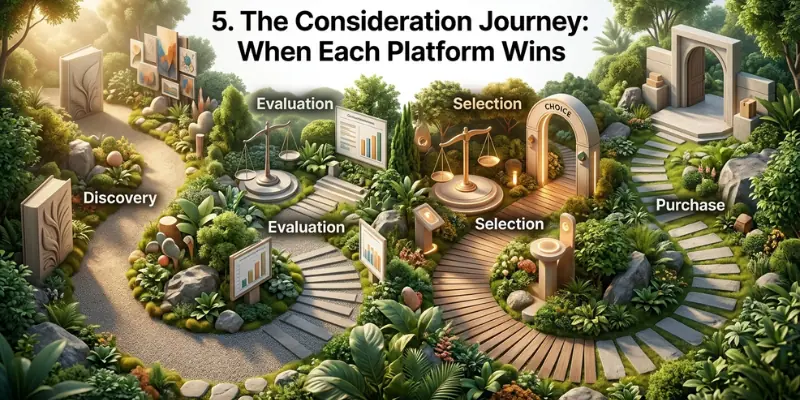
The consideration journey — the process a Pakistani buyer goes through from first awareness to purchase — determines which platform should own each stage. Visualising your buyer’s journey is the most reliable framework for platform allocation decisions
| Journey Stage | User Mindset | Recommended Platform | Tactic |
| Awareness | I don’t know this brand or product exists’ | I don’t know this brand or product exists’ | Video ads, carousel ads, Story ads — interruption-based discovery. Brand awareness campaigns optimised for reach and video views. |
| Interest | ‘I’ve seen this brand — it looks relevant to me’ | Facebook/Instagram Retargeting | Website visitor retargeting, Facebook engagement audiences, Instagram profile visitor retargeting. Show more product detail, social proof |
| Consideration | ‘I’m thinking about buying this — let me research’ | Google Search Ads | Capture active search intent: ‘best [product] Pakistan,’ ‘[service] price,’ ‘[brand] reviews.’ User is now in research mode on Google |
| Intent | ‘I’ve decided I want this — where do I buy?’ | Google Search Ads + Shopping | High-commercial-intent keywords: ‘[product] buy online,’ ‘[service] Karachi,’ price-specific queries. Maximum conversion-focused bidding. |
| Purchase | ‘I’m ready to buy now’ | Google Search + Google Shopping | Last-click capture. Branded keyword campaigns to prevent competitor interception at the final decision moment |
| Loyalty/Repeat | ‘I’ve bought before — what else do they offer?’ | Facebook Custom Audiences + Email | Customer list retargeting on Facebook. Cross-sell and upsell campaigns to existing customer audiences. |
6. Budget Allocation Recommendations by Pakistani Business Type
Based on Clickmasters’ campaign performance data across 300+ Pakistani clients, the following allocation frameworks represent our recommended starting budgets and platform split by business type. These are starting frameworks — actual allocation should be data-driven and adjusted monthly based on ROAS performance.
| Business Type | Recommended Starting Budget/Month | Platform Split | Primary Rationale |
| Local service business (single city) | PKR 50,000–80,000 | 70% Google, 30% Facebook | Google Search captures local intent (‘plumber DHA Karachi’); Facebook builds local awareness and handles retargeting. |
| National B2B service | PKR 100,000–200,000 | 80% Google, 20% Facebook/LinkedIn | B2B buyers search Google. Facebook B2B targeting less precise. LinkedIn worth testing for senior decision-makers. |
| D2C e-commerce (fashion, lifestyle) | PKR 80,000–150,000 | 40% Google, 60% Facebook/Instagram | Visual products convert well on Instagram Shopping. Google Shopping captures active searchers. Both essential. |
| Education / online courses | PKR 60,000–120,000 | 40% Google, 60% Facebook | Facebook’s demographic targeting (age, interests) for student audiences more cost-effective than keyword-based. |
| Healthcare / clinic | PKR 50,000–100,000 | 70% Google, 30% Facebook | Healthcare decisions are search-driven. Google captures appointment intent. Facebook handles awareness and health content. |
| Restaurant / food delivery | PKR 30,000–60,000 | 20% Google, 80% Facebook/Instagram | Visual food content on Instagram + Facebook Local Awareness ads outperform text search for food discovery. |
| Real estate | PKR 150,000–300,000 | 50% Google, 50% Facebook | Property searches happen on Google. Property imagery and neighbourhood lifestyle content performs on Facebook. |
7. Measurement and Attribution in Pakistan
Measuring the true ROI of both platforms in Pakistan requires understanding two practical complications specific to the Pakistani market:
The WhatsApp Attribution Problem
The dominant Pakistani conversion path is not a website form submission or online checkout — it is a WhatsApp message. Pakistani buyers research on Google or discover on Facebook, then contact businesses via WhatsApp Business rather than completing a digital conversion. This means standard Google Ads and Facebook Ads conversion tracking significantly undercount actual conversions for Pakistani businesses.
Solutions: (1) Create a dedicated WhatsApp Business landing page URL per campaign (wa.me/92XXXXXXXXXX?text=From+GoogleAds). When a user lands on this URL and opens WhatsApp, you can attribute the WhatsApp conversation to the campaign. (2) Use Google Ads call-only campaigns with call conversion tracking for phone-first businesses. (3) Ask every WhatsApp enquiry ‘How did you find us?’ and manually attribute in a CRM. (4) Meta’s Click-to-WhatsApp Ad format natively tracks conversations — use this format for Facebook campaigns where WhatsApp is the intended conversion action.
The Mobile Payment Attribution Gap
Pakistani e-commerce using JazzCash, EasyPaisa, or cash-on-delivery payments creates attribution gaps when payment redirects interrupt Google’s and Meta’s conversion tracking. Solutions: server-side conversion tracking using Google’s Conversion API and Meta’s Conversions API (CAPI) to attribute conversions that fire server-side rather than relying on browser-based pixels that break during payment redirects.
8. The Clickmasters Verdict: Platform Recommendations by Scenario
| Scenario | Recommended Approach |
| You have PKR 50,000/month and must choose one platform | Google Ads Search. Your limited budget is best deployed capturing people who are actively searching for your specific product or service. Guaranteed intent beats estimated audience match. |
| You sell visual consumer products (fashion, food, home decor) | Facebook/Instagram primary. Visual platforms drive discovery for products where seeing is buying. Use Google Shopping as a secondary conversion capture layer. |
| You provide professional services (legal, accounting, consulting) | Google Ads primary. Professional service buyers research on Google before making high-consideration decisions. Facebook for brand awareness to a professional demographic. |
| You have no brand awareness in your market | Facebook Ads first. Build brand recognition, then layer Google Ads for conversion once your brand has established recognition. Branded search CPCs are lower for known brands. |
| You are e-commerce with PKR 150,000+ monthly budget | Both platforms essential with correct allocation. Google Search + Shopping for active purchasers. Facebook/Instagram for discovery, retargeting, and repeat purchase. |
| You are a local restaurant, salon, or retail shop | Facebook Local Awareness + Instagram + Google Business Profile (free). Paid Google Ads are secondary to local social presence for discovery-driven foot traffic businesses. |
| You target business decision-makers (B2B) | Google Ads primary, LinkedIn Ads secondary. Facebook B2B targeting is imprecise for reaching actual decision-makers. LinkedIn’s job title targeting is more reliable despite higher CPCs. |
Case Study: Islamabad Dermatology Clinic — Platform Comparison Run Simultaneously
Islamabad dermatology clinic ran identical PKR 80,000/month budgets on Google Ads and Facebook Ads simultaneously for 3 months, enabling a true side-by-side comparison with the same business, same offer, and same time period.
| Metric | Google Ads (PKR 80K/month) | Facebook Ads (PKR 80K/month) | Winner |
| Appointment bookings | 68 appointments | 42 appointments | Google Ads |
| Cost Per Appointment | PKR 1,176 | PKR 1,905 | Google Ads (−38%) |
| Average patient value | PKR 8,400 (treatment patients) | PKR 4,200 (lower-value consultations) | Google Ads (higher value) |
| ROAS | 715% | 220% | Google Ads significantly |
| New patient awareness | Limited — only reached active searchers | High — 280,000 reach in Islamabad | Facebook Ads |
| Brand follower growth | 0 | +1,840 Instagram followers | Facebook Ads |
| Retargeting effectiveness (month 3) | N/A | Facebook retargeting: 34 bookings at PKR 420 each | Facebook (retargeting) |
Conclusion: Google Ads dramatically outperformed on direct revenue generation and ROI. Facebook Ads delivered superior brand awareness and follower growth — and became highly efficient for retargeting audiences who had previously visited the website (including from Google Ads traffic). Combined strategy recommendation: 65% Google, 35% Facebook (primarily retargeting).
Frequently Asked Questions: Facebook Ads vs Google Ads Pakistan
Q: Is Facebook Ads becoming less effective in Pakistan due to iOS privacy changes?
Facebook’s ad targeting in Pakistan has been impacted by Apple’s App Tracking Transparency (ATT) framework, which reduced the accuracy of audience targeting for iOS users (approximately 9% of Pakistani internet users). However, Pakistan’s high Android market share (91% of smartphones) means ATT impact is lower in Pakistan than in Western markets. Meta’s Advantage+ campaigns, which use AI to compensate for reduced pixel data, have partially offset the tracking limitations. Pakistani Facebook Ads remain effective for consumer audiences but require more budget and testing for comparable performance to 2021–2022 benchmarks.
Q: Should Pakistani businesses use Google Ads or Facebook Ads for Ramadan/Eid campaigns?
Both platforms see significantly elevated competition and CPCs during Ramadan and Eid. Google Ads works best for Eid for high-intent purchase queries (‘Eid lawn collection 2026,’ ‘Eid gift delivery Karachi’). Facebook/Instagram wins for Eid awareness and brand engagement — the platform where Pakistani audiences actively engage with Eid content, brand campaigns, and festive creative. Recommended Eid strategy: launch Facebook brand awareness campaign 3–4 weeks before Eid to build awareness, then increase Google Shopping and Search budget for the final 2 weeks as purchase intent peaks.
Q: How do I track which platform is actually generating revenue for my Pakistani business?
Three-tier attribution approach: (1) Platform-native tracking: Google Ads conversion tracking (Google tag on confirmation page) + Meta Pixel + Conversions API for both platforms. (2) UTM parameters: tag every ad URL with UTM source/medium/campaign and track in Google Analytics 4. (3) Manual attribution: for WhatsApp-heavy businesses, ask every enquiry ‘How did you find us?’ and track responses in a simple CRM or Google Sheet. Combine all three for the most complete picture. Never rely solely on platform-reported conversions — both Google and Meta overcount in ways that disadvantage the other platform.