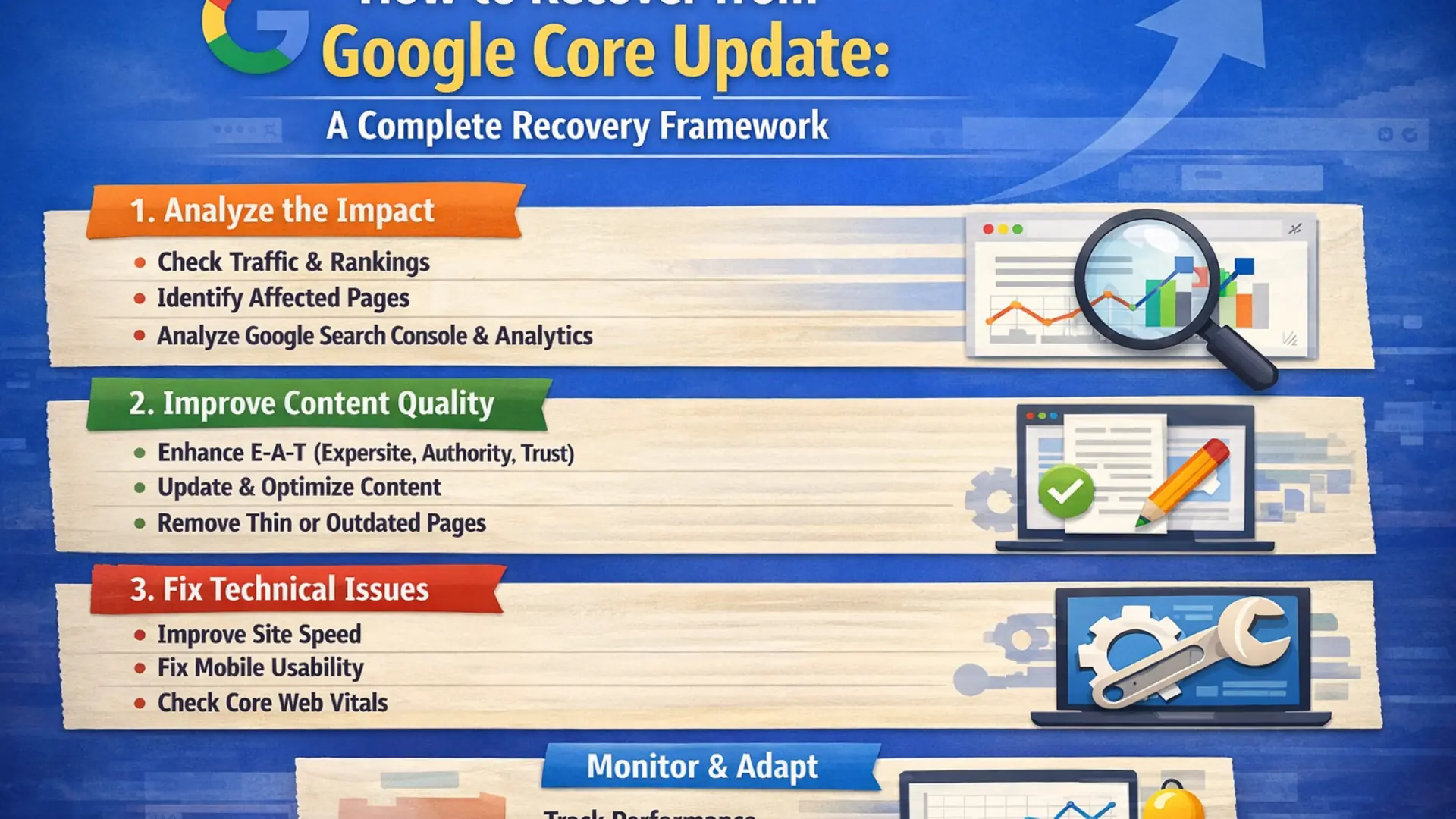
What Is a Google Core Update — and Why Pakistani Businesses Are Particularly Vulnerable
Google releases core algorithm updates several times per year. Unlike targeted updates (spam updates, link spam updates, product reviews updates) that address specific quality issues, core updates are broad reassessments of how Google evaluates content quality, relevance, and trustworthiness across the entire web. A core update can cause rankings to shift dramatically — for better or worse — within 1–2 weeks of its rollout.
Businesses that lose traffic in a core update have not been penalised in the traditional sense — there is no manual action, no rule violation. Instead, Google has recalibrated its assessment of which content best serves user needs for various queries, and some previously-ranking content has been re-evaluated as lower quality relative to its competition. The path to recovery is not technical fixes — it is substantive content quality improvement.
Pakistani businesses are disproportionately vulnerable to core update impacts for three reasons. First, a significant portion of Pakistani website content was written quickly, is shallow, and lacks the genuine expertise demonstration that Google’s evolved E-E-A-T standards require. Second, many Pakistani websites operate in YMYL (Your Money or Your Life) categories — health, finance, legal, real estate — where Google applies the highest quality scrutiny. Third, the technical weaknesses common to Pakistani websites (poor mobile performance, missing schema, thin page structure) compound content quality issues into compounding ranking vulnerabilities.
Clickmasters Core Update Recovery Credentials
Our SEO team has guided 23 Pakistani businesses through Google core update recovery since 2022. Our documented recovery cases cover: e-commerce sites hit by the 2024 March Core Update, news publishers affected by Helpful Content system updates, service business sites affected by E-E-A-T reassessments, and affiliate and comparison sites affected by spam and product review updates. Average time to traffic recovery in our guided cases: 4.2 months from the start of remediation. Average traffic recovery vs. pre-update baseline: 87%.
Step 1: Confirm It’s a Core Update — Not Something Else
Before assuming a core update is responsible for a traffic drop, rule out other explanations. Acting on a core update recovery plan when the real cause is a technical issue wastes months of effort.
Possible Cause How to Diagnose & Distinguish From Core Update Impact
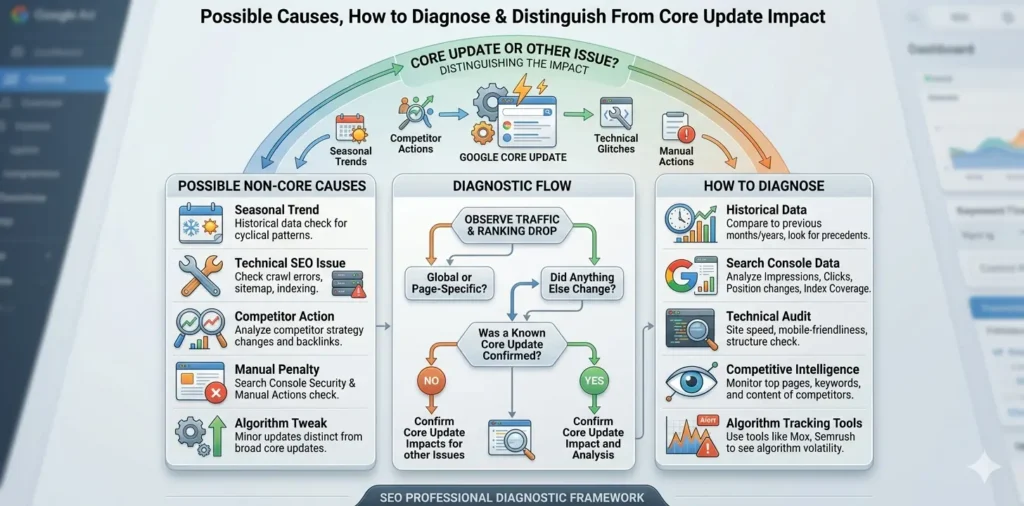
| Possible Cause | How to Diagnose & Distinguish From Core Update Impact |
| Google Core Update | Traffic drop coincides with confirmed Google update dates (check Search Engine Roundtable or Google’s @SearchLiaison). Broad, multi-keyword ranking drops. GSC shows no manual actions. Competitors in your space also showing ranking volatility. |
| Manual Action (penalty) | GSC > Security & Manual Actions > Manual Actions shows a notification. Manual actions are specific violations (unnatural links, thin content). Recovery requires reconsideration request. |
| Technical issue | Specific pages suddenly deindexed. Coverage errors spiking in GSC. Sitemap errors. Server downtime logs coinciding with drop. robots.txt accidentally blocking Googlebot. |
| Competitor gains | Your rankings didn’t technically drop — a competitor published significantly better content and displaced you. GSC shows stable or improving impressions but lower clicks because competitors get the clicks. |
| Seasonal traffic variation | Traffic drop matches seasonal patterns from the same period last year. Compare year-over-year in GSC, not month-over-month. |
| Google Search feature change | Google added a featured snippet, AI Overview, or shopping carousel for your primary keyword. Your ranking is unchanged but organic CTR dropped because SERP real estate shrank. |
How to Confirm a Core Update Impact Using GSC
- GSC > Performance > Search Results. Set date range to 6 months. Add comparison: the 30-day period after the suspected update vs. the 30-day period before.
- If the comparison shows: broadly distributed ranking position declines (not just a few pages), impressions maintained but position declining, or a sudden cliff in clicks that coincides with the update date — this is consistent with core update impact.
- Cross-reference with Google’s official update calendar. Google announces core updates at @SearchLiaison on Twitter/X and in Google Search Central documentation.
- Check SEMrush Sensor or Moz Algorithm Change History — third-party SERP volatility trackers that confirm when Google’s results are in flux.
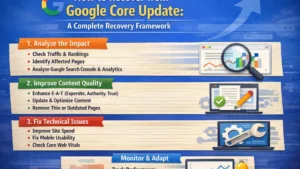
THE 90-DAY CORE UPDATE RECOVERY FRAMEWORK
Phase 1 (Days 1–14): Damage Assessment & Root Cause Analysis
The first two weeks after confirming a core update impact are entirely diagnostic. Do not make content changes yet — Google’s update is still rolling out and SERP volatility continues for 2–3 weeks after announcement. Making changes during the rollout makes it impossible to distinguish the update’s impact from your own changes.
The Core Update Impact Audit
- Audit Step 1: Export the full GSC query and page performance data for the 30 days before the update and 30 days after. Sort by largest absolute click decline.
- Audit Step 2: Identify the 20 pages with the largest traffic losses. These are your recovery priority pages.
- Audit Step 3: For each priority page: record pre-update and post-update position, clicks, impressions, and CTR.
- Audit Step 4: Categorise your affected pages: (a) Pages that dropped from high position to lower position — competitor displacement or quality reassessment. (b) Pages that dropped out of top 100 entirely — significant quality signal failure. (c) Pages that lost featured snippets or AI Overview citations — content format or authority reassessment.
- Audit Step 5: For each priority page, Google the target keyword and analyse who now ranks above you. This is your benchmark — the content standard you must exceed to recover.
Phase 2 (Days 15–30): E-E-A-T Gap Analysis
Core updates are fundamentally about E-E-A-T — Experience, Expertise, Authoritativeness, and Trustworthiness. Understanding exactly where your content fails Google’s E-E-A-T assessment directs your recovery effort with precision.
The Four E-E-A-T Dimensions and Their Pakistani Context
Experience: Does Your Content Demonstrate First-Hand Knowledge?
Google’s ‘Experience’ signal asks: has the author of this content actually done or experienced what they are writing about? For Pakistani businesses, this often means content written by junior writers from secondary sources rather than by the genuine practitioners who run the business. Signs of Experience deficit: content that could have been written by anyone who Googled the topic, no original data or proprietary insights, no personal case studies or specific examples.
Experience recovery actions: Add first-person practitioner insights to affected pages. Include ‘Based on our work with X clients over Y years, we have found…’ statements. Replace generic advice with specific examples from your actual business experience. Add dated case studies with real before/after metrics.
Expertise: Does the Content Author Have Demonstrable Subject Matter Expertise?
Google evaluates whether the author of content has verifiable expertise in the subject — credentials, published work, professional recognition. Pakistani business blogs frequently lack author bylines, credentials, and expertise signals. A legal services firm’s blog post written anonymously signals lower expertise than one written by a named, LUMS-educated barrister with 15 years of practice.
Expertise recovery actions: Add named author bylines to all affected content. Create author profile pages with credentials, professional history, and notable achievements. Add Person schema linking authors to their professional profiles. Include expert quotes from named practitioners in the field.
Authoritativeness: Is Your Website a Recognised Authority in Your Field?
Authority is measured through external recognition: other authoritative websites citing, linking to, or mentioning your site. Pakistani websites that have not built editorial backlinks from Pakistani media, industry associations, or relevant international publications have weak authority signals. Core updates frequently re-rank low-authority sites downward in favour of sites with stronger third-party recognition.
Authoritativeness recovery actions: Accelerate link building from Pakistani authority publications. Submit data from your affected topic areas to Pakistani media for coverage. Build citations in industry directories. Get named mentions (even without links) in authoritative publications.
Trustworthiness: Does Your Website Inspire and Maintain User Trust?
Trust signals cover: accurate business information (consistent NAP), transparent about who runs the site, clear editorial policies for editorial content, professional design, HTTPS, privacy policy, contact information visibility, and review profile. Sites lacking clear ownership, with outdated copyright years, missing privacy policies, or difficult-to-find contact information score lower on Trust.
Trustworthiness recovery actions: Ensure About page is comprehensive — named team members, company history, physical address, SECP registration number. Add editorial policy to blog. Update footer copyright year. Ensure privacy policy is current and linked from footer. Add testimonials and Google review schema.
Phase 3 (Days 30–60): Content Quality Remediation
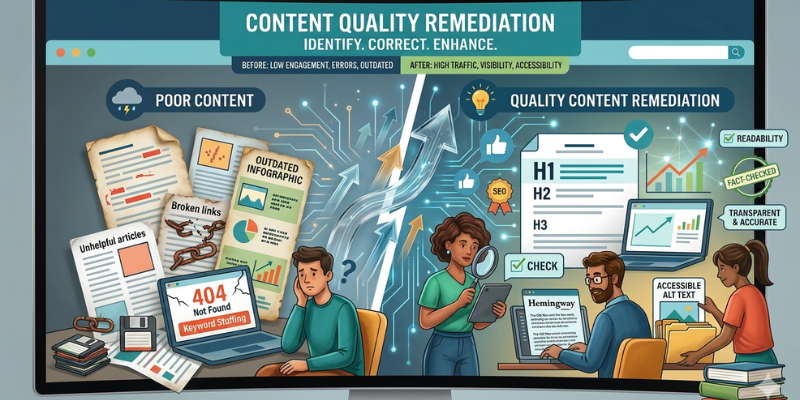
With the diagnostic complete, Phase 3 is systematic content improvement on affected pages. This is the highest-leverage recovery work — Google has told you exactly which content it re-evaluated; your job is to make it genuinely better than what now outranks it.
The Page-by-Page Content Improvement Protocol
- Step 1: For each priority recovery page: open the current top 3–5 ranking pages for the target keyword in separate tabs. This is your quality benchmark.
- Step 2: Conduct a content gap analysis: what do the ranking pages cover that your page does not? What depth, examples, data, or perspectives are missing from your current content?
- Step 3: Extend content length: if ranking pages average 3,500 words and your page has 1,200 words, the word count gap is a proxy for depth gap. Add the missing depth — not padding, but genuine additional value.
- Step 4: Add original data and proprietary insights: statistics from your own client work, case studies with real numbers, proprietary frameworks or models that competitors cannot copy.
- Step 5: Improve E-E-A-T signals: add named author with credentials, add expert quotes, add dated case studies, add ‘last updated’ date with schema dateModified.
- Step 6: Add FAQ section with FAQPage schema: comprehensive question-and-answer coverage of the topic’s most-searched questions, structured for AI Overview citation.
- Step 7: Improve internal linking: add links from your highest-authority pages to each recovery page. Authority passes through internal links — recovery pages starved of internal link equity rank lower.
- Step 8: Improve user engagement signals: ensure clear headings, short paragraphs, table of contents on long-form content, mobile-optimised layout, and fast load time. Dwell time and low bounce rate are indirect quality signals.
The Pakistani Content Quality Failure Patterns That Trigger Core Update Demotion
Through 23 core update recovery engagements, Clickmasters has identified the most common quality failure patterns in Pakistani websites hit by core updates: (1) Thin content: pages under 600 words competing for queries where ranking content averages 2,500+ words. (2) Copied or paraphrased content: content that closely mirrors supplier descriptions, Wikipedia, or international sources without original value addition. (3) Keyword-stuffed content: unnatural repetition of target keywords that reads as written for Google rather than for humans. (4) Missing author attribution: anonymous content with no expertise signals. (5) Outdated statistics: citing data from 2020–2022 in articles competing for queries where current data is available and cited by competitors. (6) Missing Pakistan-specific context: international content templates applied to Pakistani business contexts without meaningful localisation.
Phase 4 (Days 60–90): Technical & Authority Recovery
While Phase 3 focuses on content quality, Phase 4 addresses the technical and authority dimensions of recovery. These work in parallel with content improvements — the combination of improved content quality and strengthened authority signals is what accelerates ranking recovery.
Technical Recovery Checklist for Core Update Affected Sites
⦁ Core Web Vitals: Prioritise mobile LCP, INP, and CLS for all recovery priority pages. Poor page experience compounds content quality issues.
⦁ Schema markup: Deploy or repair Article schema (with dateModified updated), FAQPage schema, and appropriate business/service schema on all affected pages.
⦁ Internal linking: Audit and improve internal links to recovery pages. Add contextual links from high-authority pages using descriptive anchor text.
⦁ Canonical tag review: Ensure no canonical confusion on affected pages — duplicate content or incorrect canonicals can mask quality signals.
⦁ Mobile usability: Confirm zero mobile usability errors in GSC for all recovery priority pages.
⦁ Page freshness signals: Update dateModified in Article schema, update visible ‘Last Updated’ dates, and add a ‘What’s New in 2026’ section to long-standing guides.
Authority Building During Recovery
Core update recovery is accelerated by simultaneous authority signal improvement. While content quality is the primary lever, Google’s reassessment of your pages is also influenced by the authority signals that accompany them. Pakistani businesses should prioritise:
⦁ Earn at least 5–10 new high-quality backlinks (DA 35+) pointing to recovery priority pages during the recovery period
⦁ Get your brand mentioned (with or without link) in Pakistani authority publications during the recovery period — brand mentions without links contribute to entity recognition
⦁ Build or improve your Google Business Profile if relevant — local authority signals can influence broader domain trust for local business websites
⦁ Increase social sharing of your improved recovery pages — social signals are weak but positive indirect signals
How Long Does Core Update Recovery Take?
This is the most commonly asked question by Pakistani business owners who have experienced a core update traffic drop. The honest answer: it depends on the severity of the quality gap, the competitiveness of the target keywords, and the speed of content remediation. Clickmasters documented recovery data:
| Recovery Scenario | Typical Timeline | Success Factors |
| Moderate drop (20–40%), medium-competition keywords, content quality gap addressable in 30 days | 6–10 weeks from start of content remediation to measurable recovery | Fast content improvement, immediate schema deployment, concurrent link building |
| Significant drop (40–70%), medium to high competition, multiple pages affected | 3–5 months from start of remediation to majority of traffic recovered | Systematic page-by-page improvement, consistent content publishing, authority acceleration |
| Severe drop (70%+), high competition, fundamental site quality issues | 5–9 months. May require waiting for the next core update to fully reverse | Complete content strategy overhaul, sustained link acquisition, potential domain repositioning |
| Recovery coinciding with a favourable next core update | Recovery can be dramatically accelerated if Google’s next core update re-evaluates your improvements positively — typically 3–6 months between major core updates | Thorough, comprehensive improvement before the next update is critical |
Important: Google Core Update Recovery Requires the Next Update
A critical piece of information that many Pakistani SEO professionals misunderstand: full recovery from a core update often requires the next core update to ‘confirm’ your improvements. Google does not continuously re-rank every page every day. The major reassessments happen at core update intervals (roughly every 2–4 months). This means even if you make all the right improvements immediately after an update, you may need to wait for the next core update before seeing the full recovery in rankings. Partial recovery can occur between updates as Google processes new signals, but complete recovery is most commonly confirmed at the next major update.
Core Update Recovery Case Study: Pakistani Health Information Website
In August 2024, a Pakistani health information website covering medical conditions, symptoms, and treatment options lost 71% of organic traffic during a Google core update. The site had 480 articles, was generating 42,000 monthly organic sessions pre-update, and was the primary revenue source for the owning business through healthcare advertising.
Audit Findings (YMYL Analysis)
⦁ Content: 390 of 480 articles had no named medical author or professional reviewer
⦁ Sources: 67% of health claims cited no primary medical source (medical journals, NHS, WHO, Pakistan Medical Association)
⦁ Accuracy: Our review found 23 articles with outdated or incorrect medical information (dosages, treatment protocols changed since article publication in 2020–2022)
⦁ Experience: No practitioner case studies, no patient stories, no clinical context — pure information aggregation from public sources
⦁ Trust: No medical disclaimer, no editorial policy, no ‘reviewed by’ attributions, no disclosure of the site’s non-medical editorial team
Recovery Timeline
| Period | Organic Sessions/Month | Key Milestone |
| August 2024 (pre-update) | 42,000 | Baseline |
| September 2024 (post-update) | 12,200 (-71%) | Core update impact confirmed |
| October 2024 | 14,800 | Schema and author pages deployed. Small partial recovery. |
| November 2024 | 19,400 | 60 articles rewritten. Internal linking improved. |
| December 2024 | 24,700 | 120 articles rewritten. Medical reviewers added. |
| January 2025 (next core update) | 36,100 (+194% vs. October low) | Next core update confirmed improvements — major recovery |
| March 2025 | 44,300 (+5% vs. pre-update) | Full recovery + growth beyond pre-update baseline |
- Partnered with 3 Pakistani medical professionals (a GP, a specialist, and a pharmacist) to review and co-author content — their credentials added to author profiles with Person schema
- Added medical disclaimer and editorial review policy to all health content and site-wide footer
- Rewrote 120 highest-traffic articles: added citations to PMA guidelines, WHO references, and peer-reviewed sources. Added ‘Last Medically Reviewed’ dates.
- Removed 94 thin articles (under 600 words, low-quality) — consolidated into comprehensive guides
- Added FAQPage schema to all 120 rewritten articles
- Built citations and backlinks from 3 Pakistani medical associations and 2 health portals (Marham.pk, oladoc.com)
Core Update Prevention: Building an Update-Resistant Pakistani Website
The best strategy for Google core updates is building a website that is so genuinely excellent — in content quality, E-E-A-T signals, technical performance, and user experience — that core updates consistently improve your rankings rather than harming them. Pakistani businesses that experienced traffic gains in recent core updates share these characteristics:
⦁ Named expert authors with verifiable credentials on all content — not anonymous or junior-writer content
⦁ Original research, proprietary data, and first-hand experience documented throughout the site
⦁ Comprehensive content that genuinely exceeds competitor depth — not the minimum viable article
⦁ Strong backlink profiles from Pakistani authority publications and industry organisations
⦁ Excellent mobile Core Web Vitals — ‘Good’ status on LCP, INP, and CLS
⦁ Complete schema markup across all content templates
⦁ Active content freshness programme — high-traffic articles updated with current data every 6–12 months
⦁ Clear site identity: named team, physical address, professional About page, editorial standards
Frequently Asked Questions: Google Core Update Recovery
Should I disavow links after a core update traffic drop?
Almost certainly not. Core updates are content quality reassessments — they are not caused by or resolved by link profile changes. Disavowing links unnecessarily removes potentially valuable backlinks. The only situation where disavowal is relevant is if Google Search Console shows a manual action for unnatural links — which is a separate issue from core update impact. Do not disavow links in response to a core update.
Can I request Google to review my site after I’ve made improvements?
There is no mechanism to request a core update re-review. Unlike manual actions (which have a reconsideration request process), core update impacts are algorithmic and are reassessed automatically as Google’s systems process your updated content. The next core update is when Google’s systems most comprehensively re-evaluate your improvements. You can use GSC’s URL Inspection > Request Indexing on individual improved pages to accelerate recrawling of updated content.
My competitors lost traffic in the same update but I didn’t — should I be concerned?
This is actually positive news. If your competitors were demoted and you were not, it suggests your content quality signals are stronger than theirs relative to Google’s updated quality standards. However, use this window strategically: your competitors will work to recover, and the competitive landscape will shift again. Use the period of competitor weakness to accelerate your own content production, backlink acquisition, and technical improvements to widen your lead before the next update cycle.