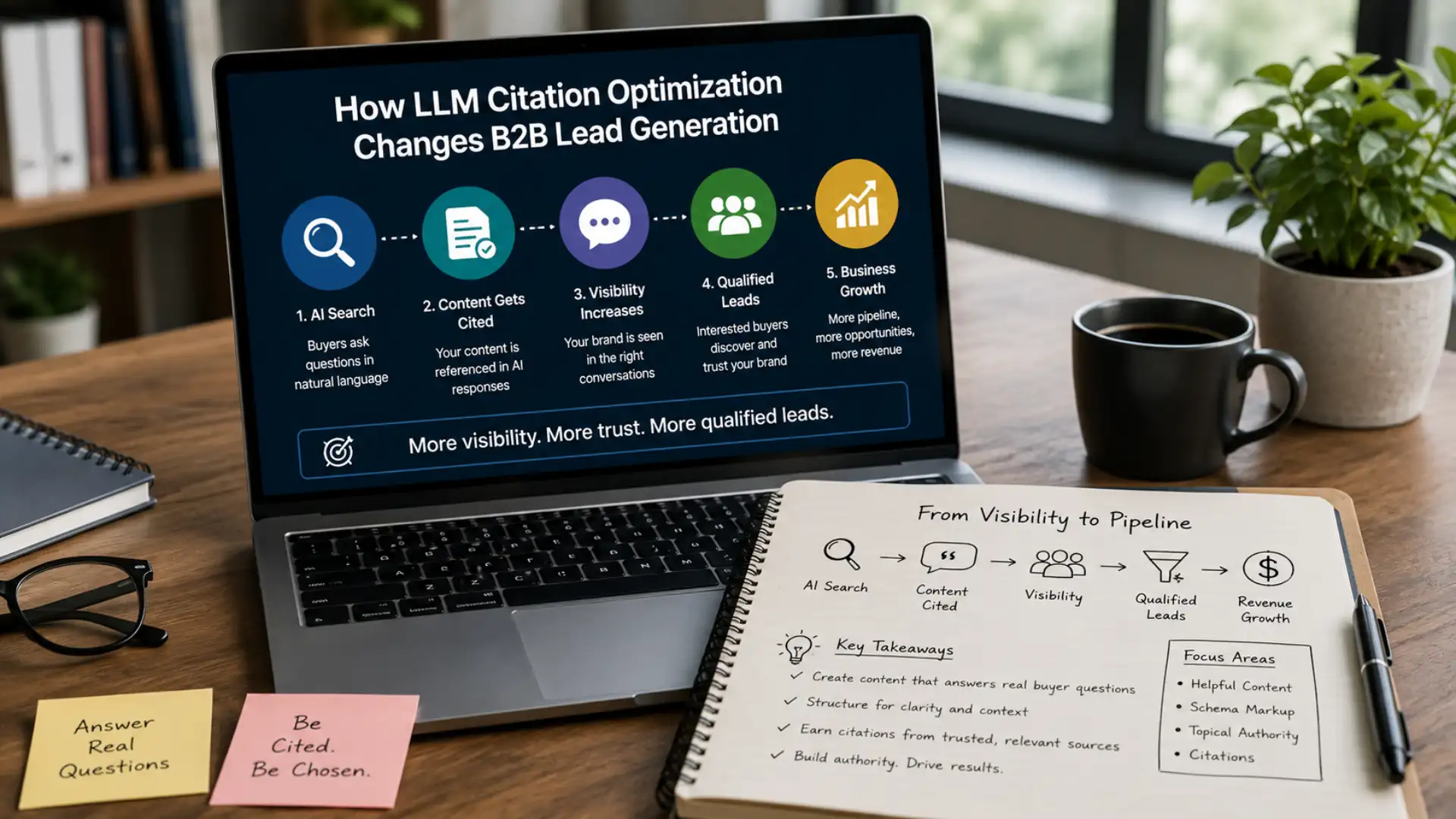
The classic B2B funnel assumed a discoverable research phase: a buyer Googles the category, reads comparison posts, downloads a whitepaper, enters your nurture sequence, and books a demo six touches later. Every stage leaves footprints your marketing team could see and retarget. That funnel isn’t dead — but a growing slice of it now happens inside a chat window where you have zero visibility. A procurement lead asks ChatGPT for “ERP vendors with textile industry experience and local support in Pakistan,” gets a five-name shortlist, and contacts two of them. If you’re named three, you got a demo request from a buyer you never touched. If you’re absent, you lost a deal that never appeared in any funnel report.
LLM citation optimization is the discipline of winning that invisible shortlist. It’s not a replacement for demand gen — it’s a repair job on a funnel stage that quietly moved out of your instrumentation. And because AI engines assemble shortlists from the open web, the work runs on the same foundation as everything else in this cluster and our broader SEO services in Pakistan programs: rankings, entities, structure, evidence.
Table of Contents
What Actually Changed in the B2B Buying Journey
Three structural shifts, each with a pipeline consequence:
1. Compression. The 8–12 touch research phase collapses into one conversational session. The buyer arrives at your site having already compared you — pricing models, weaknesses, alternatives — using whatever the model said. Consequence: your first human touchpoint is later and better-informed. Demo-request quality goes up; top-of-funnel volume metrics go down. Teams that don’t adjust their dashboards misread this as decline.
2. Delegation of trust. The buyer outsources shortlisting to the model. The model outsources it to sources: review platforms, comparison articles, analyst mentions, community threads, your own published claims. Consequence: third-party evidence about you now does the selling before you know the deal exists.
3. Loss of retargeting surface. No cookies inside a ChatGPT session. No “visited pricing page” signal. Consequence: you can’t buy your way back in front of a buyer you lost at the AI stage. You either got cited, or you didn’t.
The Anatomy of an AI Vendor Shortlist
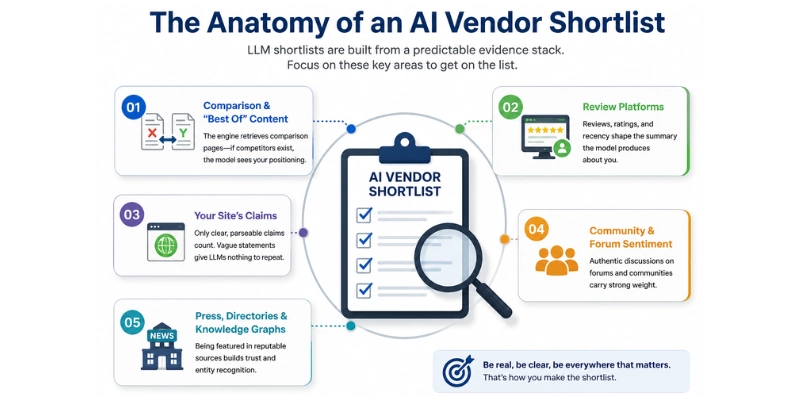
Run your own category prompt and study the answer. LLM shortlists are assembled from a predictable evidence stack — this is your target list, in rough weight order:
- Comparison and “best of” content the engine retrieves — including your competitors’ comparison pages. If the only “X vs Y” page online is your rival’s, the model is reading their framing of you.
- Review platforms — Clutch, G2, Capterra, Trustpilot, depending on category. Volume, recency, and text content of reviews all feed the summary the model produces about you.
- Your own site’s claims — but only the parseable ones. Vague “leading solutions provider” copy gives the model nothing to repeat. “Serves 40+ textile manufacturers across Pakistan and the Gulf with on-site support in Karachi and Lahore” is a citable fact.
- Community and forum sentiment — Reddit, LinkedIn discussions, industry forums. LLMs weight authentic peer discussion heavily because their training does.
- Press, directories, and knowledge-graph entities — corroboration that you’re real, established, and correctly described.
The strategic reframe: your citable footprint is now a sales asset with a pipeline number attached, not a brand nicety.
The B2B Citation Playbook
Move 1: Claim the Comparison Layer
Publish honest comparison content in your category: “X vs Y for [industry],” “best [category] for [segment] in Pakistan,” alternatives pages, transparent pricing-range guides. Two rules make this work: genuinely useful comparisons (models increasingly reflect balanced sources over pure self-promotion), and answer-block formatting so verdicts are liftable. B2B buyers ask comparative questions; comparative content is what gets retrieved.
Move 2: Weaponize Your Review Presence
This is the highest-ROI move for most B2B firms and the most neglected:
- Systematize review collection at project milestones — not a yearly panic
- Get reviews with text describing specifics (“delivered the ERP migration in 11 weeks”) — models summarize text, not star counts
- Respond to every review; response content is also parsed
- Keep your Clutch/G2 profiles complete and current — service lines, industries, minimum engagement size. An unclaimed or half-empty profile is a half-empty answer about you
Move 3: Publish Evidence, Not Adjectives
Every claim on your commercial pages should survive being quoted out of context: client counts, industries served, delivery timelines, retention rates, named frameworks, certifications. Add one proprietary-data asset per quarter — original benchmarks or industry stats make you the source other content cites, which compounds your retrieval presence. (The GEO explainer in this series covers the research behind why statistics and quotations win citations.)
Move 4: Entity and Schema Foundation
Organization schema with sameAs links binding your site to your review profiles, consistent descriptions everywhere, real named authors with credentials on your content. This is the technical layer from Spoke 2 — for B2B it’s what lets a model confidently say who you are instead of hedging.
Move 5: Show Up Where Peers Talk
Genuine participation in the LinkedIn conversations, communities, and industry publications your buyers’ questions draw from. Not astroturfing — models and platforms both punish it — but ensuring that when someone asks “anyone worked with a good [category] firm?”, the thread that gets retrieved contains your name for honest reasons.
Rewiring Measurement: The Pipeline Metrics That Change
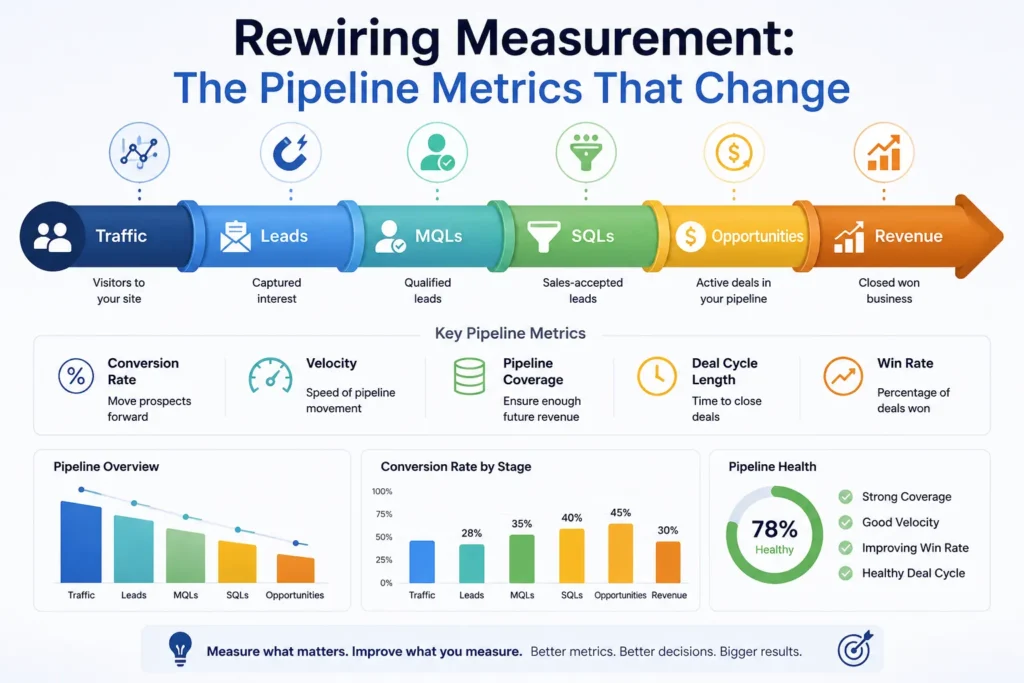
If AI-stage buying is invisible, measure its edges:
- AI referral segment in GA4 (chatgpt.com, perplexity.ai, gemini referrers) with conversion rate tracked separately — expect low volume, disproportionate demo-request rate
- “How did you hear about us?” as a required demo-form field with an explicit AI option. Companies adding this are routinely surprised — it’s the cheapest attribution fix available
- Monthly shortlist audits: your 15–20 buying prompts run across ChatGPT, Perplexity, and Gemini; log presence, position, and what the model says about you. Track share-of-voice against named competitors over time — this is the new rank tracking
- Branded search and direct traffic lift correlated with citation presence — the visible shadow of invisible research
- Sales-call intelligence: train reps to ask what tools the buyer used to research. Their answers calibrate how much pipeline is AI-originated
Then adjust targets: fewer raw MQLs, higher demo-to-close rates is the expected signature of AI-compressed funnels — not a marketing failure.
The 90-Day Rollout for a B2B Team
- Weeks 1–2: Baseline shortlist audit; add attribution field; build the AI referral segment
- Weeks 3–6: Review-platform overhaul (profiles completed, collection system live); entity/schema cleanup
- Weeks 6–12: First comparison-layer content shipped (3–5 pages); first proprietary-data asset scoped; commercial pages rewritten from adjectives to evidence
- Ongoing: Monthly prompt audits, quarterly data publication, review velocity maintained
Firms doing this now in Pakistani and regional B2B categories face almost no competition for the shortlist — most vendors haven’t run a single prompt audit. That window closes the way all of them do: quietly, and then all at once.
If you want the audit, the citation strategy, and the content engine run as one managed program — alongside the classic rankings that feed the retrieval layer — that’s exactly what our AI SEO and B2B lead generation services are built for. Final piece of this series: the budget question — how to split 2026 spend between traditional SEO and answer engine optimization.
GET IN TOUCH
Get 1 Free Consultation Call
FAQ
How much B2B research actually happens in AI tools now?
It varies by category and buyer demographic, and self-reported survey numbers run ahead of measurable referrals. What’s beyond dispute: AI referral traffic to B2B sites converts at outsized rates, and demo-form attribution consistently surfaces AI tools once you ask. Measure your own category before extrapolating anyone’s headline stat.
Can we pay to appear in ChatGPT or Perplexity answers?
Organic answer citations aren’t for sale, though ad formats around AI experiences are emerging. The durable path is the evidence trail: reviews, comparisons, entities, and data.
Does this replace our outbound and paid demand gen?
No — it repairs the research stage those channels hand off to. Buyers you cold-email still verify you through AI tools; citation presence raises reply and close rates on everything else you run.
What’s the fastest single win?
The demo-form attribution field plus a review-platform overhaul. One tells you the size of the problem; the other moves the answer engines’ single heaviest B2B evidence source.