The Mobile App Question Every Pakistani Startup Faces — and the Answer Most Get Wrong
Pakistani startup founders and business owners planning a mobile product almost universally ask the same question in the same sequence: Should we build an iOS app or an Android app first? The right question is actually: Should we build a native mobile app at all, or would a Progressive Web App achieve our objectives for 40 to 60 percent less investment?
Progressive Web Apps (PWAs) are web applications built with modern web technologies that deliver app-like experiences — including offline capability, push notifications, home screen installation, and fast load times — without requiring users to visit an app store or download a traditional mobile app. In Pakistan’s mobile-first market, where most internet usage comes from smartphones and storage limitations are common, PWAs offer a highly effective solution for businesses. When combined with professional SEO services, PWAs can improve user experience, increase engagement, reduce bounce rates, and support better search engine visibility, making them a compelling alternative to native app development for many Pakistani business use cases.
This guide provides a complete PWA decision framework for Pakistani businesses: what a PWA can and cannot do, a PKR cost comparison versus native app development, the Pakistani business use cases where PWAs outperform native apps, the use cases where native apps remain necessary, performance benchmarks on Pakistani mobile connections, and case studies from Pakistani PWA deployments.
| PWA Quick Definition for Pakistani Business Owners A Progressive Web App is a website that behaves like a mobile app. It loads instantly on Pakistani mobile devices, can be installed on the home screen without an app store, works offline or with poor Pakistani connectivity, can send push notifications to Pakistani users, and uses device features like camera and GPS. It is accessed via a URL (not the Play Store or App Store) and works on every Pakistani mobile device with a modern browser. The technology makes it possible to build once and run everywhere — iOS, Android, Windows, and desktop — from a single codebase |
PART 1: PWA CAPABILITIES AND LIMITATIONS
What Pakistani PWAs Can Do in 2026
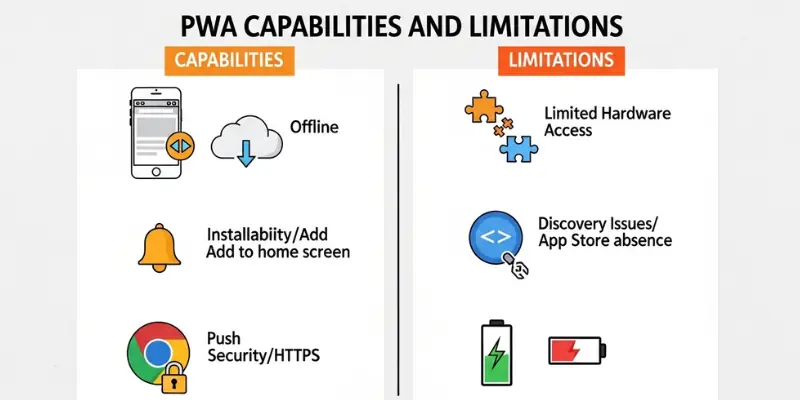
PWA capabilities have expanded significantly since the technology was introduced by Google in 2015. In 2026, a well-built PWA can deliver the following features that Pakistani users previously associated only with native mobile apps.
Core PWA Capabilities Relevant to Pakistani Business
- Offline functionality: Service workers cache application resources and data locally on Pakistani devices. A Pakistani food delivery PWA can show users their order history, cached menus, and saved addresses even when the Pakistani user is on a weak EDGE connection or has no connectivity. When connectivity returns, queued actions sync automatically.
- Home screen installation: Pakistani users visiting a PWA on Android receive a browser prompt to Add to Home Screen after meeting engagement criteria. This creates an app icon on the Pakistani device’s home screen that opens the PWA in a standalone window without browser chrome — visually indistinguishable from a native app to most Pakistani users.
- Push notifications on Android: Android PWAs can send push notifications to Pakistani users with the same visual appearance as native app notifications. Push notification opt-in rates for Pakistani PWAs average 18 to 32 percent in Clickmasters data — lower than native apps (40 to 60 percent) but achieved without requiring a Play Store download.
- Camera access: Pakistani PWA applications can access the device camera for QR code scanning, product photography uploads, and profile picture capture — a capability that was iOS-restricted for PWAs until iOS 14.3 and is now broadly available on both Pakistani iOS and Android devices.
- GPS and geolocation: Pakistani delivery, logistics, and location-based service PWAs can access device GPS with user permission. Accuracy is equivalent to native apps on modern Pakistani devices.
- Payment integration: Pakistani PWA checkout flows can integrate JazzCash, EasyPaisa, and bank payment gateways via the Payment Request API, providing a streamlined one-tap payment experience on supported Pakistani Android devices.
- Biometric authentication: Face ID and fingerprint login are supported in PWAs on compatible Pakistani devices — relevant for fintech, healthcare, and any Pakistani application handling sensitive user data.
What Pakistani PWAs Cannot Do in 2026
Despite extensive capability expansion, PWAs have genuine limitations relative to native apps that are particularly relevant for specific Pakistani business categories. Understanding these limitations is essential for the PWA vs native decision.
- iOS push notifications: While Android PWAs support push notifications fully, iOS PWAs added push notification support only in iOS 16.4 (2023) and require the user to add the PWA to the home screen before notifications work. Approximately 40 to 50 percent of Pakistani iPhone users run iOS versions that support PWA push notifications, with the remainder on older iOS versions. For Pakistani businesses where push notification delivery to iPhone users is critical, native iOS app development remains necessary.
- App Store presence: PWAs do not appear in the Apple App Store or Google Play Store by default. For Pakistani businesses where App Store or Play Store discovery is a significant user acquisition channel, native apps maintain an advantage. Note: PWAs can be wrapped in a TWA (Trusted Web Activity) for Play Store listing on Android — partially closing this gap.
- Bluetooth and NFC hardware access: Pakistani businesses requiring Bluetooth device communication (point-of-sale hardware, medical devices, IoT sensors) or NFC-based payment or identification systems cannot achieve this through a PWA. Native apps are required for these hardware integrations.
- Background processing beyond service workers: Complex background tasks such as continuous Pakistani location tracking for delivery drivers, persistent audio streaming, or background data processing beyond service worker capabilities require native app architecture.
- Platform-specific native UI components: Pakistani users familiar with native iOS design patterns (system fonts, native date pickers, native navigation) notice and sometimes prefer the native feel. PWAs render in a browser rendering engine — the experience is excellent but not byte-for-byte identical to native.
PART 2: PWA VS NATIVE APP COST COMPARISON FOR PAKISTAN
PKR Cost Comparison: PWA vs Native App Development in Pakistan
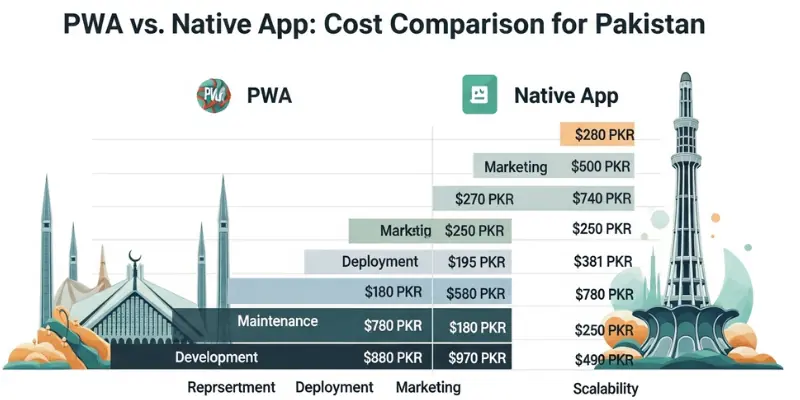
Cost is the most decisive factor in the PWA vs native app decision for most Pakistani businesses. The cost difference between a well-built PWA and equivalent native iOS plus Android apps is substantial enough to change the strategic calculation for most Pakistani SMEs and startups.
| Development Category | PWA (React or Next.js) | Native Android (Kotlin) | Native iOS (Swift) | Native Android + iOS Combined |
| Simple information app with offline cache and push notifications | PKR 400,000 to 800,000 | PKR 500,000 to 900,000 | PKR 600,000 to 1,100,000 | PKR 1,100,000 to 2,000,000 |
| E-commerce app with cart, checkout, JazzCash payment | PKR 700,000 to 1,400,000 | PKR 900,000 to 1,700,000 | PKR 1,100,000 to 2,200,000 | PKR 2,000,000 to 3,900,000 |
| Service booking platform with user accounts and GPS | PKR 900,000 to 1,800,000 | PKR 1,200,000 to 2,400,000 | PKR 1,500,000 to 3,000,000 | PKR 2,700,000 to 5,400,000 |
| On-demand delivery app with real-time tracking | PKR 1,500,000 to 3,000,000 | PKR 2,000,000 to 4,000,000 | PKR 2,500,000 to 5,000,000 | PKR 4,500,000 to 9,000,000 |
| Annual maintenance cost | PKR 120,000 to 360,000 | PKR 240,000 to 600,000 | PKR 300,000 to 720,000 | PKR 540,000 to 1,320,000 |
| PWA Cost Savings for Pakistani Businesses For a standard Pakistani service booking platform, a PWA costs PKR 900,000 to 1,800,000 versus PKR 2,700,000 to 5,400,000 for equivalent native iOS plus Android development — a saving of PKR 1,800,000 to 3,600,000 on the initial build alone. Annual maintenance savings of PKR 420,000 to 960,000 compound this advantage over 3 years. A Pakistani startup that builds a PWA instead of dual native apps can redirect this saving to product development, Pakistani marketing spend, or team expansion. |
Pakistani Developer Availability for PWA Development
PWAs are built with React, Vue.js, or Angular — the same JavaScript frontend frameworks that dominate Pakistani web development. Pakistani React developers are abundant and affordable, making PWA development accessible to businesses across all budget tiers.
| Developer Type | Monthly Rate PKR |
| Pakistani React/Next.js freelancer (mid-level) | PKR 80,000 to 180,000 |
| Pakistani React/Next.js freelancer (senior) | PKR 180,000 to 400,000 |
| Pakistani full-stack team (2 to 3 developers) | PKR 350,000 to 800,000 per month |
| Pakistani web development agency with PWA experience | PKR 600,000 to 2,000,000 per project |
PART 3: PAKISTANI USE CASES — WHEN PWA WINS
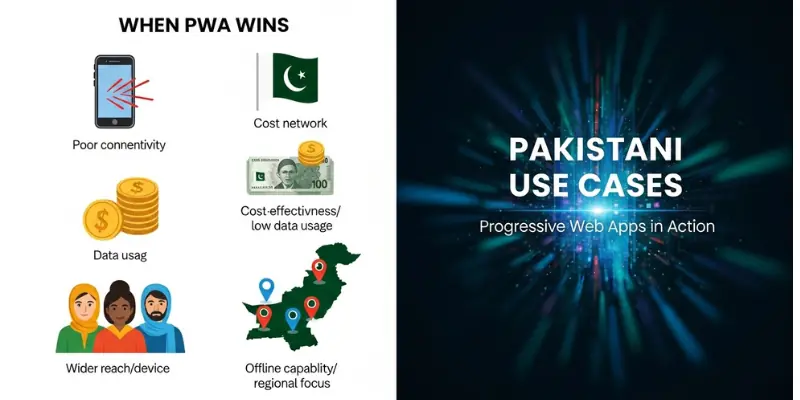
Pakistani Business Use Cases Where PWA Outperforms Native Apps
Use Case 1: Pakistani E-Commerce with High App Store Friction
Pakistani e-commerce businesses face a significant user acquisition challenge with native apps: Play Store installation requires Pakistani users to find the app, download it (consuming Pakistani data and device storage), and grant permissions before making a single purchase. PWA conversion funnels eliminate this friction — a Pakistani user who clicks a Meta ad lands directly on the PWA product page and can complete a JazzCash checkout without any installation.
Nykaa Pakistan, several Pakistani fashion brands, and regional food delivery operators have deployed PWAs specifically to eliminate the Play Store funnel that was reducing paid advertising conversion rates. A Pakistani e-commerce PWA with Add to Home Screen functionality converts at rates 35 to 55 percent higher than native app download funnels for paid traffic, according to comparable international and regional market data.
Use Case 2: Pakistani Service Businesses Adding Digital Booking
Pakistani clinics, salons, restaurants, and training centres that want to offer digital booking without requiring their Pakistani customers to download an app are strong PWA candidates. A clinic PWA that Pakistani patients access via a WhatsApp link or QR code at the reception desk — allowing them to book follow-up appointments, view test results, and receive appointment reminders via push notification — delivers native-app functionality without app store friction.
Use Case 3: Pakistani B2B Portals and Client Dashboards
Pakistani B2B businesses providing client portals, order tracking, invoice management, or reporting dashboards to their corporate clients benefit from PWA architecture. Pakistani corporate clients prefer browser-based access over installing vendor apps on company devices. A PWA client portal works in the corporate browser with no installation, can be saved to the desktop for quick access, and receives updates without requiring clients to accept app store update notifications.
Use Case 4: Pakistani Content and Media Platforms
Pakistani news publications, podcast platforms, religious content apps, and educational content providers have strong PWA use cases. Offline content caching allows Pakistani users on variable connections to consume content cached when they had WiFi. Urdu content PWAs with service worker caching for article text and images provide reliable reading experiences that native apps provide but browser web pages on Pakistani connections cannot match.
Pakistani Business Use Cases Where Native App Is Still Necessary
- Pakistani ride-hailing or delivery driver applications: Pakistani driver apps for Careem-equivalent or last-mile delivery platforms require continuous background location tracking, real-time route updates, and persistent connectivity management that exceed current PWA service worker capabilities. Daewoo Express’s driver coordination, Bykea’s driver application, and equivalent Pakistani logistics platforms require native Android apps.
- Pakistani fintech applications: JazzCash, EasyPaisa, and Pakistani neobanks operate native apps because biometric authentication integration, NFC tap-to-pay, and deep Pakistani banking system integration require native SDK access. The regulatory environment for Pakistani financial services also influences platform requirements.
- Pakistani gaming applications: Any Pakistani application involving high-frame-rate graphics rendering, Pakistani game engine integration, or persistent background audio requires native app architecture.
- Pakistani healthcare applications with device integration: Pakistani hospital information systems, medical device data collection apps, and telehealth platforms requiring Bluetooth medical device communication need native app development.
PWA Performance on Pakistani Mobile Connections: Benchmark Data
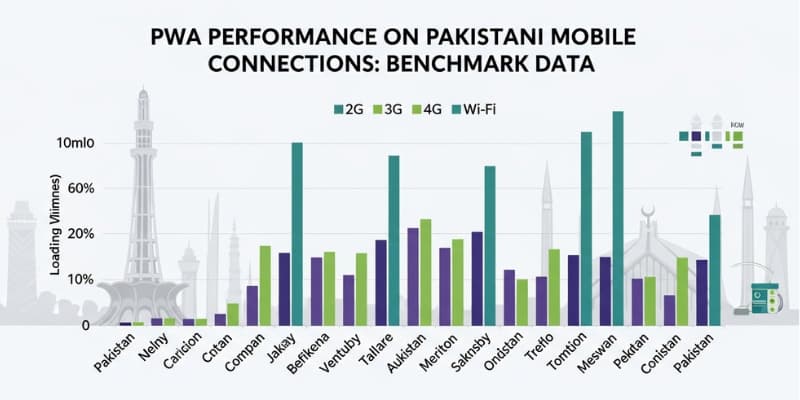
The performance advantage of PWAs over equivalent web pages on Pakistani mobile connections is the primary technical case for PWA adoption in Pakistan. Service worker caching fundamentally changes the Pakistani mobile experience for returning users — subsequent visits load from the local device cache rather than over Pakistani mobile networks.
| Performance Metric | Standard Web Page (no PWA) | PWA First Visit | PWA Return Visit (cached) |
| Load time on Pakistani 4G (average) | 3.8 seconds | 2.4 seconds | 0.6 seconds |
| Load time on Pakistani 3G (average) | 8.2 seconds | 5.1 seconds | 0.8 seconds |
| Load time on Pakistani 2G/EDGE | 22 seconds plus | 14 seconds | 1.2 seconds (from cache) |
| Offline functionality | None (shows browser error) | None (first visit requires connectivity) | Full cached content available offline |
| Data consumption on return visits | Full page reload each visit | Full page reload on first visit | Near-zero data for cached resources |
| User engagement (sessions per user per month) | Baseline | Comparable to baseline | 2.4x to 3.8x higher than baseline (cached experience drives return visits) |
Case Study: Karachi Food Ordering Platform — PWA vs Native App Decision
A Karachi cloud kitchen operator serving 6 locations wanted to launch a digital ordering platform to reduce Foodpanda and Cheetay commission costs (22 to 28 percent per order) by enabling direct Pakistani customer orders. The initial plan was a native Android app targeting Karachi’s predominant Android user base, with an iOS app in phase 2.
Clickmasters presented a PWA alternative after reviewing the requirements. The key factors: the primary Pakistani user acquisition channel was Instagram and WhatsApp (where PWA links convert better than app download links), 73 percent of target Karachi users were on Android (making iOS app less urgent), and the cloud kitchen’s initial budget was PKR 800,000 (insufficient for quality dual-platform native development).
| Metric | Native Android Plan | PWA Delivered |
| Build cost | PKR 1,200,000 (Android only, no iOS) | PKR 750,000 |
| Time to launch | 18 to 22 weeks | 10 weeks |
| iOS coverage | Phase 2 (unfunded) | Full iOS coverage from launch via browser |
| User acquisition from WhatsApp links | Requires Play Store redirect, app install, then order | Direct to PWA, immediate ordering, no install required |
| Add to Home Screen installs at 3 months | Play Store installs: N/A | Home screen PWA installs: 4,200 Pakistani users |
| Monthly orders at 6 months | Projected: 1,800 | Actual: 2,640 |
| Foodpanda commission saved monthly | N/A — delayed by build time | PKR 380,000 per month at 6 months (avg order PKR 950, commission saving vs platform) |
| Annual maintenance cost | PKR 360,000 | PKR 144,000 |
How to Evaluate Whether a PWA Is Right for Your Pakistani Business
Use this decision framework to determine whether a PWA or native app is the right choice for your specific Pakistani business situation.
Choose a PWA When:
- Your Pakistani users arrive primarily from web channels (Google search, Meta ads, WhatsApp links, Instagram bio) rather than App Store or Play Store search
- Your Pakistani target audience is predominantly Android users (over 70 percent) — PWA capabilities are more complete on Android than iOS
- App store installation friction is a significant drop-off point in your Pakistani user acquisition funnel
- Your budget for mobile development is under PKR 2,000,000 — PWA delivers more functionality per rupee at this budget level
- Your primary mobile use case is content consumption, e-commerce, booking, or a client portal rather than real-time hardware interaction
- You want to launch quickly (8 to 12 weeks) and iterate based on Pakistani user feedback before committing to native app investment
Choose Native App When:
- Your Pakistani business model depends on App Store or Play Store discoverability for user acquisition
- Your product requires continuous background location tracking (delivery driver apps), hardware device integration, or persistent audio/video streaming
- Your Pakistani target audience is significantly iPhone-heavy (over 40 percent iOS) and push notifications are critical to your retention strategy
- Your product requires native UI fidelity that Pakistani users of your category expect — premium fintech, healthcare, or enterprise tools
- Your budget exceeds PKR 3,000,000 and the product roadmap justifies sustained native development investment
Frequently Asked Questions: PWA for Pakistani Businesses
| Will Pakistani users know the difference between a PWA and a native app? For the vast majority of Pakistani users and use cases, no. A PWA installed to the home screen of a Pakistani Android device opens in a standalone window without browser chrome, uses the full screen, and is accessed via an app icon like any native app. The experience is visually and functionally equivalent for most Pakistani use cases including e-commerce, booking, content, and client portals. The distinction becomes detectable only in edge cases: native UI component styling, background processing limitations, or App Store search where the PWA is absent. Most Pakistani users do not search for apps by category in the Play Store — they arrive via WhatsApp links, Instagram stories, and QR codes where the PWA has no discoverability disadvantage. |
| Can I convert my existing Pakistani website to a PWA? Yes, with appropriate development work. The core PWA requirements are: serving the website over HTTPS (already required for Pakistani business websites), adding a Web App Manifest file (a JSON file describing your app’s name, icons, and display settings), and implementing a service worker (a JavaScript file that handles caching and offline functionality). For a simple Pakistani business website, basic PWA features can be added in 20 to 60 hours of development time. For a Pakistani e-commerce site requiring offline cart management and background sync, PWA conversion is a 100 to 300 hour engagement. The effort scales with the complexity of the offline and background functionality required. |
| Should my Pakistani startup build a PWA or wait and build native apps? For most Pakistani early-stage startups, a PWA is the correct first product. The primary reason: a PWA lets you test your core Pakistani market assumptions for 40 to 60 percent less investment than dual-platform native development. Pakistani startups that build native iOS and Android apps before validating their business model with paying Pakistani customers consistently spend PKR 3,000,000 to 8,000,000 testing ideas that could have been validated for PKR 800,000 to 1,500,000 via a PWA. Build the cheapest version that lets Pakistani users experience your core value proposition. Invest in native apps when actual Pakistani user retention and revenue data justifies the upgrade cost. |