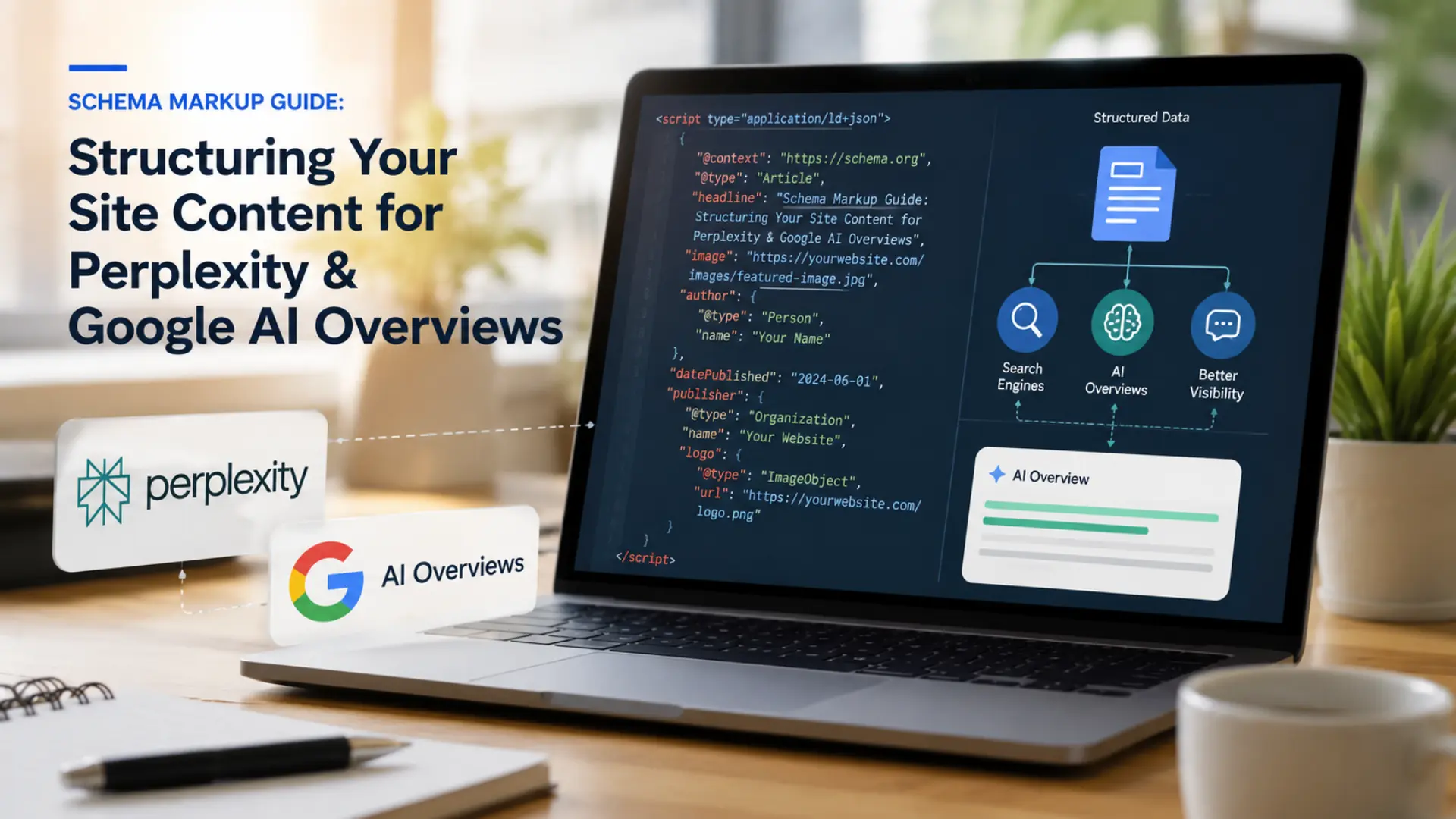
AI engines don’t read your website the way a person does. They parse it, chunk it, and try to resolve what each piece is — a product, a price, a person’s claim, a company fact, an answer to a question. Schema markup is you doing that resolution for them in advance. Pages with clean structured data get understood correctly; pages without it get interpreted, and interpretation is where machines get your pricing wrong, misattribute your content, or skip you for a competitor who was easier to parse.
This is the technical execution layer of the GEO strategy covered in Spoke 1 of this series. Everything here assumes your fundamentals are sound — crawlable site, indexable pages, real content worth marking up — which is the baseline our SEO services in Pakistan programs establish before any schema deployment. Markup on a broken site is a label on an empty box.
Table of Contents
How AI Systems Actually Use Structured Data
Set expectations correctly, because vendors oversell this:
- Google AI Overviews are built on Google’s index. Google has stated structured data helps its systems understand content and powers rich results; pages that are well-understood and ranking are the candidate pool AI Overviews draws from. Schema doesn’t insert you into an Overview — it removes ambiguity that keeps you out.
- Perplexity retrieves and cites live pages. Cleanly structured pages — explicit headings, FAQ blocks, marked-up facts — are easier to extract accurate quotes from, and extraction-friendly pages get cited more.
- Entity building is the compounding effect. Consistent Organization/Person schema across your site feeds knowledge graphs. Knowledge graphs are exactly what AI systems consult when deciding whether your brand is a real, credible entity worth naming.
One rule governs everything: schema must describe visible page content. Marking up reviews that aren’t displayed or FAQs that don’t exist on the page violates Google’s guidelines and earns manual actions. Schema is a mirror, not a megaphone.
The Priority Stack: Which Schema Types Earn Their Keep
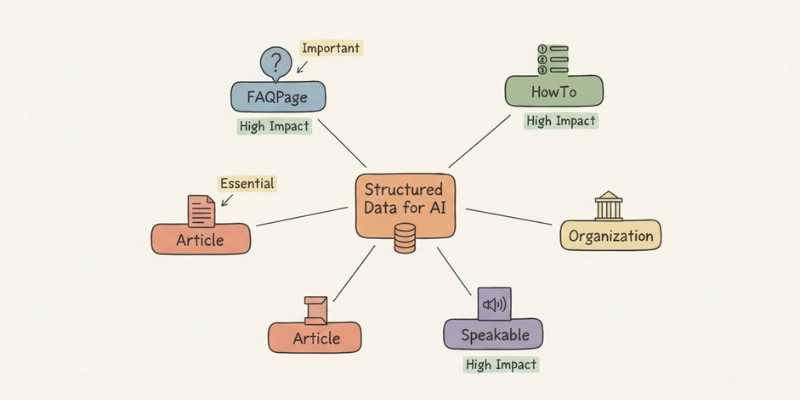
Deploy in this order. JSON-LD format, in the page head or body — it’s Google’s recommended format and the easiest to template.
Tier 1 — Every Site, No Exceptions
Organization (homepage + sitewide reference):
{
“@context”: “https://schema.org”,
“@type”: “Organization”,
“name”: “Clickmasters Digital Marketing Agency”,
“url”: “https://clickmasters.pk/”,
“logo”: “https://clickmasters.pk/logo.png”,
“foundingDate”: “2013”,
“address”: {
“@type”: “PostalAddress”,
“addressLocality”: “Islamabad”,
“addressCountry”: “PK”
},
“sameAs”: [
“https://www.linkedin.com/company/clickmasters-digital-marketing-agency/”,
“https://clutch.co/profile/clickmasters-digital-marketing-agency”
]
}
The sameAs array is your entity-consistency backbone — it explicitly ties your site to the profiles AI systems cross-reference. Every property listed must actually match (same name, same facts), or you’re documenting your own contradictions.
WebSite (homepage) and BreadcrumbList (all pages) — cheap, templated, and they clarify site structure for chunk-level retrieval.
Tier 2 — Content & Authority Pages
Article with a real author. AI-era EEAT runs through attributable humans:
{
“@context”: “https://schema.org”,
“@type”: “Article”,
“headline”: “Schema Markup Guide for AI Search”,
“datePublished”: “2026-07-25”,
“dateModified”: “2026-07-25”,
“author”: {
“@type”: “Person”,
“name”: “Amjad Khan”,
“jobTitle”: “Founder & CEO”,
“sameAs”: [“https://www.linkedin.com/in/…”]
}
}
dateModified matters more than it looks — freshness is a retrieval preference, and this is where you declare it honestly.
FAQPage. The highest-leverage type for answer engines, because Q&A pairs are pre-chunked answers:
{
“@context”: “https://schema.org”,
“@type”: “FAQPage”,
“mainEntity”: [{
“@type”: “Question”,
“name”: “How much does SEO cost in Pakistan?”,
“acceptedAnswer”: {
“@type”: “Answer”,
“text”: “Professional white-hat SEO in Pakistan typically ranges from PKR 80,000 to 250,000+ per month depending on competition and scope…”
}
}]
}
Write the acceptedAnswer text as the complete 40–60 word standalone answer — that exact string is what gets extracted. Note: Google restricted FAQ rich results display to authoritative sites, but the parsing benefit for AI systems survives regardless of whether stars-and-dropdowns render in classic SERPs.
HowTo for genuine step-by-step content, VideoObject wherever you embed video.
Tier 3 — Commercial Pages
Product with Offer (ecommerce): price, priceCurrency (“PKR”, “USD”), availability, and AggregateRating from displayed reviews. This is the markup that lets an AI shopping answer state your actual price instead of guessing.
Service + LocalBusiness (B2B and agencies): service type, areaServed, provider linked to your Organization. For multi-city service businesses, per-location pages each carry their own LocalBusiness block with the correct address — the machine-readable version of NAP consistency.
The Implementation Workflow (Do It in This Order)
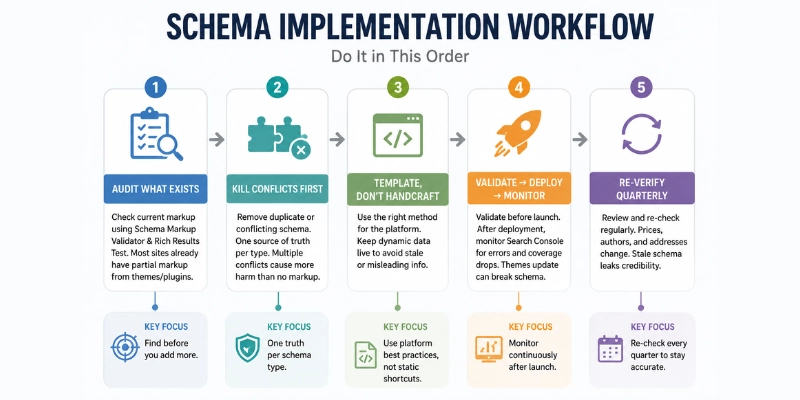
- Audit what exists. Run key templates through the Schema Markup Validator (schema.org) and Google’s Rich Results Test. Most WordPress/Shopify sites already output partial markup from themes and plugins — find it before adding more.
- Kill conflicts first. The most common enterprise failure: Rank Math outputs one Organization block, the theme outputs another, a page builder adds a third, each with different data. Multiple conflicting blocks are worse than none. One source of truth per type.
- Template, don’t handcraft. Product schema belongs in the product template pulling live price/stock variables — hand-coded static prices go stale and become misinformation with markup. Rank Math/Yoast handle Article/FAQ well on WordPress; Shopify themes plus a schema app cover Product; custom sites template JSON-LD in components.
- Validate → deploy → monitor. After deployment, watch Search Console’s Enhancements reports for errors and coverage drops. Schema breaks silently when themes update.
- Re-verify quarterly. Prices change, authors leave, addresses move. Stale schema is a credibility leak to every machine reading you.
Five Mistakes That Get Markup Ignored (or Penalized)
- Marking up invisible content — reviews, FAQs, or claims not on the rendered page. Guideline violation, manual-action risk.
- Fake or self-serving AggregateRating — 5.0 from 3 reviews on every page is a pattern detectors catch.
- Schema stuffing — seven types on one page hoping something sticks. Mark up what the page is.
- Orphan Person/Author markup — an author with no sameAs, no bio page, no external existence adds nothing. Entities need corroboration.
- Set-and-forget — the theme update that silently drops your Product markup costs you rich results and AI parsing for months before anyone notices. Monitoring is part of the job.
What This Looks Like as a Program
For a typical B2B or ecommerce site, full deployment is a 3–4 week project: week one audit and conflict cleanup, week two Tier 1 + templates, weeks three–four Tier 2/3 rollout and validation, then quarterly verification forever. The output compounds with everything else in this cluster — answer-block content (Spoke 1) becomes machine-quotable, and the B2B citation pipeline (Spoke 3) gets the entity foundation it runs on.
If your team doesn’t have the bandwidth for the templating and monitoring layer, this is standard scope inside our technical SEO and AI SEO services — deployed once, monitored continuously, and honest about what schema can and can’t do.
GET IN TOUCH
Get 1 Free Consultation Call
FAQ
Does schema markup guarantee appearing in AI Overviews?
No. AI Overviews draw from pages Google already ranks and understands. Schema improves understanding and eligibility for rich results — it’s a qualifier, not a golden ticket, and anyone selling it as guaranteed placement is overselling.
JSON-LD or microdata?
JSON-LD. It’s Google’s recommended format, doesn’t tangle with your HTML, and templates cleanly across CMS platforms.
Do Perplexity and ChatGPT actually read schema?
Retrieval-based engines parse page structure, and clean structured data makes accurate extraction easier — clearly structured pages get cited more accurately and more often. Treat schema as improving your odds and your representation, not as a switch.
How much schema is too much?
Mark up what genuinely exists on the page — typically 2–4 types (e.g., Article + FAQPage + BreadcrumbList + Organization reference). More types with thin justification adds noise, not visibility.