Every B2B and enterprise marketing lead is fielding the same broad question this year: “Should we move budget from SEO into this AI search thing?” The question is reasonable. Most answers to it are not — because they’re framed as a rivalry between two line items when the honest picture is a shared foundation with two output layers. Get the framing wrong, and you’ll either burn money on “AEO packages” that repackage work you already pay for, or starve the AI layer and watch competitors become the default answer in your category.
This guide gives you the decision framework we use with clients inside our SEO services in Pakistan engagements: what each discipline actually covers, where they overlap (the overlap is the budget insight), and allocation models by business stage. It closes the four-part Future of Search series — the GEO explainer, schema guide, and B2B citation playbook cover the execution behind everything referenced here.
Table of Contents
Definitions Without the Vendor Fog
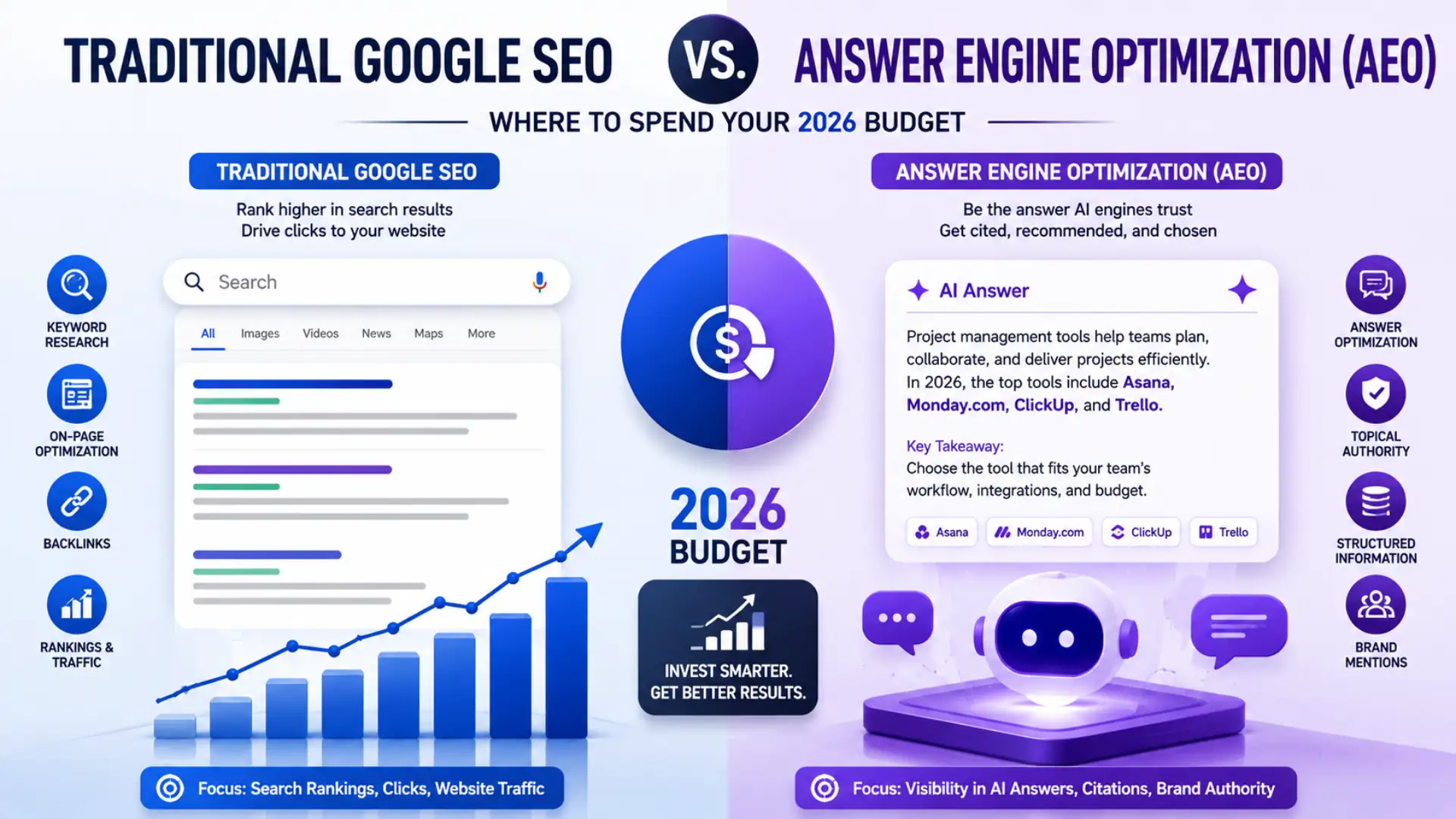
Traditional SEO earns visibility in ranked search results: technical health, content targeting search demand, authority via links, and increasingly the experience signals Google measures. Output: rankings → clicks → sessions you control.
AEO (Answer Engine Optimization) earns presence in answers: featured snippets, People Also Ask, voice results, Google AI Overviews, and citations inside ChatGPT, Perplexity, and Gemini responses. Output: being the quoted source → brand presence at the decision moment → high-intent visits and direct contact. (GEO — targeting generative engines specifically — sits inside AEO for budgeting purposes.)
The strategic difference in one line: SEO wins the click; AEO wins the answer. In 2026 you need both, because buyers now split between the two behaviors mid-journey — often in the same session.
The 70% Overlap Nobody Selling “AEO Packages” Mentions
Here’s the budget-critical fact: the two disciplines share most of their inputs.
| Work Item | Serves SEO | Serves AEO |
|---|---|---|
| Technical health & crawlability | ✔ | ✔ (retrieval engines need access) |
| Content targeting real questions | ✔ | ✔ |
| Answer-block page structure | ✔ (snippets) | ✔ (citations) |
| Schema markup | ✔ (rich results) | ✔ (machine parsing) |
| Authority & digital PR | ✔ (links) | ✔ (entity trust, source pool) |
| Reviews & third-party presence | partial | ✔✔ (heaviest AI evidence source) |
| Rankings themselves | ✔ | ✔ (top results feed AI Overviews & retrieval) |
Roughly 70% of well-executed modern SEO is AEO groundwork, because AI Overviews draw on ranked pages and retrieval engines pull from search indexes. A page that can’t rank generally can’t get retrieved either.
The two budget conclusions that follow:
- Never buy AEO as a separate vendor line on top of an SEO retainer. If your SEO program is modern, you’d pay twice for the shared 70%. Buy one integrated program where AEO deliverables (prompt audits, answer-block refactoring, review-platform ops, entity work, AI visibility tracking) are named line items inside it.
- The real allocation question is about the incremental 30% — the AEO-specific work — and how much of your content mix should chase answers versus clicks.
What the Incremental AEO 30% Actually Buys
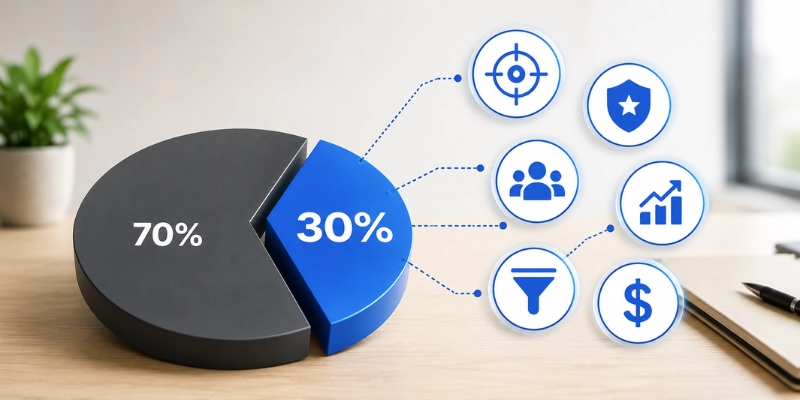
Concrete deliverables, so you can audit any proposal against them:
- Monthly AI shortlist/citation audits — your 15–25 money prompts tracked across ChatGPT, Perplexity, Gemini, and AI Overview presence logged for target queries
- Answer-block refactoring of existing money pages (40–60 word direct answers under question headings)
- Review-platform operations — profile completeness, collection systems, response management on Clutch/G2/Trustpilot
- Entity consistency program — sameAs schema web, unified descriptions, author entities with credentials
- Proprietary data publication — quarterly original stats/benchmarks that make you the citable source
- Comparison-layer content — the “X vs Y” and “best for [segment]” pages AI shortlists are assembled from
- Crawler/llms.txt governance — deliberate access decisions for GPTBot, PerplexityBot, ClaudeBot, Google-Extended
- AI referral + attribution measurement — GA4 segments, demo-form source fields, branded-search correlation
If a proposal can’t name these, it’s an SEO retainer with a sticker on it.
Allocation Models by Business Stage
New site / early-stage (first 12 months): 90/10. You have no rankings, so you have nothing for retrieval engines to find. Foundation first — technical, money pages, initial authority — with the 10% spent on cheap future-proofing: answer-block formatting and schema from day one (free when built in, expensive to retrofit), and a baseline prompt audit so you can measure movement later.
Established SMB with rankings (Pakistani market focus): 75/25. Your rankings are the asset; AEO converts them into answer presence. The 25% goes to refactoring top pages, review-platform ops, and monthly citation tracking. In most Pakistani categories, almost no competitor has done any of this — the 25% buys first-mover position in the category answer, which is disproportionately sticky.
B2B with long sales cycles: 60/40. The heaviest AI-research buyers are B2B evaluators building shortlists (the Spoke 3 playbook). Comparison-layer content, evidence-based commercial pages, and review operations carry direct pipeline weight. High-ticket economics change the math too: one AI-shortlist-originated enterprise deal can repay the entire annual AEO increment.
Enterprise/category leader: 55/45, defensive posture. At scale, the risk inverts: AI answers will describe your category with or without you, and zero-click summaries can cannibalize the informational traffic you’ve owned for years. The 45% funds owning the answers (so summaries cite you, not a challenger), protecting branded and comparison narratives, and measuring share-of-voice across engines as a board-level metric.
Publisher/affiliate models: hardest hit by zero-click answer surfaces — this framework understates your urgency, and diversification beyond search economics belongs in the conversation.
Signals to Rebalance Mid-Year

Budget splits are starting points. Shift toward AEO when: AI referral sessions convert well above site average (typical), demo-form attribution shows AI tools appearing unprompted, AI Overviews start rendering on your money keywords, or competitors appear in category prompts where you don’t. Shift back toward core SEO when: prompt audits show you cited but rankings slipping (the foundation feeding the citations is eroding), or technical debt is capping crawl and indexation — AEO on a decaying foundation is repainting a cracking wall.
Red Flags in 2026 Proposals
The scam economy has updated its inventory. Decline anything featuring:
- “Guaranteed ChatGPT ranking” — nobody controls model outputs; this is the Rs. 10,000 backlink package reborn
- AEO priced as a parallel retainer duplicating your existing SEO scope
- No measurement plan — if they can’t show you a prompt-audit template and an AI-referral dashboard, they can’t prove anything they sell
- Schema sold as placement — markup improves parsing and eligibility, not guaranteed inclusion (the schema guide in this series covers what it honestly does)
- Deliverables that never mention reviews or third-party presence — the single heaviest AI evidence source, absent from most repackaged offerings
The One-Line Answer for Your Board
“We’re not choosing between SEO and AEO — we’re funding one search program where roughly 70% of the work feeds both, and deliberately allocating the incremental 30% [adjust by stage] to own the answers our buyers now read before they ever click.”
That’s defensible, measurable, and honest — three things this vendor category currently lacks. If you want the integrated version built for your situation — audit, allocation, execution, and the monthly citation tracking to prove it’s working — that’s precisely how our SEO and AI search services are structured: one program, both layers, commit less, deliver more.
GET IN TOUCH
Get 1 Free Consultation Call
FAQ
Is traditional SEO dying in 2026?
No — it’s becoming the substrate. AI Overviews build on Google’s rankings and retrieval engines pull from search indexes, so ranking ability increasingly determines answer eligibility. What’s declining is the share of journeys that end in a classic click, which changes what you optimize for, not whether you optimize.
Can I do AEO without SEO?
Only narrowly (e.g., pure review-platform presence for shortlist queries). For anything content-dependent, unretrievable pages can’t be cited — SEO visibility is the entry ticket.
How do I measure AEO ROI?
Monthly prompt audits (citation share-of-voice), AI referral segments in GA4 with per-session conversion rates, an AI option on “how did you hear about us” form fields, and branded-search lift. Low volumes, high intent — judge on conversion quality and pipeline attribution, not sessions.
What’s a realistic AEO budget for a Pakistani SMB?
As the incremental 25% layer inside a proper SEO program — not a second retainer. On typical professional SEO pricing in Pakistan (PKR 80,000–250,000+/month depending on scope), that’s the difference between a modern program and a 2019 one, at far less than paying twice for overlapping work.