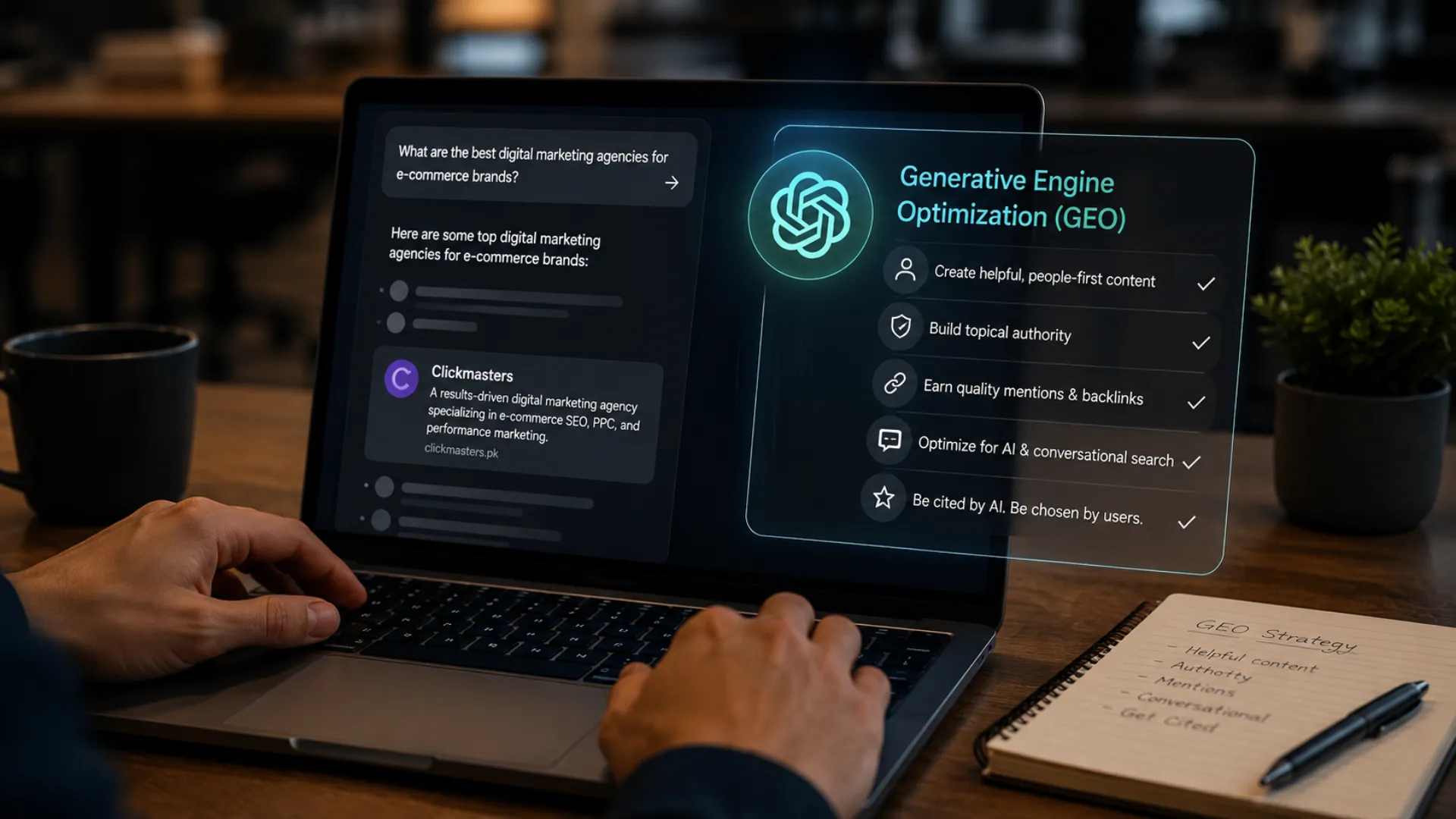
A growing share of your buyers no longer click ten blue links. They ask ChatGPT “best ERP software for textile manufacturers” or ask Perplexity “top digital agencies for B2B SaaS” and act on the answer. If your brand appears in that answer, you get the lead. If a competitor appears, you never even knew the buyer existed — there’s no SERP position to lose, no impression in your reports. The opportunity was simply routed elsewhere.
Generative Engine Optimization (GEO) is the discipline of making your brand the one the machine cites. It doesn’t replace SEO — it sits on top of it, because AI systems learn about you from the same web Google crawls. That’s why we run GEO as an integrated layer inside our SEO services in Pakistan rather than selling it as a separate magic trick. Here’s how the machinery works and how to feed it.
Table of Contents
How AI Engines Actually Decide What to Cite
Different engines source answers differently. Optimizing without knowing this wastes budget:
- ChatGPT (with search/browsing): blends its trained knowledge of your brand with live web retrieval (historically powered by Bing’s index). Two levers: what the model already believes about you, and what it retrieves right now.
- Perplexity: retrieval-first. Every answer is assembled from live sources with visible citations. The most “SEO-like” engine — rank in the retrievable set, get cited.
- Google AI Overviews / AI Mode: built directly on Google’s index and ranking systems. If you rank top 10–20 for the underlying queries, you’re in the candidate pool; structure decides whether you get quoted.
- Claude, Gemini, and others: similar split between trained brand knowledge and live retrieval.
Two implications fall out of this:
- Rankings still matter. If you’re invisible to search engines, you’re invisible to the retrieval step. GEO on a technically broken site is decoration.
- Brand footprint matters in a new way. Models form an internal representation of your brand from every consistent mention across the web. Thin, contradictory, or absent coverage means the model has nothing to say about you.
What the Research Says Actually Moves Citations
Academic work on generative engines (the original GEO research out of Princeton and follow-ups) tested which content modifications increase the odds of being cited. The consistent winners:
- Citing sources and statistics inside your content — pages with concrete numbers get quoted more
- Quotations from named experts — attributable claims beat anonymous claims
- Clear, authoritative, fluent phrasing — direct declarative sentences the model can lift verbatim
- Unique information — data or perspectives that exist nowhere else force the engine to cite you
Keyword stuffing showed no benefit. The pattern is blunt: AI engines cite content that looks like evidence.
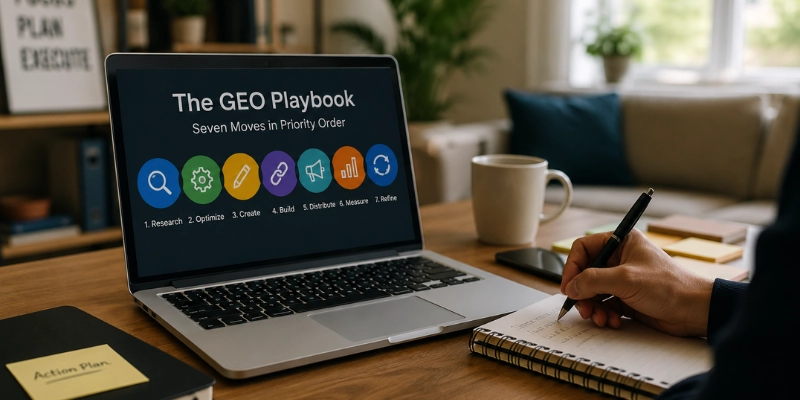
The GEO Playbook: Seven Moves in Priority Order
1. Win the “Answer Block” Format
Restructure key pages so every important question gets a direct 40–60 word answer immediately under its heading, then elaboration. AI systems extract these blocks nearly intact. Test yourself: paste your page into ChatGPT and ask the target question — if it can’t find a quotable answer, neither can the live engine.
2. Publish Proprietary Numbers
The single strongest citation magnet is data nobody else has. A Pakistani software house publishing “average enterprise app development timelines from 40 projects” becomes the citable source for that fact permanently. One original stat outperforms ten generic blog posts.
3. Build Entity Consistency
Models triangulate your brand across LinkedIn, Clutch, directories, press, and your site. Identical descriptions everywhere — same positioning line, same services, same founder attribution. Contradictions (different founding years, conflicting claims) make the model hedge or skip you. Audit this ruthlessly; most companies fail it.
4. Get Into the Sources AI Engines Trust
When ChatGPT answers “best [category] in Pakistan,” it heavily weighs existing listicles, review platforms, and industry roundups. The fastest citation win is often not your own site — it’s being present in the third-party pages the engine already retrieves: Clutch profiles with reviews, credible “top 10” articles, industry association listings, Wikipedia-adjacent references where legitimate.
5. Deploy Schema Everywhere It’s Honest
Organization, FAQPage, Article with real authors, Product, Review. Structured data helps machines parse what you are and who said it. (Full implementation walkthrough in the schema guide, Spoke 2 of this series.)
6. Maintain Freshness Signals
Retrieval engines prefer current sources. Visible “last updated” dates, refreshed statistics, and current-year context keep you in the retrievable set. A 2023 page loses citations to a 2026 page saying the same thing.
7. Open the Gates
Check robots.txt: don’t block GPTBot, PerplexityBot, ClaudeBot, or Google-Extended unless you’ve consciously decided to trade AI visibility for content protection. An llms.txt file summarizing your key pages is an emerging convention — low cost, possible upside, no downside.
Measuring GEO (Yes, You Can)

The “you can’t measure AI search” complaint is outdated:
- Direct prompt testing: monthly, run your 20 money questions (“best X in Pakistan,” “X vs Y,” “top X for [industry]”) across ChatGPT, Perplexity, and Gemini. Log citations. This is your rank tracker now.
- Referral traffic: GA4 segments for chatgpt.com, perplexity.ai, gemini.google.com referrers — small volumes, absurdly high intent. Watch conversion rate per session.
- AI visibility tools: platforms now track brand share-of-voice across AI answers, the AI-era equivalent of rank tracking (we run this layer inside client programs).
- Branded search lift: users often see you in an AI answer, then Google your name. Rising branded queries alongside AI-answer presence is the causal chain showing up in your data.
What GEO Looks Like from Pakistan
Two honest observations for Pakistani and South Asian businesses:
The bad news: AI engines inherit the web’s authority bias. Thin local coverage means models default to citing Western sources even for regional questions.
The good news: that’s a vacuum. Very few Pakistani businesses have any GEO footprint, so category-defining questions — “best [service] in Pakistan,” “[industry] costs in Pakistan” — are winnable now at low cost. First movers who publish real data and structured answers are already becoming the default citation for their category. Waiting means competing later against an incumbent answer, and incumbent answers are sticky.
And beware the new scam wave: “guaranteed ChatGPT ranking” packages are the 2026 version of the Rs. 10,000 backlink scheme. Nobody controls model outputs. What’s controllable is the evidence trail the model reads — which is exactly what the seven moves above build.
Where to Start This Quarter
- Prompt-test your 20 money questions and log where you stand (one afternoon)
- Fix entity consistency across your site, LinkedIn, Clutch, and directories (one week)
- Restructure your top 5 commercial pages into answer-block format (two weeks)
- Publish one proprietary-data asset (one month)
- Verify crawler access and schema coverage (ongoing)
That sequence — measurement, foundation, structure, evidence — mirrors how we run it for clients. If you’d rather have it managed end-to-end alongside your rankings, our AI SEO and GEO services cover the full stack. Next in this series: the schema markup guide — the technical layer that makes everything above machine-readable.
GET IN TOUCH
Get 1 Free Consultation Call
FAQ
Is GEO different from AEO?
They overlap heavily. AEO (Answer Engine Optimization) targets answer surfaces like featured snippets and AI Overviews; GEO targets being cited inside generative AI responses. In practice, one well-structured content program serves both — the budget comparison guide in this series breaks down the split.
Does GEO replace SEO?
No. Retrieval-based AI engines pull from search indexes, so SEO visibility is the entry ticket. GEO determines whether the engine quotes you once you’re retrievable.
How long does it take to get cited by ChatGPT?
Retrieval-based citations (Perplexity, ChatGPT search) can appear within weeks of ranking for the underlying queries. Influencing the model’s trained brand knowledge is slower — a 6–12-month brand-footprint game.
Can you guarantee AI citations?
No one can, and anyone promising guarantees is selling the 2026 version of a backlink scam. What’s controllable: the structure, evidence, and consistency that measurably increase citation probability.