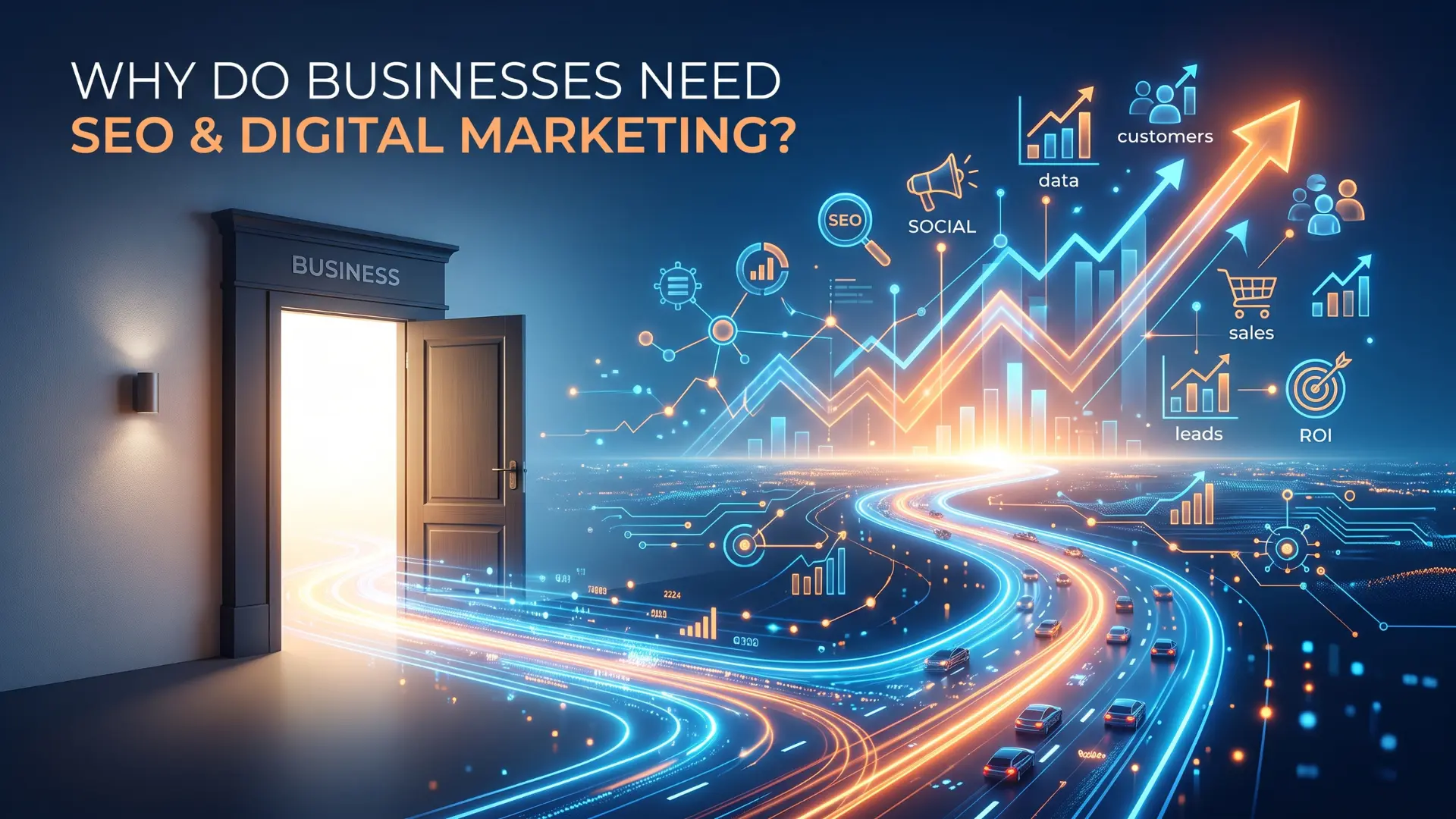
Businesses need SEO and digital marketing because people search online before buying a product or choosing a service. Why do businesses need SEO and digital marketing? The simple answer is that SEO helps your website appear on Google, while digital marketing helps you reach more people through social media, ads, content, and email. Together, they can bring more visitors, leads, and sales to your business and help you grow online with Clickmasters.
Table of Contents
What Is Digital Marketing? The Main Types Explained
Digital marketing is the umbrella term for every way a business promotes itself, sells, and builds relationships using digital channels instead of (or alongside) traditional ones like TV, print, and billboards. There are several main types of digital marketing, each playing a different role:
- Search engine optimization (SEO): earning visibility in organic search results
- Pay-per-click advertising (PPC): Paying for placement in search results, social feeds, or display networks
- Social media marketing: Building a presence and running campaigns on platforms like Facebook, Instagram, LinkedIn, and TikTok with digital marketing services
- Content marketing: Blogs, videos, guides, and other material that attract and educate an audience
- Email marketing: Nurturing leads and retaining customers through direct inbox communication
- Web design and conversion optimization: Making sure the website itself turns visitors into customers
- Analytics and reporting: Measuring what’s working so the budget goes where it performs
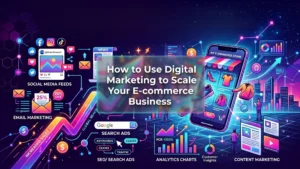
None of these exists in isolation. Why do businesses need SEO and digital marketing? Because a well-run PPC campaign sends traffic to a page that needs to be optimised, while a blog post written for SEO can be promoted on social media. A social media follower may later become a customer through an email campaign. Digital marketing works best when these channels work together, as each one supports the others and helps improve overall results.
What Is SEO and Why It Sits at the Center of the Strategy
Of all the channels listed above, SEO tends to get the most attention, and for good reason. Search engines are still where most buying journeys begin. Someone with a problem — a leaking pipe, a need for accounting software, a craving for the best biryani in town — types that problem into Google before they type a brand name. If your business isn’t visible at that moment, a competitor’s is.
SEO is the practice of shaping a website so that search engines understand it, trust it, and rank it for the terms your potential customers are actually searching. Why do businesses need SEO and digital marketing? It is not a single task; it’s a discipline made up of several interlocking parts.
On-Page Elements
This covers everything that happens directly on your website: page titles, headings, the actual written content, internal links between pages, image alt text, and URL structure. Why do businesses need SEO and digital marketing? Good on-page SEO means a search engine (and a human reader) can immediately understand what a page is about and why it deserves to rank. It also means writing for people first — content that actually answers the question someone typed, not content stuffed with keywords in a way that reads like it was written by a robot for another robot.
Technical Foundations
A website can have brilliant content and still fail to rank if the technical groundwork is broken. This includes page load speed, mobile responsiveness, secure connections (HTTPS), clean site architecture, and ensuring that search engines can crawl and index your pages without encountering errors. Why do businesses need SEO and digital marketing? Technical SEO is invisible to most visitors, but it’s the plumbing that everything else depends on. A slow, broken site undermines even the best-written content.
Authority and Trust Signals
Search engines also look outside your website to decide how much to trust it — things like other reputable sites linking to yours, mentions of your brand across the web, and consistent business information across directories. This is often referred to as off-page SEO, and it’s built gradually through genuine relationships, useful content that other sites want to reference, and a business that genuinely deserves the reputation it’s building online.
Local Visibility
For businesses that serve a specific city or region – clinics, restaurants, law firms, agencies, and retail stores – local SEO is often more valuable than broader national rankings. Why do businesses need SEO and digital marketing? This is the world of Google Business Profiles, local citations, and “near me” searches, where three listings and a map often get more clicks than every organic result combined.
The Newer Layer: AI-Driven Search
Search itself is evolving. Tools like Google’s AI Overviews, ChatGPT, and Perplexity are increasingly answering questions directly, sometimes without a click to any website at all. Why do businesses need SEO and digital marketing?
This has given rise to newer disciplines – often called Answer Engine Optimisation (AEO) or Generative Engine Optimisation (GEO) – focused on getting a brand cited as a source inside AI-generated answers, not just ranked on a results page. It’s an evolution of SEO’s core principle rather than a replacement for it: search engines and AI models both reward content that is clear, well-structured, genuinely useful, and backed by credibility.
Paid Media (PPC): Buying Your Way to the Top, Temporarily
SEO is often described as the “long game”, and it is — rankings built through consistent, quality work tend to compound over months and years. Paid media is the opposite: instant visibility, in exchange for an ongoing cost. Pay-per-click advertising, most commonly through Google Ads and Meta Ads (Facebook and Instagram), lets a business appear at the top of search results or in front of a highly targeted audience immediately.
The moment the budget stops, so does the visibility — which is the fundamental trade-off compared to SEO. Understanding this difference helps answer the question: Why do businesses need SEO and digital marketing? But paid media has strengths SEO can’t match on its own:
- Speed: A new business or product launch can be live and generating traffic within hours with search engine optimisation services.
- Precision targeting: You can reach people by age, location, interests, past behaviour, and even by the exact keyword they searched.
- Testing: Paid campaigns are an excellent way to test messaging, offers, and landing pages before investing further in organic content around the same themes.
- Predictability: Within reason, ad spend has a fairly linear relationship with traffic volume, which makes forecasting easier than with organic growth.
The mistake many businesses make is treating SEO and paid media as competitors for the same budget, when in practice they serve different timelines and different purposes. A healthy strategy usually uses paid media to generate immediate demand and gather data, while SEO builds a durable asset that reduces cost-per-acquisition over time.
Social Media: Presence, Community, and Discovery
Social platforms have shifted from being purely relationship-building tools into genuine discovery engines. Younger audiences in particular now search TikTok and Instagram the way older generations search Google. This means social media marketing today has to do three jobs at once:
- Brand presence: Being visible and recognizable where your audience already spends time
- Community and trust-building: Replying to comments, sharing behind-the-scenes content, and showing the human side of a business
- Direct discovery and sales: Short-form video, shoppable posts, and influencer content that turn scrolling into buying
Each platform behaves differently. LinkedIn rewards professional insight and works well for B2B lead generation. Instagram and TikTok reward visual storytelling and authenticity over polish. Facebook remains strong for local businesses and community groups, especially in markets where it’s still the dominant platform. Why do businesses need SEO and digital marketing? Choosing where to show up — rather than trying to be everywhere at once — is often the single biggest factor in whether social media marketing produces a return.
Content Marketing: The Fuel Behind Everything Else
Content marketing is frequently mistaken for “just blogging”, but it’s really the raw material that powers SEO, social media, email, and even paid campaigns. Why do businesses need SEO and digital marketing? A well-researched guide can rank in search, get shared on LinkedIn, be broken into five social posts, and become the basis of an email nurture sequence — all from one piece of original work.
Good content marketing starts with a simple question: what does our audience actually want to know, and where are they stuck? Businesses that answer real questions – clearly, honestly, and without burying the answer under fluff – consistently outperform businesses that publish content purely to “have a blog”. Search engines have also gotten much better at detecting content written to satisfy an algorithm rather than a human being, which makes genuine usefulness a competitive advantage, not just a nice-to-have.
Email Marketing: The Most Underrated Channel
Each platform behaves differently. LinkedIn rewards professional insight and works well for B2B lead generation. Why do businesses need SEO and digital marketing? Instagram and TikTok reward visual storytelling and authenticity over polish. Facebook remains strong for local businesses and community groups, especially in markets where it’s still the dominant platform. Choosing where to show up — rather than trying to be everywhere at once — is often the single biggest factor in whether social media marketing produces a return.
The Website: Where All the Traffic Has to Land
It’s worth pausing on something easy to overlook amid all the talk of channels and campaigns: none of it matters if the website itself can’t convert. A business can rank first, run flawless ads, and build a large social following and still see disappointing results if the website is slow, confusing, or doesn’t clearly guide a visitor toward taking action.
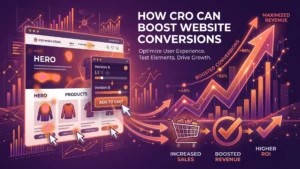
This is where web design and conversion rate optimization (CRO) come in.
Why do businesses need SEO and digital marketing? It’s not about the website looking impressive — it’s about whether a visitor can quickly understand what you offer, trust that you’re credible, and know exactly what to do next, whether that’s calling, filling a form, or buying. Small changes — a clearer headline, a shorter form, a visible phone number, and real testimonials instead of generic stock claims — often move conversion rates more than any amount of extra traffic.
How These Channels Work Together: A Simple Example
Imagine a mid-sized furniture brand launching an online store. Here’s how the channels might realistically connect:
- SEO: Builds long-term visibility for terms like “sofa sets in [city]” and informational content like “how to choose a sofa for a small living room”.
- PPC: Runs immediately, capturing high-intent shoppers searching “buy sofa online” while the SEO content is still gaining traction.
- Social media: Showcases the products visually, builds a following, and drives traffic through short-form video and influencer partnerships.
- Content marketing: Buying guides, room-design inspiration, and care tips — supports both the SEO effort and gives social media something worth sharing.
- Email marketing: Captures visitors who aren’t ready to buy yet, nurturing them with style guides and offers until they are.
- The website: Ties it all together, converting the traffic each channel sends.
No single channel did all the work. Removing any one of them would have made the whole system weaker. This is the core idea worth taking away from this entire article: Why do businesses need SEO and digital marketing? Digital marketing succeeds as an integrated system, not a collection of isolated tactics.
Measuring What Actually Matters
One of the most common traps businesses fall into is chasing vanity metrics — follower counts, impressions, or keyword rankings — without connecting them to outcomes that actually matter: leads, sales, and revenue. A page can rank #1 for a keyword nobody searches for. A social post can get thousands of views and zero customers. A healthier approach ties every channel back to business outcomes:
- Traffic matters, but only as a leading indicator — more visitors should eventually mean more opportunities.
- Conversion rate tells you whether that traffic is actually valuable.
- Cost per acquisition tells you whether a channel is sustainable at scale.
- Customer lifetime value tells you whether it’s even worth acquiring that customer in the first place, especially for businesses with repeat purchases or long-term contracts.
- Return on ad spend (ROAS) and return on investment (ROI) for organic work are the numbers that ultimately decide whether a strategy continues or gets cut.
Regular reporting — monthly at minimum — should connect the dots between activity (what was done), output (what changed), and outcome (what it meant for the business). Why do businesses need SEO and digital marketing? Anything less than that isn’t really measurement; it’s just activity tracking.
Common Mistakes Businesses Make
A few patterns show up again and again across businesses trying to figure out digital marketing on their own:
Expecting instant results from SEO
Organic growth is cumulative. Meaningful movement typically takes a few months of consistent work, not a few weeks. Businesses that abandon SEO after six weeks because “nothing happened” are usually stopping right before the compounding effect would have kicked in.
- Running ads to a website that isn’t ready: Paid traffic is expensive. Sending it to a slow, confusing, or untrustworthy website is one of the fastest ways to burn a budget without seeing a return.
- Treating every platform the same: Repurposing content is smart; copy-pasting the same post across every platform without adapting it to that platform’s audience and format usually underperforms everywhere.
- Ignoring mobile experience: In most markets, the majority of traffic is now mobile. A site that looks great on a desktop but is clunky on a phone is quietly losing the majority of its visitors.
- Focusing on acquisition and ignoring retention: It’s almost always cheaper to sell again to an existing customer than to acquire a new one. Email marketing, loyalty programs, and simple follow-up communication are frequently the most neglected — and most profitable — part of a digital strategy.
- No clear tracking setup: Without proper analytics and conversion tracking in place from day one, it becomes almost impossible to know which channels are actually driving results, which leads to budget decisions based on guesswork instead of data.
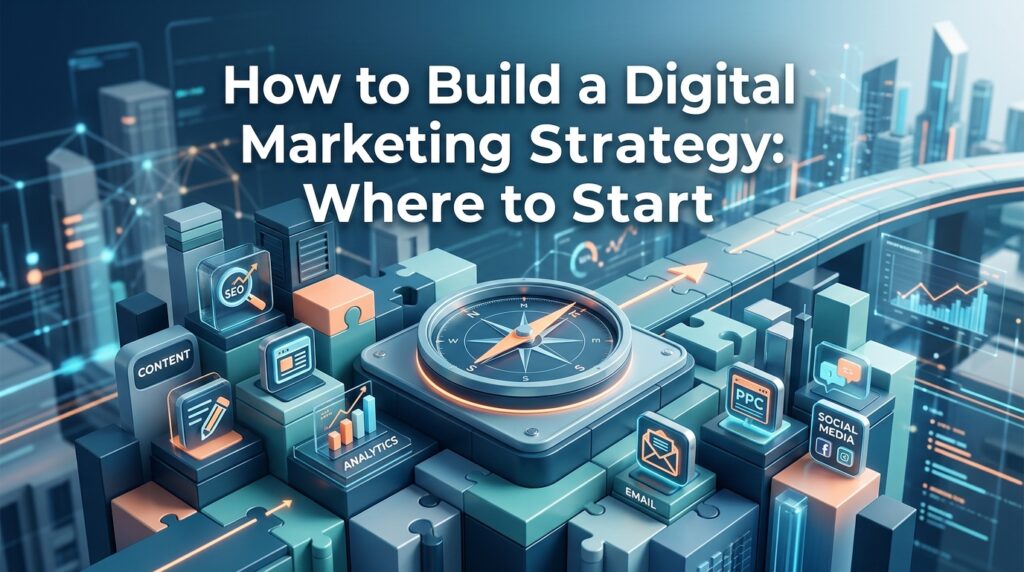
How to Build a Digital Marketing Strategy: Where to Start
For a business just getting serious about digital marketing, trying to do everything at once usually backfires. A more realistic approach looks something like this:
- Get the foundation right first. A fast, mobile-friendly, clearly structured website with proper analytics tracking installed. Nothing else works well without this.
- Establish core SEO fundamentals. Make sure the site is indexable, has accurate on-page content, and claims and optimises local listings if the business serves a physical area.
- Use paid media for quick learning and quick revenue. Small, controlled campaigns that generate data on what messaging and offers actually resonate with the target audience.
- Build a content engine. Consistent, genuinely useful content that supports SEO and gives every other channel something to work with.
- Layer in social media and email to build community and retention once there’s traffic and a customer base to nurture.
- Review and adjust monthly, letting the data — not assumptions — decide where the next round of budget goes.
This order isn’t a rigid rule, but it reflects how the channels naturally support each other. Why do businesses need SEO and digital marketing? Skipping steps – running expensive ad campaigns to a broken website or trying to build a social following before there’s anything worth converting that audience into – is where a lot of marketing budgets quietly disappear.
Doing It In-House vs. Working With an Agency
There’s no universally right answer here — it depends on internal capacity, budget, and how quickly a business needs results. Doing digital marketing in-house gives full control and deep product knowledge, but it also demands expertise across SEO, paid media, design, analytics, and content – skill sets that rarely live in one person.
Many businesses end up either spreading one generalist too thin or hiring a full team before they have the budget to justify it. Working with an SEO or digital marketing agency, such as Clickmasters, can save time and reduce mistakes, especially for businesses that need help with different online channels. The main goal is to have one clear strategy that connects all your marketing efforts. Why do businesses need SEO and digital marketing? Because using these channels together can help businesses get better results. If you are not sure what your business needs, a free consultation can help you choose the right approach.
GET IN TOUCH
Get 1 Free Consultation Call
Frequently Asked Questions
What is SEO?
SEO (search engine optimisation) is the practice of improving a website so it ranks higher in unpaid, organic search results — through on-page content, technical performance, and off-page trust signals like backlinks. It’s one part of the broader digital marketing mix. If you want to know more about SEO, then visit Clickmasters
What are the main types of digital marketing?
The core types are SEO, pay-per-click (PPC) advertising, social media marketing, content marketing, email marketing, and web design/conversion optimisation. Most effective strategies combine several of these rather than relying on just one.
What’s the difference between SEO and digital marketing?
SEO is one channel within digital marketing — specifically, the practice of earning visibility in organic (unpaid) search results. Digital marketing is the broader umbrella that also includes paid ads, social media, email, content, and web design. SEO tends to be the foundation that the other channels build on.
How long does SEO take to show results?
Most businesses start seeing meaningful movement within three to six months of consistent work, with results compounding further after that. Highly competitive industries or keywords can take longer. This is why SEO is usually paired with paid media in the early months — to generate results while the organic strategy matures.
Should a small business start with SEO or paid ads?
It depends on urgency and budget. Paid ads deliver traffic immediately but stop the moment spending stops. Why do businesses need SEO and digital marketing? SEO takes longer to build but keeps producing traffic without an ongoing per-click cost. Most businesses benefit from running both together rather than choosing one over the other.
What is Answer Engine Optimisation (AEO)?
AEO (also called Generative Engine Optimisation, or GEO) is the practice of optimising content to be cited or featured inside AI-generated answers from tools like Google AI Overviews, ChatGPT, and Perplexity — Why Do Businesses Need SEO and Digital Marketing? not just ranked on a traditional search results page. It builds on the same fundamentals as SEO: clear, well-structured, credible content.
How much should a business budget for digital marketing?
This varies widely by industry, competition, and goals, but a common starting range for small to mid-sized businesses is 7–15% of revenue, split across SEO, paid media, and content, depending on how quickly results are needed. A proper free SEO audit is the best way to get a number specific to your situation rather than a generic industry average.