Blog

Your blog category

How Much Does Quality White-Hat SEO Cost in Pakistan
Blog

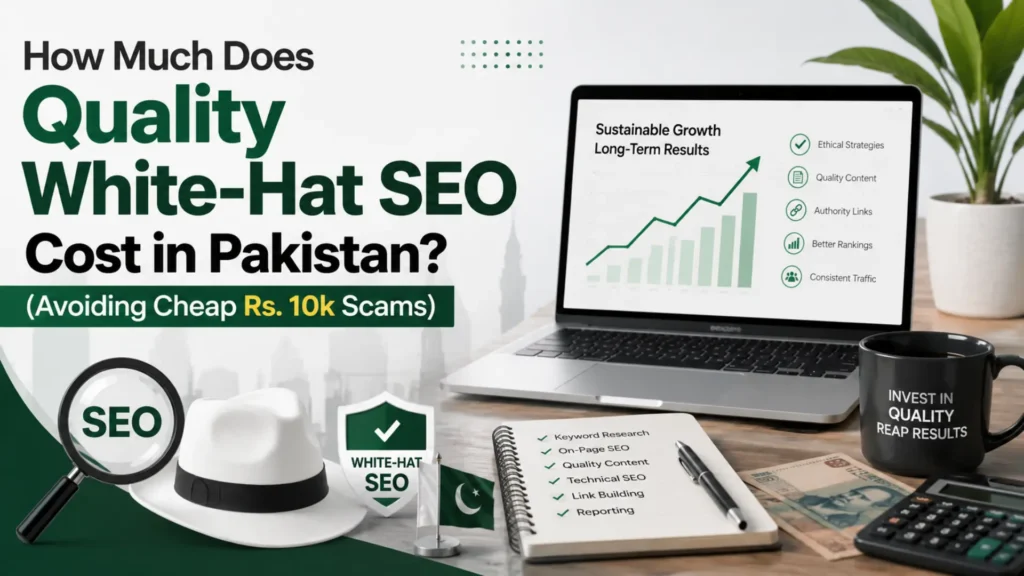
How Much Does Quality White-Hat SEO Cost in Pakistan? (Avoiding Cheap Rs. 10k Scams)

Ask ten Pakistani providers for SEO pricing, and you’ll get quotes from Rs. 8,000 to Rs. 500,000 a month for what sounds like the same service. It isn’t the same service — the spread exists because “SEO” in this market describes two different industries wearing one name: a professional discipline with real labor costs, and a volume scam that sells the word SEO to businesses who can’t yet verify the work. This guide gives you the pricing anatomy of both, so you can never be sold the second one again. We publish our own numbers, so this isn’t vendor coyness: our packages run PKR 80,000 to 150,000+ per month depending on scope, listed openly on our SEO services in Pakistan page, with enterprise and multi-market programs above that. What follows explains what those tiers buy, why the price floor for real work sits where it does, and exactly how the Rs. 10,000 economy operates underneath it. The Cost Mathematics: Why a Price Floor Exists SEO is labor. Reverse-engineer any monthly price into hours, and the truth falls out. A minimum competent month for one small business website requires roughly: That’s 28–43 hours monthly of skilled work. At even modest professional Pakistani rates for experienced SEO talent, the labor alone prices a real program above PKR 60,000–70,000 before tools (Ahrefs/Semrush licenses run hundreds of dollars monthly), management, and margin. This is why credible Pakistani SEO starts around PKR 80,000/month — not because agencies are greedy, but because arithmetic is stubborn. Now run the same math on Rs. 10,000: at any legitimate rate, it buys 3–5 hours a month. Three hours cannot contain strategy, content, technical work, and outreach. So it doesn’t — and what it contains instead is the scam anatomy below. What Each Real Tier Buys (Pakistan, 2026) Entry professional — PKR 80,000–100,000/month. For local service businesses and small sites in moderate competition: focused keyword set, on-page optimization of core pages, essential technical upkeep, foundational content cadence, basic authority work, GBP/local layer, honest monthly reporting. This tier wins local and niche markets; it cannot fight Karachi real estate or national ecommerce categories. Growth — PKR 120,000–150,000/month. Competitive city-level and national niches, small ecommerce: everything above at higher volume, plus full technical program, link building with verifiable placements, content targeting commercial keyword clusters, CRO-aware money-page work, and — in current programs — the AI-search layer (answer-block structuring, schema, citation tracking per this series’ Future of Search cluster). Premium/Enterprise — PKR 200,000–500,000+/month. Large catalogs, multi-city or multi-country targeting (PK + UAE/UK/US), programmatic SEO, aggressive authority campaigns, dedicated strategy resource. At this tier you’re buying a growth department, and the evaluation shifts from price to pipeline math. Project pricing (audits: PKR 50,000–200,000 by site size; migrations, one-time technical rescues) and hourly consulting exist alongside retainers — legitimate for defined problems, wrong for the ongoing compounding work SEO actually is. The only pricing question that matters at every tier: what is a customer worth to you? A PKR 120,000 retainer producing 40 organic leads at a 15% close rate for a service worth PKR 50,000 per client is printing money. The same retainer for a business whose average sale is PKR 800 needs ecommerce-scale volume to justify itself. Price SEO against customer value, never against the cheapest quote. Anatomy of the Rs. 10,000 Package What that money actually funds, step by step — this is a documented pattern, not speculation: Why the scam persists: SEO’s 3–6 month feedback delay means the seller collects six retainers before failure is undeniable — the delay is the business model. Your defense is verifying work, not waiting for results. The Buyer’s Filter: Six Questions That Expose Everyone Put these to any provider, including us: Then cross-check their answers against the monthly report standard from this cluster’s reporting guide, and hand your dev team the on-page checklist to verify technical claims independently. The three articles together are a complete procurement kit. Contract Terms That Protect You The Bottom Line Quality white-hat SEO in Pakistan costs PKR 80,000–150,000+ monthly for most SMBs because that’s what 30–40 hours of skilled labor, professional tooling, and honest management cost — and it returns multiples of that in owned, compounding lead flow when matched to businesses whose customer value supports it. Rs. 10,000 SEO costs Rs. 10,000 plus your year, and sometimes plus your rankings. If your budget genuinely can’t reach the floor yet, don’t buy fake SEO — buy the honest alternatives: a one-time professional audit executed by your own team, founder-written content on a sound technical base (the dev checklist in this series is free), or Google Ads for immediate leads (the ROI comparison opening this cluster shows when that’s the right call) until SEO becomes affordable. And when you’re ready to buy the real thing, buy it like this cluster taught you: itemized deliverables, verifiable links, honest reports, conservative commitments. That’s the standard our SEO services in Pakistan are built on — transparent packages from PKR 80,000, every link listed, every month accountable. Ask us the six questions. That’s what they’re for. GET IN TOUCH Get 1 Free Consultation Call FAQ Why is there such a huge price range for SEO in Pakistan? Because two industries share the name: professional SEO priced on real labor (30–40+ hours monthly of skilled work plus tools), and volume scams priced on what unverifying buyers will pay. The range collapses once you demand itemized deliverables. Is Rs. 25,000–50,000/month SEO always a scam? Not always — a freelancer or very lean provider can deliver a narrow, honest scope (a few hours of focused local SEO) at that level. Apply the same six questions; honesty scales down, scams don’t survive itemization at any price. Can I negotiate SEO pricing? Negotiate scope, not hours-for-free: fewer target keywords, reduced content cadence, or a phased start (technical-first) legitimately lowers price. A provider who cuts price without cutting scope was padding one or planning to under-deliver. How long before SEO pays for itself? For most Pakistani SMBs on a properly

What Should Be Included in a Professional Monthly SEO Performance Report
Blog

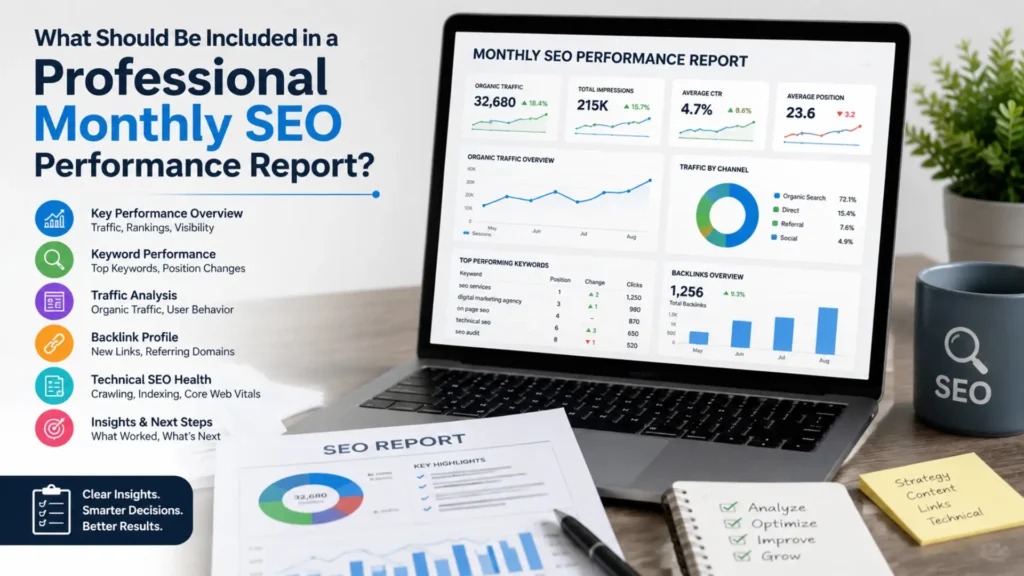
What Should Be Included in a Professional Monthly SEO Performance Report?

The monthly report is where SEO agencies either prove their work or hide from it. If yours arrives as a 40-page PDF of screenshots — keyword positions you don’t recognize, traffic graphs with no revenue attached, and a “great progress this month!” summary — you’re not being reported to. You’re being managed. In Pakistan’s SEO market, where a large share of retainers produce no verifiable work at all, the report is your single best audit instrument — if you know what a real one contains. This guide is the anatomy of an honest report, section by section, with the red flags that expose a hollow one. Use it to evaluate your current provider or to set the reporting standard in your next contract. It reflects exactly how we structure reporting inside our own SEO services in Pakistan engagements — built on a “commit less, deliver more” rule: conservative commitments in the proposal, then reports that show delivery against them. An agency that resists this reporting standard is telling you something; believe them. The Governing Principle: Business Outcomes First, Diagnostics Second A professional report answers three questions in descending order: Amateur reports invert this — burying you in diagnostics because diagnostics can’t be judged. Every section below follows that hierarchy. Section 1: Executive Summary (One Page, Plain Language) Red flag #1: no reference to previously committed targets anywhere. If the report never mentions what was promised, the promise was decorative. Section 2: Business Impact — Leads & Revenue from Organic The section most Pakistani SMB reports omit entirely, because it requires real tracking setup: Red flag #2: an agency that has managed your SEO for 6+ months and still can’t report conversions “because tracking isn’t set up.” Setting it up was their week-one job. Section 3: Organic Traffic — Segmented or It’s Noise Red flag #3: total-traffic graphs only, no branded split, no segmentation. That graph can grow while the paid work produces nothing. Section 4: Rankings & Search Visibility Red flag #4: rankings reported for keywords nobody searches (“best quality affordable services provider Islamabad Pakistan”) — position #1 trophies for zero-volume terms are the oldest trick in the Pakistani SEO market. Section 5: Work Completed — The Accountability Ledger The section that separates agencies doing work from agencies collecting retainers: Red flag #5: vague verbs. “Performed on-page optimization, built quality backlinks, improved technical health” with zero URLs, zero specifics — the standard text of agencies doing nothing. Every claimed deliverable should be independently verifiable by you in under a minute. Section 6: Technical Health Snapshot Section 7: Next Month’s Plan + Honest Context The Meeting Standard A report without a conversation is a document nobody reads. Professional cadence: report delivered in advance, then a 30-minute call — ten minutes on results, twenty on decisions and next actions. If your agency delivers PDFs into silence month after month, the silence is the service. The One-Paragraph Standard to Put in Your Next Contract “Monthly reporting will include: organic conversions and revenue from configured GA4 tracking; organic traffic segmented branded/non-branded with YoY comparison; positions for the contracted keyword set plus top 3/10/20 distribution; all completed deliverables with verifiable URLs (content, technical fixes, and every acquired link); technical health status; and next month’s specific plan — delivered with a monthly review call.” Any competent agency signs that without blinking, because it describes work they’re already doing. Hesitation is your answer. It’s the standard we hold ourselves to across every SEO engagement — committed KPIs in the proposal, verifiable delivery in the report, every month. Final piece of this buyer’s cluster: what quality SEO actually costs in Pakistan, and the full anatomy of the cheap-package scam economy. GET IN TOUCH Get 1 Free Consultation Call FAQ How long should a monthly SEO report be? Five to ten substantive pages beats forty pages of screenshots. Length is not evidence; verifiable specifics are. The executive summary alone should let a founder judge the month in one minute. What’s the single most important metric in an SEO report? Organic-attributed leads or revenue, trended against the retainer cost. Everything else — rankings, traffic, links — is a leading indicator feeding that number. My agency says results take time, so early reports show only activity. Fair? Fair for months 1–4, if the activity is specific and verifiable (URLs, fixes, published pages) and leading indicators (impressions, index coverage, early rankings) are moving. “Trust the process” with vague deliverables past month 4 is not patience — it’s the scam’s script. Should I have independent access to the data? Always. Owner-level access to your own GA4, Search Console, and GBP is non-negotiable — agencies work in your accounts, not the reverse. An agency resisting this is planning to hold your data hostage, and that’s covered in the pricing guide’s red-flag list.

A developer-first on-page SEO checklist: 40 verifiable checks across HTML, performance, indexation, structured data, and templates your team can ship.
Blog

The On-Page SEO Checklist for Dev Teams (Downloadable, Sprint-Ready)

Most on-page SEO checklists are written for marketers and die in translation. “Optimize your meta tags” isn’t a ticket a developer can close — it has no acceptance criteria, no definition of done, and no owner. Then the marketing manager wonders why the audit findings from March are still open in September. This checklist fixes the translation problem. Every item is written the way dev teams actually work: a verifiable condition that is either true or false in production. Drop it into your sprint board as-is, assign owners, and ship. It covers the on-page layer — what lives in your code and templates. It assumes strategy (keyword mapping, content planning) is handled upstream, which is the division of labor inside a full SEO services in Pakistan program: strategists decide what each page targets; this checklist governs how the build expresses it. [Download the checklist as a formatted PDF/Sheet at the end of this guide] — printable version for sprint planning, spreadsheet version with owner/status columns for tracking. Section 1: The HTML Head (8 checks) Section 2: Document Structure & Content Markup (7 checks) Section 3: Performance & Core Web Vitals (8 checks) Pakistani mobile networks are your real test environment. Budgets, not vibes: Section 4: Indexation & Crawl Plumbing (7 checks) Section 5: Structured Data (5 checks) Section 6: Template-Level & Release Discipline (5 checks) How to Run This With Your Team First pass: run all 40 as an audit sprint — most sites fail 12–20 on first contact, and Sections 1, 3, and 4 typically hide the traffic-killers. Then: items 36–40 convert the checklist from a one-time cleanup into a permanent quality gate, which is the actual goal — on-page SEO as a property of your build process, not a recurring rescue project. Get the downloadable versions here: (printable PDF for sprint planning + Google Sheet with owner/status/priority columns) — and if the audit surfaces more red than your team has bandwidth for, this exact checklist is the execution layer of our technical and on-page SEO services: we run the audit, hand your developers the prioritized tickets, and verify the fixes in production. Next in this cluster: what your agency’s monthly report should contain — including how to check they actually fixed any of this. GET IN TOUCH Get 1 Free Consultation Call FAQ How is this different from a normal SEO checklist? Every item is a verifiable production condition with a testing method — written as acceptance criteria for developers, not advice for marketers. It’s designed to be pasted into Jira/Trello/Linear, not read and forgotten. Which checks matter most if we can only do a few? The traffic-killers: robots/noindex audit (4, 24), canonical correctness (3, 26), sitemap hygiene (25), Core Web Vitals on mobile (16–18), and the staging/production check (37). These are the items whose failure costs entire sites, not percentages. How often should the full checklist run? Full pass at launch and after any replatform/redesign; the CI smoke test (38) every deploy; the crawl diff (40) quarterly. Continuous small checks beat annual heroics. Does this checklist cover content SEO? Deliberately not — keyword strategy, content depth, and internal-link architecture are the strategist’s layer. This governs everything the code controls, so content lands on templates that don’t sabotage it.

SEO vs. Google Ads Which Offers Better ROI for Pakistani Small Businesses
Blog

SEO vs. Google Ads: Which Offers Better ROI for Pakistani Small Businesses?

Every Pakistani founder with a marketing budget eventually faces the same fork: put the money into Google Ads and get leads this week, or put it into SEO and get… something, eventually, maybe? Framed that way, Ads wins every boardroom argument — which is exactly how businesses end up three years deep in a channel where the meter never stops running, wondering why growth stalls the moment spend does. The honest answer isn’t a winner. It’s a timeline and a math problem, and once you run the actual PKR numbers, the right split for your stage becomes obvious. This guide runs those numbers. It’s written from the vendor side — we sell SEO services in Pakistan and manage Google Ads for clients, so we have no incentive to trash either channel — only to stop you from funding the wrong one at the wrong time. The Structural Difference in One Table Google Ads SEO Time to first lead 24–72 hours 3–6 months typically Cost behavior Pay per click, forever Front-loaded, then compounding When you stop paying Traffic stops same day Traffic persists for months/years Asset created Account data & learnings Rankings, content, authority — a sellable asset Scaling Linear (2x leads ≈ 2x spend) Non-linear (content compounds) Click behavior Many users skip ads Organic results carry higher trust Vulnerability CPC inflation, competitor bidding Algorithm updates, slow start Rent versus buy. Ads is renting visibility at market rate; SEO is buying it on installments. Neither is “better” — but confusing one for the other is how budgets die. The PKR Math: Cost Per Lead, Both Channels Illustrative but realistic numbers for a Pakistani service business (adjust with your own CPCs — competitive niches like real estate, legal, and hosting run far hotter): Google Ads scenario: SEO scenario (same PKR 200,000/month, professional retainer + content): The crossover point — where cumulative SEO leads-per-rupee overtake Ads — typically lands between months 8 and 14 for Pakistani SMBs in moderate competition. Everything before it, Ads wins. Everything after it, SEO wins by a widening margin. Which means the real question was never “which channel” — it’s “can you survive to the crossover, and what covers you until then?” When Google Ads Is the Right Answer Be honest about these situations — SEO evangelism wastes money here too: When SEO Is the Right Answer The Answer for Most Pakistani Small Businesses: Sequenced, Not Either/Or The pattern that consistently works: Phase 1 (Months 1–3): 70% Ads / 30% SEO. Ads generate cash flow and conversion data; the SEO 30% funds the technical foundation and money pages — the boring phase that determines everything later. Bonus: Ads search-term reports become SEO keyword intelligence for free. Phase 2 (Months 4–9): 50/50. Rankings start landing. Cut Ads spend only on keywords where you now rank top 3 organically — paying for clicks you’d get free is the most common silent waste in Pakistani accounts. Keep Ads on everything you don’t yet own. Phase 3 (Months 10+): 30% Ads / 70% SEO. Ads narrows to its permanent jobs — instant-intent keywords, promotions, retargeting, defending your brand name — while SEO carries baseline lead flow at a CPL Ads can’t touch. Businesses at this stage routinely generate the majority of leads organically while spending less in total than they did in month one. The one configuration to refuse: 100% of a small budget into Ads indefinitely. It feels productive — leads arrive, dashboards move — while the business builds nothing and the CPL quietly rises. That’s not a growth strategy; it’s a subscription to your own market. Measure Both on the Same Scoreboard Channel debates end when both report identically: The Board-Meeting Answer Ads buys this quarter’s leads; SEO buys every future quarter’s at a falling price. We fund Ads for cash flow now, SEO for the crossover at month ~10, and rebalance quarterly on cost-per-customer — one scoreboard, both channels. If you want that scoreboard built and both channels run against it honestly — including the part where we tell you to cut ad spend on keywords you’ve come to own — that’s how our integrated SEO and performance marketing programs operate: zero markup on ad spend, conservative commitments, measured delivery. The rest of this cluster arms you for the buying process itself: the on-page checklist your dev team can execute today, what a real monthly SEO report contains, and what quality SEO actually costs in Pakistan — including how to spot the Rs. 10,000 scams before they spend a year of your time. GET IN TOUCH Get 1 Free Consultation Call FAQ Which is cheaper in Pakistan, SEO or Google Ads? Per lead: Ads is cheaper for roughly the first 8–14 months; SEO is cheaper — often dramatically — after the crossover. Per customer over three years, SEO wins in most service and B2B niches. Cash-flow reality, not channel ideology, should decide your starting weight. Can I do only SEO and skip Ads entirely? If you can fund 6+ months without needing search leads, yes — but you’ll fly blind on keyword conversion data Ads would surface in weeks. Even SEO-first businesses benefit from small validation campaigns. Should I stop Ads once SEO rankings arrive? Stop bidding on keywords you rank top 3 for organically (test it — pause and watch total traffic), keep Ads for keywords you don’t own, promotions, retargeting, and brand defense if competitors bid on your name. What budget does this strategy need for a Pakistani small business? Meaningful dual-channel programs start around PKR 150,000–250,000/month combined (spend + fees), weighted by phase as above. Below that, sequence harder: Ads-only for cash flow first, or lean SEO with founder-produced content — the pricing guide in this series breaks down what each tier buys.

Law Firm SEO Playbook How Pakistani Lawyers Can Safely Win Clients Online
Blog

Law Firm SEO Playbook: How Pakistani Lawyers Can Safely Win Clients Online

Legal marketing in Pakistan carries a constraint no other niche in this series faces: the profession’s own conduct rules. The Pakistan Bar Council’s Canons of Professional Conduct and Etiquette restrict advocates from advertising and soliciting clients — which is precisely why so many excellent Pakistani lawyers have no meaningful web presence, and why the “SEO for lawyers” packages sold locally (stuffed with “best lawyer in Lahore #1” claims) are professionally radioactive for the advocates who buy them. Here’s the strategic reading of that constraint: the same rules bind your competitors, most of whom respond by doing nothing online. The firms winning clients from search are the ones who found the compliant lane — educational authority instead of advertisement, findability instead of solicitation. A person searching “khula procedure in Pakistan” at midnight isn’t being solicited when your accurate guide answers them; they’re being served, and they call the author. This playbook builds that lane end to end. One caveat governs everything below: conduct rules and their enforcement evolve, and interpretations vary — have your own Bar Council obligations reviewed before launch, and treat every recommendation here through that filter. That compliance-first sequencing is how we structure legal-sector engagements within our SEO services in Pakistan generally: constraints first, then strategy inside them. The Compliance Frame: What Shapes Every Decision Below Without giving legal advice about legal advertising (the irony is noted), the working principles careful Pakistani firms operate on: Everything that follows is built to work inside this frame. Keyword Reality: How Pakistanis Search for Legal Help Legal search intent in Pakistan splits into three layers, and the money is in understanding which converts: Layer 1 — Procedural questions (massive volume, authority-building): Layer 2 — Situation + city (the converting core): Layer 3 — Urgent/specific (low volume, immediate clients): The overseas segment again deserves separate mention: diaspora Pakistanis with inheritance, property-fraud, and family matters back home search in English from the UK/US/Gulf, need remote handling with power of attorney, and represent the highest-value, least-served client pool in Pakistani legal search. A dedicated content and intake track for them routinely outperforms everything else on a firm’s site. Romanized Urdu matters throughout (“khula ka tarika,” “wirasat ka qanoon”) — write primary pages in English, weave the Roman-Urdu phrasings naturally into headings and FAQs, and consider parallel Urdu-language guides for the highest-volume family-law topics. Site Architecture: Practice Areas Are Your Money Pages /practice-areas/family-law/    ← money page /practice-areas/family-law/khula/  ← sub-service page /practice-areas/corporate-law/ /lawyers/[advocate-name]/  ← credential pages /resources/khula-procedure-guide/ ← authority content /locations/islamabad/  ← office page(s) Each practice-area page carries, in compliant form: what matters the firm handles (factual list), the courts and forums involved, the process a client should expect, who on the team handles it (linked credentials), and an FAQ block answering the procedural questions clients actually bring. No adjectives doing the work facts should do. Advocate profile pages are your EEAT engine. Bar enrollment (year, council), courts of practice (High Court, Supreme Court), education, publications, reported judgments where citable, languages, professional memberships — marked up with Person and Attorney-type schema. In a YMYL category, Google’s quality systems and clients ask the same question: who exactly is behind this advice? Named, credentialed authors on every guide are the strongest ranking and conversion asset a firm has — and entirely compliant, because credentials are facts. The Content Engine: Answer the Midnight Questions Educational content is where the compliance constraint becomes an advantage — it’s both the permitted lane and the highest-performing legal SEO strategy globally: Every guide internally links to its practice-area page. Spokes feed money pages — the architecture this very series demonstrates. Local Visibility: The Map Pack, Conservatively Run “Lawyer near me” and “advocate [city]” trigger the Local Pack, and law-office profiles follow the full playbook from Spoke 1 of this cluster with extra restraint: Intake: Where Legal SEO Actually Converts or Dies Legal leads are perishable and anxious. The conversion layer: The 6-Month Build The compounding effect in this niche is unusually strong: legal guides earn citations from journalists, students, and — increasingly — AI answer engines, and every citation deepens the authority of the advocates behind them. Firms that start now are building the profile competitors will be quoting from in three years. If you want this built with the compliance sensitivity it demands — architecture, guide production with review workflows, local layer, and intake tracking as one program — our law firm SEO services run exactly this playbook. This closes the Local SEO cluster: Map Pack fundamentals, real estate, franchise scale, and legal — four niches, one discipline. GET IN TOUCH Get 1 Free Consultation Call FAQ Is SEO even allowed for lawyers in Pakistan? Maintaining an informational web presence and publishing educational legal content sits in a different category from advertisement and solicitation, and it’s how careful firms operate — but conduct rules are the profession’s own domain: review your Bar Council obligations and current interpretations before launching anything, and keep self-promotional claims out of the copy regardless. What content works best for Pakistani law firms? Procedural guides answering the questions clients search for before they know they need a lawyer — khula procedure, inheritance shares, company registration, cheque dishonour — written by named, credentialed advocates with visible review dates. Can law firms show client testimonials and case results? Confidentiality and conduct constraints make identifiable client stories and outcome-boasting off-limits for most firms. The compliant trust stack is credentials, publications, reported judgments where citable, and carefully handled service reviews. How long until a law firm sees clients from SEO? Procedural guides in low-competition topics can rank in 6–10 weeks; city + practice-area terms typically take 4–8 months depending on the city. Family law in Lahore and Karachi is the most contested; specialized practice areas move fastest.

Franchise SEO Managing Multiple Google Business Profiles Without Getting Suspended
Blog

Franchise SEO: Managing Multiple Google Business Profiles Without Getting Suspended

A single suspended Google Business Profile is a bad month. Twelve suspended profiles across your franchise network is a crisis: every branch vanishes from Maps simultaneously, calls stop, and reinstatement drags for weeks while franchisees blame head office. Multi-location suspensions seldom come from bad luck — they come from structural mistakes made during setup that Google’s systems eventually catch all at once. The chains that never get suspended aren’t lucky; they’re built correctly. This guide is the build spec: account architecture, verification at scale, the suspension triggers that kill networks, and the location-page layer that turns Map Pack presence into a lead machine. It extends the single-location Map Pack playbook (Spoke 1 of this cluster) to franchise scale, and like everything in this series, it assumes the website foundation a proper SEO services in Pakistan program provides — because at franchise scale, the website and profile layers must agree with each other perfectly, or the disagreements become your suspension evidence. Rule Zero: Only Real Locations Get Profiles Google’s eligibility line is simple and ruthlessly enforced at scale: a profile requires a genuine location with staff, signage, and in-person customer contact during stated hours (or a genuine service-area base). The moment a network creates profiles for virtual offices, a partner’s shop corner, a franchisee’s home “branch,” or a city you merely deliver to, it has planted suspension seeds — and networks get judged as networks: one fake location detected invites review of every profile in the account. In Pakistan, where virtual-office GBP schemes are openly sold, this discipline is your first competitive moat, because the shortcuts your competitors buy eventually erase them from the map en masse. The Account Architecture That Survives Growth Get this right before profile #2, because retrofitting is painful: The Suspension Triggers, Ranked by Kill Rate Learn these the cheap way: If a suspension hits anyway: don’t create a new profile (that’s evasion and deepens the hole). Fix the actual violation first, then file one complete reinstatement request with evidence — signage photos, utility bills, registration documents. Incomplete appeals burn weeks; you typically get one clean shot at a fast reinstatement. Verification at Scale in Pakistan Under 10 locations, expect video verification per branch: continuous footage of signage, surroundings, entry, interior operations. Make it an opening-checklist item — permanent signboard installed before verification is attempted, matching utility bill or tenancy agreement on hand, and a head-office-run recording (never left to franchisee improvisation). Failed attempts stack against the account. At 10+, pursue bulk verification and protect that status by keeping the network spotless — bulk-verified accounts that accumulate violations lose the privilege network-wide. Location Pages: The Website Half of Franchise Local SEO Every profile’s website link should land on a dedicated location page — and this is where most Pakistani franchises fail in the other direction, publishing thirty template clones with the city name swapped. That’s a doorway-page pattern, and it caps the whole domain. The differentiation floor per location page: The location page and the GBP profile are two halves of one entity statement. When they match perfectly, both rank better; when they drift, you feed the mismatch signals suspension reviews look for. Centralized Operations: Reviews, Posts, and the Monthly Cadence Franchise local SEO is won by operations, not setup: Attribution at scale: UTM-tag every profile’s website link with its branch ID (?utm_source=google&utm_medium=organic&utm_campaign=gbp-lahore-gulberg), and use per-branch numbers or call tracking. Franchise networks that skip this can never prove which branches’ leads come from local search — and then head office cuts the budget that was quietly filling half the stores. Rollout Sequence for a Network Executed fully, the network effect is real: every branch’s health strengthens the brand entity all branches share, and the Map Pack becomes a moat competitors must out-operate — not out-spend — to cross. Running this across 10, 30, or 100 locations is a permanent operations function, and it’s one we run as managed scope inside our franchise and multi-location SEO services: architecture, compliance, location pages, and the monthly cadence, reported per branch. Final spoke in this cluster: the law firm playbook — where local SEO meets professional-conduct rules and “safe” means something stricter. GET IN TOUCH Get 1 Free Consultation Call FAQ Can each franchisee just manage their own Google profile? They can hold Manager access on their branch — never Owner. Networks where franchisees own their profiles lose those assets in every dispute, exit, or sale, and brand consistency collapses within a year. How many locations before bulk verification? Ten or more locations of the same business qualify you to request bulk verification, replacing per-branch verification. It’s the strongest argument for structuring your account as a proper Business Group early. A branch closed — delete the profile? Mark it permanently closed in GBP (don’t delete), and on the website redirect its location page to the nearest branch or city hub. Deletion discards history; “closed” preserves the entity record accurately. Do service-area franchises (no walk-in premises) follow the same rules? Same structure, one difference: hide the address and define honest service areas per branch base. Overlapping service areas between branches are fine; fabricated bases to blanket extra cities are Rule Zero violations.

Real Estate SEO Strategy Dominating High-Intent Property Keywords in Pakistan
Blog

Real Estate SEO Strategy: Dominating High-Intent Property Keywords in Pakistan

Real estate search in Pakistan has a monster in the middle of it: the big property portals own the head keywords. Search “plots for sale in Lahore” and Zameen, Graana, and their peers fill page one. Most agencies look at that, conclude SEO is unwinnable, and surrender their entire pipeline to portal listing fees and Facebook ads — paying rent forever on leads they could own. The surrender is premature. Portals win breadth; they structurally cannot win depth. No portal page answers “is Bahria Town Phase 8 a good investment in 2026” or “DHA Multan file transfer process and charges” with the authority of someone who transacts there weekly. Pakistani property search is intensely society-specific, phase-specific, and trust-starved — three gaps a focused agency exploits. This playbook shows how, as the niche application of the same SEO services in Pakistan methodology we run across industries: foundation, money pages, then content depth. The Keyword Map: Fight Where Portals Are Thin Pakistani property demand splits into four intent layers. Your rankings live in layers 2–4: Layer 1 — Head terms (“plots for sale Islamabad,” “house for sale Karachi”): portal-dominated. Deprioritize; you’ll fund this fight and lose. Layer 2 — Society + phase + product (the core battlefield): Marla/kanal sizing, block letters, and phase numbers are how Pakistanis actually search. Portals have thin, auto-generated pages here; a rich, current, expert page wins. Layer 3 — Investment & decision queries (highest lead quality): NOC status and development-update queries are pure gold: urgent, recurring, and answerable only by someone with ground truth. Layer 4 — Process & cost queries (trust builders): The overseas segment deserves its own attention: diaspora buyers in the UK, USA, and Gulf search in English, transact remotely, carry high budgets, and are the most scam-fearful audience in the market. Content answering their process questions (“can I buy DHA property with power of attorney from UK”) converts at rates local traffic never matches. Site Architecture: Societies Are Your Money Pages Structure the site around society hub pages, not just listings: /dha-lahore/    ← society hub (the money page) /dha-lahore/phase-6/ ← phase page /dha-lahore/phase-6/plots/  ← live inventory dha-lahore/prices/     ← price guide (updated monthly) /blog/dha-lahore-development-update-q3-2026/ Each society hub must contain what portals can’t maintain: current market price ranges by size (5/10 marla, 1 kanal), a dated development and possession status section, transfer process and charges for that authority, map and block breakdown, your recent transactions there, and an FAQ block. Update the prices and status monthly with a visible “last updated” date — freshness is your structural advantage over portal boilerplate, and it’s also what AI search engines increasingly cite. Listing pages: unique titles (“10 Marla Plot for Sale, Block C, DHA Phase 6 Lahore — Direct Deal”), real photos, RealEstateListing/Offer schema with PKR pricing, and a sold-listing protocol: mark as sold and redirect to the parent phase page after 30 days. Hundreds of dead “sold” listings are index bloat that drags the whole domain. The Content Engine: Three Assets That Compound 1. The monthly price index. Publish “[Society] Plot Prices — [Month] 2026” for your 5–8 core societies, with a simple table of asking-price ranges by size and a three-line expert read on direction. This is proprietary data: it earns links from investment groups and YouTube analysts, gets cited by AI engines, and ranks for the “price” queries buyers check obsessively. One asset, updated monthly, becomes your citation magnet. 2. Development-update posts. Short, dated, photographed posts per society per quarter: what’s built, what’s delayed, balloting news, NOC changes. These rank fast (low competition, high recency weight), and they demonstrate the ground presence that closes deals. 3. Comparison and guide content. “DHA vs Bahria for rental yield,” “top 5 societies under PKR 50 lakh in Rawalpindi,” “complete file-purchase safety checklist.” Every guide internally links to its society hubs — spokes feeding money pages, the same hub architecture this article series uses. A hard line on YMYL responsibility: property is Pakistani families’ life savings, and the niche is polluted with pump-content for sponsored societies. Never publish investment cheerleading for projects with unclear NOCs or paper-only development. State risks plainly. This isn’t just ethics — helpful-content systems and buyers both punish the pump pattern, and one burnt client’s review outweighs ten articles. Trust & Local Signals: The Conversion Layer Real estate is Pakistan’s least-trusted industry online. Rankings without trust signals produce traffic without calls: Lead Capture: Convert the Intent You Ranked For High-intent property traffic converts through low-friction, high-value exchanges: Track it all: separate WhatsApp numbers or UTM-tagged links per channel, and a simple CRM stage for “SEO-originated” so you can put a rupee figure on the channel within two quarters. The 6-Month Rollout Agencies that execute this stop renting leads from portals and start owning an appreciating asset — which, fittingly, is the pitch they make to their own clients. If you’d rather have the machine built and run for you — architecture, content engine, GBP layer, and lead tracking as one program — that’s exactly what our real estate SEO services deliver. Next in this cluster: multi-location and franchise SEO — running many Google Business Profiles without triggering suspensions. GET IN TOUCH Get 1 Free Consultation Call FAQ Can a small agency really outrank Zameen or Graana? Not for “plots for sale Lahore” — and you shouldn’t try. For “10 marla plot DHA Phase 6 price” and “Capital Smart City development update,” yes: portals serve those queries with thin auto-generated pages, and depth plus freshness beats them. What are the highest-converting real estate keywords in Pakistan? Society + phase + size + intent combinations (“5 marla house Bahria Phase 8 for sale”), price queries, and overseas-Pakistani process queries. Head terms bring volume; these bring transactions. How important is video for property SEO? In this niche, close to essential. Buyers research on YouTube heavily; video builds the trust the industry lacks, and embedded videos lift engagement on the exact pages you need to rank. How long until a real estate site generates

How Google Map Pack Pakistan
Blog

How to Rank in Google’s Local Map Pack in Islamabad, Lahore, & Karachi

Search “dentist in Lahore,” “software house Islamabad,” or “car workshop Karachi,” and the first thing Google shows isn’t a website — it’s a map with three businesses. That box is the Local Map Pack, and it takes the majority of clicks for every “near me” and city-level service search in Pakistan. Businesses inside it get the calls. Everyone below it fights over what’s left. The Map Pack runs on a different algorithm than regular results, which is why a business with a mediocre website can outrank one with a beautiful site — and why it’s winnable faster than classic rankings. This guide is the complete sequence for Pakistani businesses. It’s also the local layer of a full SEO services in Pakistan program: the Map Pack captures ready-to-buy local demand while your organic rankings build the rest. The Three Factors Google Actually Weighs Google states the local algorithm openly: relevance, distance, prominence. You control roughly two of the three. The playbook below is prominence and relevance maximized, in order of impact. Step 1: Claim and Bulletproof Your Google Business Profile Everything runs through your Google Business Profile (GBP) at business.google.com. Verification in Pakistan — plan for friction. Google increasingly requires video verification here: a continuous video showing your signage, surroundings, entry, and proof of operation (equipment, staff, letterhead). Prepare before recording: permanent signboard with your exact business name, and a utility bill or rent agreement matching the address. Failed verifications compound — get it right the first attempt. Non-negotiable setup rules: Step 2: Category Strategy — The Highest-Leverage Field on the Profile Your primary category is the strongest relevance signal you control. Get surgical: Then fill Services (with descriptions and PKR price ranges where sensible), Products, Attributes, hours (accurate for Ramadan and Eid — wrong holiday hours generate the negative reviews that hurt most), and a description that reads naturally while covering your services and areas. Step 3: Reviews — The Prominence Engine In competitive Pakistani niches, reviews are the visible difference between position 1 and position 8. Four levers: Step 4: Post Weekly, Photograph Monthly Two chronically ignored freshness signals: Step 5: Local Citations — Consistency Across the Pakistani Web Citations (mentions of your Name, Address, Phone) corroborate your existence. The Pakistani citation stack: The iron rule is consistency. One canonical format for name, address (decide once: “Street 12, Sector F-8/3, Islamabad” — and note it’s Islamabad Capital Territory, not Punjab; a surprising number of Pakistani listings get their own province wrong), and one primary phone number, identical everywhere. Conflicting NAP data across the web erodes exactly the trust citations exist to build. Step 6: The Website Layer — City Pages That Aren’t Doorway Spam Your GBP links to your site, and your site’s local relevance feeds the Pack: Step 7: Track Like It’s a Channel, Because It Is The Realistic Timeline Weeks 1–2: verification + full profile build. Weeks 2–6: review system live, citations built, posts running. Weeks 4–12: city pages and local links. In moderately competitive Pakistani niches, profiles executing all seven steps commonly reach Pack positions in 60–90 days — faster than almost any organic ranking outcome, which is why local is the first revenue layer we switch on for service businesses inside our local SEO services. Multi-location businesses: this entire playbook multiplies across profiles, and so do the suspension risks — that’s the franchise guide, next in this series. Real estate and law firms: your niches have their own rules; dedicated playbooks for both follow in this cluster. GET IN TOUCH Get 1 Free Consultation Call FAQ How long does it take to rank in the Map Pack in Pakistan? With a verified profile and the full playbook running: commonly 60–90 days in moderate competition, longer in saturated niches like Lahore dentistry or Karachi real estate where review depth decides the top 3. Can I rank in the Map Pack for a city where I have no office? For the map itself, no — proximity and a verified address anchor it. Service-area businesses can appear across their defined areas, and organic (below-the-map) rankings for other cities are a website content play. Do Urdu reviews help ranking? Yes. Google indexes review text in Urdu and Roman Urdu, and it matches how local customers actually search. Encourage reviews in whatever language the customer prefers. My competitor uses a fake keyword-stuffed business name. What do I do? Report it via “Suggest an edit” on their profile. Name violations are among the most commonly enforced — and don’t copy the tactic; edited names get profiles suspended.

Traditional Google SEO vs. Answer Engine Optimization (AEO) Where to Spend Your 2026 Budget
Blog

Traditional Google SEO vs. Answer Engine Optimization (AEO): Where to Spend Your 2026 Budget

Every B2B and enterprise marketing lead is fielding the same broad question this year: “Should we move budget from SEO into this AI search thing?” The question is reasonable. Most answers to it are not — because they’re framed as a rivalry between two line items when the honest picture is a shared foundation with two output layers. Get the framing wrong, and you’ll either burn money on “AEO packages” that repackage work you already pay for, or starve the AI layer and watch competitors become the default answer in your category. This guide gives you the decision framework we use with clients inside our SEO services in Pakistan engagements: what each discipline actually covers, where they overlap (the overlap is the budget insight), and allocation models by business stage. It closes the four-part Future of Search series — the GEO explainer, schema guide, and B2B citation playbook cover the execution behind everything referenced here. Definitions Without the Vendor Fog Traditional SEO earns visibility in ranked search results: technical health, content targeting search demand, authority via links, and increasingly the experience signals Google measures. Output: rankings → clicks → sessions you control. AEO (Answer Engine Optimization) earns presence in answers: featured snippets, People Also Ask, voice results, Google AI Overviews, and citations inside ChatGPT, Perplexity, and Gemini responses. Output: being the quoted source → brand presence at the decision moment → high-intent visits and direct contact. (GEO — targeting generative engines specifically — sits inside AEO for budgeting purposes.) The strategic difference in one line: SEO wins the click; AEO wins the answer. In 2026 you need both, because buyers now split between the two behaviors mid-journey — often in the same session. The 70% Overlap Nobody Selling “AEO Packages” Mentions Here’s the budget-critical fact: the two disciplines share most of their inputs. Work Item Serves SEO Serves AEO Technical health & crawlability ✔ ✔ (retrieval engines need access) Content targeting real questions ✔ ✔ Answer-block page structure ✔ (snippets) ✔ (citations) Schema markup ✔ (rich results) ✔ (machine parsing) Authority & digital PR ✔ (links) ✔ (entity trust, source pool) Reviews & third-party presence partial ✔✔ (heaviest AI evidence source) Rankings themselves ✔ ✔ (top results feed AI Overviews & retrieval) Roughly 70% of well-executed modern SEO is AEO groundwork, because AI Overviews draw on ranked pages and retrieval engines pull from search indexes. A page that can’t rank generally can’t get retrieved either. The two budget conclusions that follow: What the Incremental AEO 30% Actually Buys Concrete deliverables, so you can audit any proposal against them: If a proposal can’t name these, it’s an SEO retainer with a sticker on it. Allocation Models by Business Stage New site / early-stage (first 12 months): 90/10. You have no rankings, so you have nothing for retrieval engines to find. Foundation first — technical, money pages, initial authority — with the 10% spent on cheap future-proofing: answer-block formatting and schema from day one (free when built in, expensive to retrofit), and a baseline prompt audit so you can measure movement later. Established SMB with rankings (Pakistani market focus): 75/25. Your rankings are the asset; AEO converts them into answer presence. The 25% goes to refactoring top pages, review-platform ops, and monthly citation tracking. In most Pakistani categories, almost no competitor has done any of this — the 25% buys first-mover position in the category answer, which is disproportionately sticky. B2B with long sales cycles: 60/40. The heaviest AI-research buyers are B2B evaluators building shortlists (the Spoke 3 playbook). Comparison-layer content, evidence-based commercial pages, and review operations carry direct pipeline weight. High-ticket economics change the math too: one AI-shortlist-originated enterprise deal can repay the entire annual AEO increment. Enterprise/category leader: 55/45, defensive posture. At scale, the risk inverts: AI answers will describe your category with or without you, and zero-click summaries can cannibalize the informational traffic you’ve owned for years. The 45% funds owning the answers (so summaries cite you, not a challenger), protecting branded and comparison narratives, and measuring share-of-voice across engines as a board-level metric. Publisher/affiliate models: hardest hit by zero-click answer surfaces — this framework understates your urgency, and diversification beyond search economics belongs in the conversation. Signals to Rebalance Mid-Year Budget splits are starting points. Shift toward AEO when: AI referral sessions convert well above site average (typical), demo-form attribution shows AI tools appearing unprompted, AI Overviews start rendering on your money keywords, or competitors appear in category prompts where you don’t. Shift back toward core SEO when: prompt audits show you cited but rankings slipping (the foundation feeding the citations is eroding), or technical debt is capping crawl and indexation — AEO on a decaying foundation is repainting a cracking wall. Red Flags in 2026 Proposals The scam economy has updated its inventory. Decline anything featuring: The One-Line Answer for Your Board “We’re not choosing between SEO and AEO — we’re funding one search program where roughly 70% of the work feeds both, and deliberately allocating the incremental 30% [adjust by stage] to own the answers our buyers now read before they ever click.” That’s defensible, measurable, and honest — three things this vendor category currently lacks. If you want the integrated version built for your situation — audit, allocation, execution, and the monthly citation tracking to prove it’s working — that’s precisely how our SEO and AI search services are structured: one program, both layers, commit less, deliver more. GET IN TOUCH Get 1 Free Consultation Call FAQ Is traditional SEO dying in 2026? No — it’s becoming the substrate. AI Overviews build on Google’s rankings and retrieval engines pull from search indexes, so ranking ability increasingly determines answer eligibility. What’s declining is the share of journeys that end in a classic click, which changes what you optimize for, not whether you optimize. Can I do AEO without SEO? Only narrowly (e.g., pure review-platform presence for shortlist queries). For anything content-dependent, unretrievable pages can’t be cited — SEO visibility is the entry ticket. How do

How LLM Citation Optimization Changes B2B Lead Generation
Blog

How LLM Citation Optimization Changes B2B Lead Generation

The classic B2B funnel assumed a discoverable research phase: a buyer Googles the category, reads comparison posts, downloads a whitepaper, enters your nurture sequence, and books a demo six touches later. Every stage leaves footprints your marketing team could see and retarget. That funnel isn’t dead — but a growing slice of it now happens inside a chat window where you have zero visibility. A procurement lead asks ChatGPT for “ERP vendors with textile industry experience and local support in Pakistan,” gets a five-name shortlist, and contacts two of them. If you’re named three, you got a demo request from a buyer you never touched. If you’re absent, you lost a deal that never appeared in any funnel report. LLM citation optimization is the discipline of winning that invisible shortlist. It’s not a replacement for demand gen — it’s a repair job on a funnel stage that quietly moved out of your instrumentation. And because AI engines assemble shortlists from the open web, the work runs on the same foundation as everything else in this cluster and our broader SEO services in Pakistan programs: rankings, entities, structure, evidence. What Actually Changed in the B2B Buying Journey Three structural shifts, each with a pipeline consequence: 1. Compression. The 8–12 touch research phase collapses into one conversational session. The buyer arrives at your site having already compared you — pricing models, weaknesses, alternatives — using whatever the model said. Consequence: your first human touchpoint is later and better-informed. Demo-request quality goes up; top-of-funnel volume metrics go down. Teams that don’t adjust their dashboards misread this as decline. 2. Delegation of trust. The buyer outsources shortlisting to the model. The model outsources it to sources: review platforms, comparison articles, analyst mentions, community threads, your own published claims. Consequence: third-party evidence about you now does the selling before you know the deal exists. 3. Loss of retargeting surface. No cookies inside a ChatGPT session. No “visited pricing page” signal. Consequence: you can’t buy your way back in front of a buyer you lost at the AI stage. You either got cited, or you didn’t. The Anatomy of an AI Vendor Shortlist Run your own category prompt and study the answer. LLM shortlists are assembled from a predictable evidence stack — this is your target list, in rough weight order: The strategic reframe: your citable footprint is now a sales asset with a pipeline number attached, not a brand nicety. The B2B Citation Playbook Move 1: Claim the Comparison Layer Publish honest comparison content in your category: “X vs Y for [industry],” “best [category] for [segment] in Pakistan,” alternatives pages, transparent pricing-range guides. Two rules make this work: genuinely useful comparisons (models increasingly reflect balanced sources over pure self-promotion), and answer-block formatting so verdicts are liftable. B2B buyers ask comparative questions; comparative content is what gets retrieved. Move 2: Weaponize Your Review Presence This is the highest-ROI move for most B2B firms and the most neglected: Move 3: Publish Evidence, Not Adjectives Every claim on your commercial pages should survive being quoted out of context: client counts, industries served, delivery timelines, retention rates, named frameworks, certifications. Add one proprietary-data asset per quarter — original benchmarks or industry stats make you the source other content cites, which compounds your retrieval presence. (The GEO explainer in this series covers the research behind why statistics and quotations win citations.) Move 4: Entity and Schema Foundation Organization schema with sameAs links binding your site to your review profiles, consistent descriptions everywhere, real named authors with credentials on your content. This is the technical layer from Spoke 2 — for B2B it’s what lets a model confidently say who you are instead of hedging. Move 5: Show Up Where Peers Talk Genuine participation in the LinkedIn conversations, communities, and industry publications your buyers’ questions draw from. Not astroturfing — models and platforms both punish it — but ensuring that when someone asks “anyone worked with a good [category] firm?”, the thread that gets retrieved contains your name for honest reasons. Rewiring Measurement: The Pipeline Metrics That Change If AI-stage buying is invisible, measure its edges: Then adjust targets: fewer raw MQLs, higher demo-to-close rates is the expected signature of AI-compressed funnels — not a marketing failure. The 90-Day Rollout for a B2B Team Firms doing this now in Pakistani and regional B2B categories face almost no competition for the shortlist — most vendors haven’t run a single prompt audit. That window closes the way all of them do: quietly, and then all at once. If you want the audit, the citation strategy, and the content engine run as one managed program — alongside the classic rankings that feed the retrieval layer — that’s exactly what our AI SEO and B2B lead generation services are built for. Final piece of this series: the budget question — how to split 2026 spend between traditional SEO and answer engine optimization. GET IN TOUCH Get 1 Free Consultation Call FAQ How much B2B research actually happens in AI tools now? It varies by category and buyer demographic, and self-reported survey numbers run ahead of measurable referrals. What’s beyond dispute: AI referral traffic to B2B sites converts at outsized rates, and demo-form attribution consistently surfaces AI tools once you ask. Measure your own category before extrapolating anyone’s headline stat. Can we pay to appear in ChatGPT or Perplexity answers? Organic answer citations aren’t for sale, though ad formats around AI experiences are emerging. The durable path is the evidence trail: reviews, comparisons, entities, and data. Does this replace our outbound and paid demand gen? No — it repairs the research stage those channels hand off to. Buyers you cold-email still verify you through AI tools; citation presence raises reply and close rates on everything else you run. What’s the fastest single win? The demo-form attribution field plus a review-platform overhaul. One tells you the size of the problem; the other moves the answer engines’ single heaviest B2B evidence source.

Scroll to Top