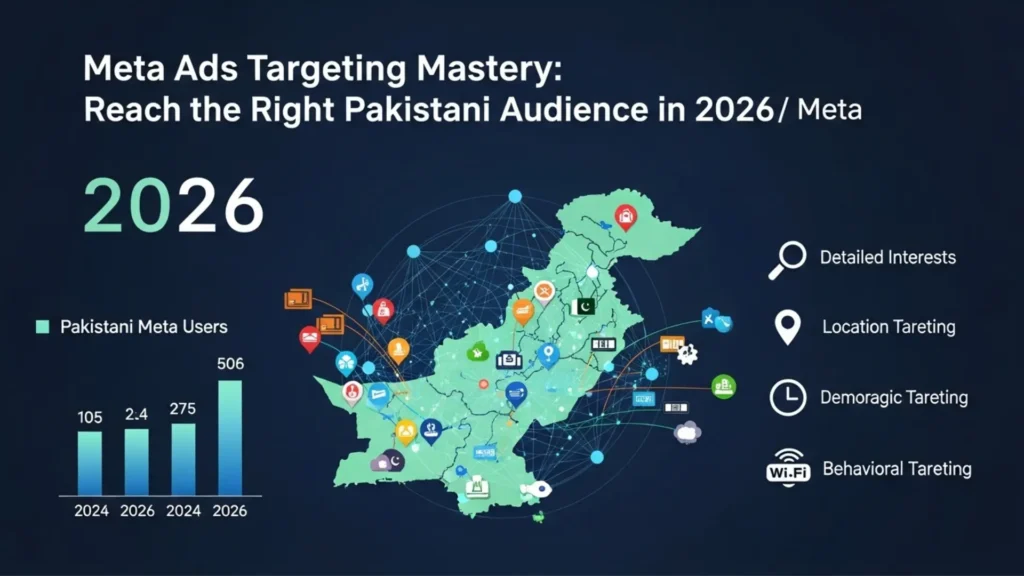
Meta Ads Targeting Mastery for Pakistan 2026 Growth.
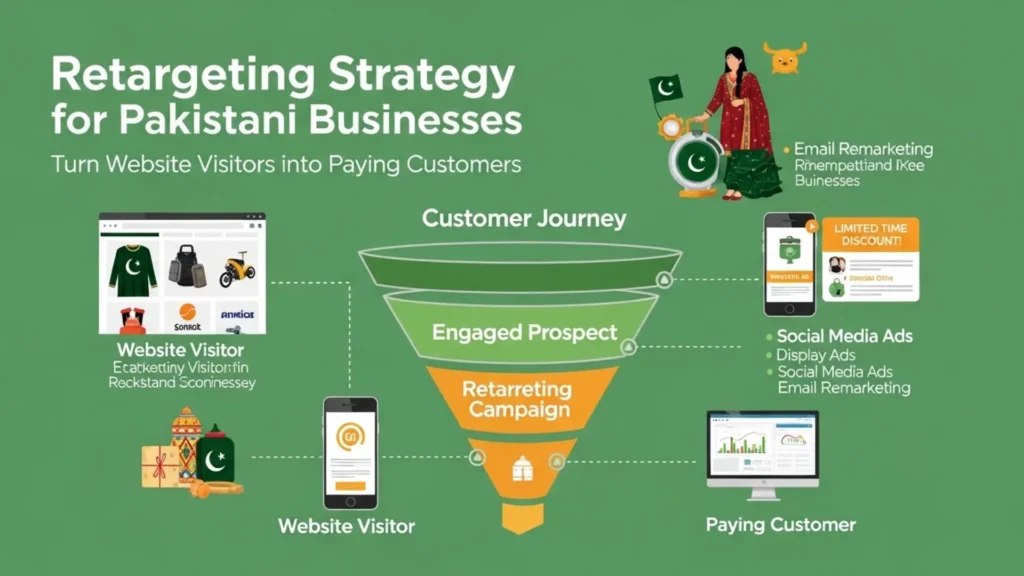
Why Meta Ads Targeting Is Pakistan’s Biggest Paid Media Opportunity and Biggest Waste Pakistan has 44 million active Facebook users and 28 million active Instagram users, making Meta the single largest addressable digital advertising audience in the country. Yet most Pakistani businesses running Meta Ads waste 40 to 70 percent of their ad spend because their targeting is fundamentally wrong.The most common mistake in Meta Ads Targeting Mastery is relying on broad interest targeting without proper audience layering, custom audiences, or exclusions. For example, a Pakistani fashion brand targeting women aged 18 to 45 in Pakistan with a general interest in fashion ends up reaching 8 to 12 million people—most of whom have little to no real purchase intent for that specific brand. This leads to low click-through rates, higher cost per thousand impressions, poor conversion rates, and ultimately the misleading belief that Meta Ads don’t woThe correct approach is audience precision: starting with your most qualified audience segments and expanding methodically through lookalike audiences and interest stacking. This guide covers the complete Meta Ads audience strategy for Pakistani businesses, from foundational Pixel setup through advanced layering techniques that consistently outperform broad targeting by 3 to 8 times in Clickmasters client campaigns. Pakistan Meta Ads Performance Benchmarks 2025 Broad interest targeting average CTR: 0.8 to 1.4% | Custom and lookalike targeting average CTR: 2.8 to 5.2% | Average CPM Pakistan: PKR 120 to 480 | Average CPC: PKR 45 to 380 | Best-performing audience: Website visitor retargeting at 4.8% CTR | Second-best: Customer Match lookalike 1 to 3% at 3.6% CTR | Worst-performing and most wasted: Broad interest no exclusions all Pakistan at 0.7% CTR | Source: Clickmasters active client portfolio data 2025 The Meta Ads Audience Temperature Hierarchy The single most important framework for Meta Ads targeting is audience temperature. Not all audiences have equal purchase intent, and your bidding, creative, and messaging should differ at each level. Audience Level Who They Are Best Use and Expected CPL Pakistan HOT: Retargeting Website visitors, product viewers, cart abandoners, checkout starters from the past 30 to 90 days Conversion campaigns. Direct offer ads. Expected CPL: PKR 800 to 2,500 WARM: Customer Lookalikes 1 to 3 percent lookalike audiences built from your customer email list or past purchaser data Conversion campaigns. Value proposition ads. Expected CPL: PKR 1,200 to 3,800 WARM: Engagement Audiences Video viewers, page engagers, ad interactors from the past 90 to 180 days Conversion or lead generation. Social proof ads. Expected CPL: PKR 1,500 to 4,200 COOL: Interest Stacking Layered interest targeting with demographic qualifiers and behaviour exclusions Awareness and consideration campaigns. Brand story ads. Expected CPL: PKR 2,500 to 6,000 COLD: Broad / Advantage+ Meta AI-driven broad targeting with minimal human-defined parameters Awareness and Advantage+ Shopping for e-commerce. Expected CPL: PKR 3,500 to 8,000 PART 1: BUILDING HOT AUDIENCES WITH THE META PIXEL The Meta Pixel: Pakistan’s Most Underutilised Ad ToolThe Meta Pixel is JavaScript code placed on your website that tracks visitor behaviour and sends data back to Meta. It is the foundation of all retargeting and lookalike audience building. Clickmasters audits of Pakistani business Meta accounts find that 68 percent have the Pixel installed incorrectly, either tracking only page views without event-level data, firing duplicate events, or missing conversion events entirely.This means the majority of Pakistani advertisers are running Meta Ads blind, without the behavioural data that powers precise targeting. A correctly configured Pixel with full event tracking is the single most impactful technical fix available to Pakistani Meta advertisers. Pixel Event When It Fires and Its Value for Pakistani Targeting PageView Every page load. Foundation for basic retargeting audiences and frequency capping. ViewContent Product or service page viewed. Creates high-intent audiences per product or service category. AddToCart Product added to cart in e-commerce. Cart abandoners are the highest-converting retargeting segment. InitiateCheckout Checkout process begins. Checkout abandoners within 14 days are your most valuable retargeting audience. Purchase Transaction completes. Core conversion optimisation event and source for past-purchaser exclusion and lookalike audiences. Lead Service enquiry form submitted. Primary conversion event for Pakistani service businesses. WhatsApp Click Custom event fired when a wa.me link is clicked. Pakistan-critical: most Pakistani conversions happen via WhatsApp, not web forms. Requires Google Tag Manager custom event setup. ScrollDepth or TimeOnSite Custom events at 75 percent scroll or 3 minutes on site. Much higher intent signal than basic page view. Pixel Event When It Fires and Its Value for Pakistani TargetingPageView Every page load. Foundation for basic retargeting audiences and frequency capping.ViewContent Product or service page viewed. Creates high-intent audiences per product or service category.AddToCart Product added to cart in e-commerce. Cart abandoners are the highest-converting retargeting segment.InitiateCheckout Checkout process begins. Checkout abandoners within 14 days are your most valuable retargeting audience.Purchase Transaction completes. Core conversion optimisation event and source for past-purchaser exclusion and lookalike audiences.Lead Service enquiry form submitted. Primary conversion event for Pakistani service businesses.WhatsApp Click Custom event fired when a wa.me link is clicked. Pakistan-critical: most Pakistani conversions happen via WhatsApp, not web forms. Requires Google Tag Manager custom event setup.ScrollDepth or TimeOnSite Custom events at 75 percent scroll or 3 minutes on site. Much higher intent signal than basic page view. Meta Conversions API for Pakistani Payment Gateways JazzCash, EasyPaisa, HBL Pay, and bank transfer redirects commonly break the browser-side Meta Pixel Purchase event, making your conversions invisible to Meta’s optimisation algorithm. Server-side tracking via Meta’s Conversions API fires conversion events from your server, bypassing payment redirect interruptions entirely.For any Pakistani e-commerce business using local payment gateways, Conversions API implementation is not optional. Clickmasters clients who implemented CAPI saw an average 47 percent increase in reported Meta conversions and a 31 percent decrease in CPM, as Meta’s algorithm better understood their converting audience profile. Building Custom Audiences: 7 Segments Every Pakistani Business Needs Customer List Custom Audiences Customer Match lets you upload existing customer phone numbers or email lists directly to Meta Ads Manager. Meta matches these against its database to create a custom audience of your actual